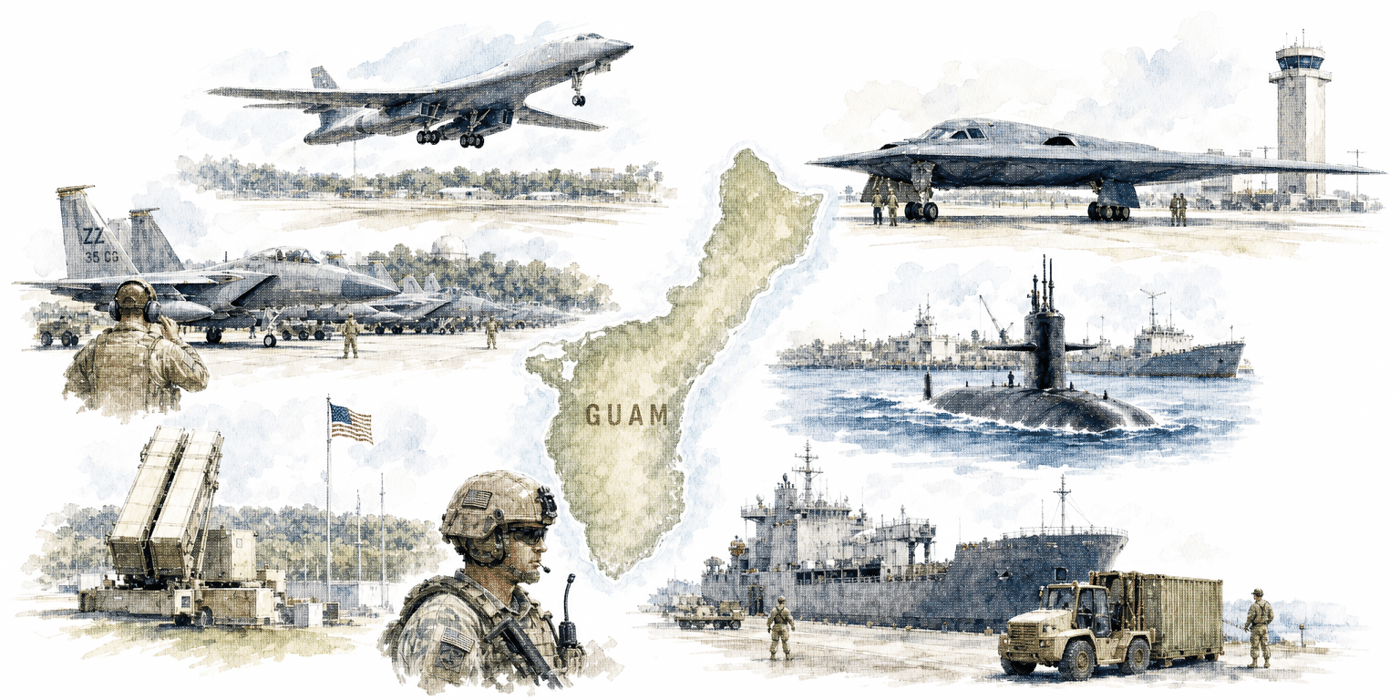

This final article in my series on the critical defense of Taiwan explores Guam’s key role in that defense and U.S. interests in the Pacific.
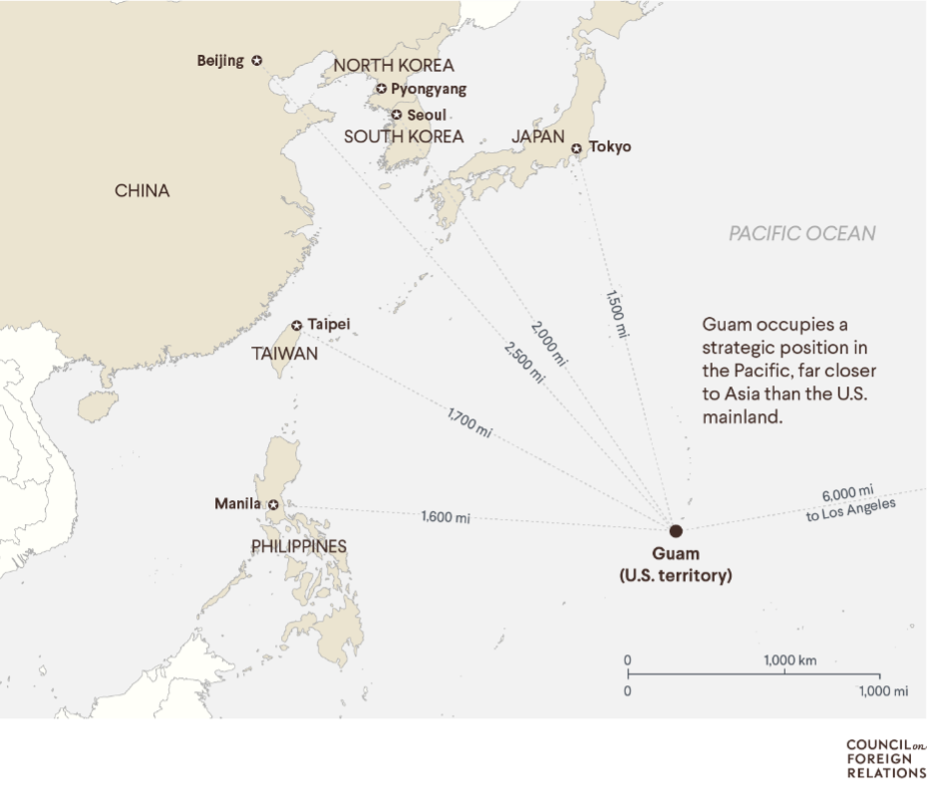
Guam has been a U.S. territory since 1898, and its citizens are loyal and patriotic, many with a long heritage of military service. Like other Pacific islands, Guam is allied with the U.S. in the region’s defense. As our closest territory to China and Taiwan, it is by far the most strategic fortress in the Western Pacific.
Guam sits 1,700 miles southeast of Taiwan, 1,800 miles southeast of mainland China, 1,500 miles east of Manila, 1,550 miles south of Japan, 3,800 miles southwest of Hawaii, and 5,674 miles from the U.S. mainland. The island is relatively small — 30 miles long and 12 miles wide — and has a native population of only 170,000.
The U.S. military has an overwhelming presence in Guam, with more than 16,000 service members and dependents. Though our military is welcomed with open arms, its huge impact has created some stress among the population related to the displacement or dilution of their traditions and culture.
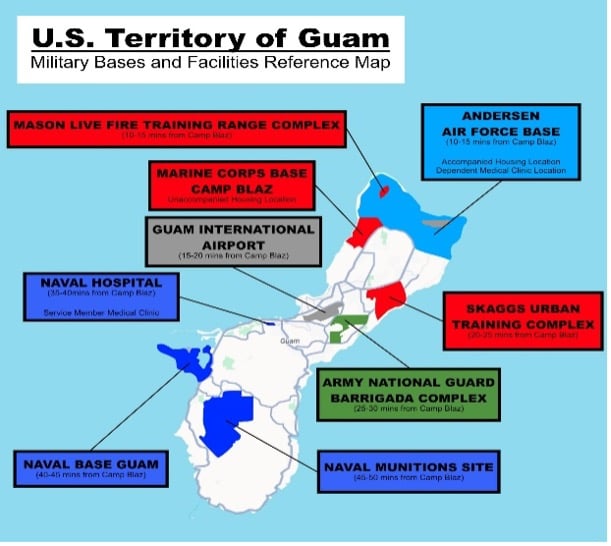
As a forward military fortress in the Western Pacific, Guam gives America strategic depth through airfields, ports, advanced sensors, repair facilities, logistics sites, and military infrastructure from all services.
Anderson Air Force Base, located on the north end of the island, is our westernmost sovereign air base, with over 8,000 personnel assigned, two major runways, and millions of square feet of ramp space. It can support surveillance, munitions storage, strategic bomber operations, and every aircraft type in the U.S. inventory. B-1Bs, B-52Hs, B-2As, KC-135s, and all fighter types routinely operate from Anderson, supporting operations in the Pacific.
Across the island, Naval Base Guam is homeport to multiple attack submarines and both U.S. submarine tenders. It can handle logistics, provide ammunition support, and sustain visiting surface ships. The Navy has its Aegis ashore system in Guam to protect against China’s long-range DF-26 missiles.
The USMC is also building Camp Blaz for Marines moving from Okinawa to Guam. When completed, up to 5,000 Marines will be stationed there. Camp Blaz gives the Marines another Pacific base to operate from, reduces our dependence on Okinawa, moves our forces farther from China’s missiles, links Marines with the other services for interservice operations, and creates a springboard from Guam for Marines to engage/assault Pacific locations.
The Army maintains a presence with defensive missile batteries, both THAAD and Patriot, since the concentration of military infrastructure carries great risk from China. To protect Guam, we are developing a new missile-defense shield in the form of the Enhanced Integrated Air and Missile Defense system. The system includes Aegis Guam, advanced radars, advanced terminal defense capability, Mk 41 vertical-launch systems, a joint command structure, and advanced SM-3 and SM-6 missiles. When completed, it will be the most layered air defense fortress around Guam.
The map below depicts Guam’s defense infrastructure:
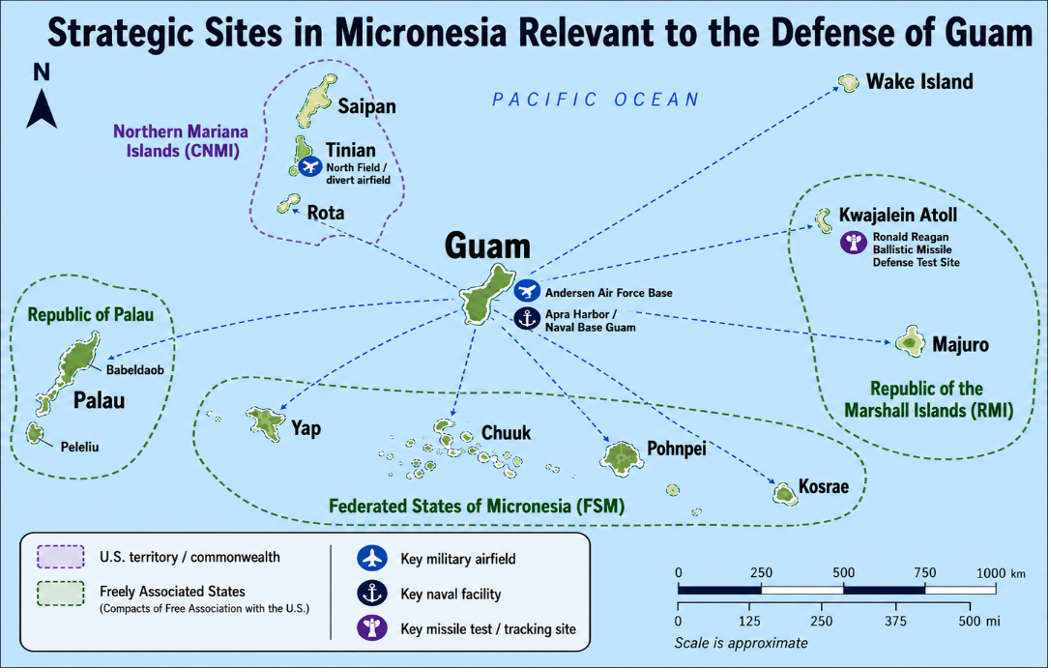
The U.S. has significant military alliances with other friendly nations like Tinian, Saipan, Palau, the Marshall Islands, and the Federated States of Micronesia.
Tinian — a U.S. territory and part of the Commonwealth of the Northern Mariana Islands — is 100 miles north of Guam. During WWII, Tinian held one of the largest air bases in the world, and we maintain many of those facilities as backup for Guam, including alternate runways, aircraft dispersal sites, refueling capacity, munitions rearming, and housing and logistics support.
While Saipan, another of the Northern Marianas, has no active forces, it keeps contingency facilities, and U.S. military reserves often train there.
Palau, part of the Compact of Free Association with the U.S., gives us access to its facilities in exchange for U.S. protection.
Palau is southwest of Guam and east of the Philippines and is a vital location for access to the first island chain. For example, it hosts the U.S. Tactical Multi-Mission Over-the-Horizon Radar, a key facility for maritime surveillance of a broad area of the western Pacific.
Many other sites make up the defense infrastructure supporting Guam, including at Yap, Chuuk, Pohnpei, and Kosrae, and in the Republic of the Marshall Islands. The U.S. has invested billions into these locations.
The map below shows the network of sites and facilities, including Kwajalein Atoll, a critical missile test and tracking location:
Our defense partnership with Guam promotes U.S. interests in the Pacific for the defense of Taiwan. China claims Taiwan is part of China and has spent a lot of time and effort building the forces necessary to conquer it. If and when they try to seize Taiwan is a matter of speculation. U.S. policy is deliberately vague, wisely keeping China in the dark and forcing it to invest in a military that may never be necessary.
Taiwan’s strategic importance cannot be overstated. If China takes Taiwan, the threat to Japan, the Philippines, and all the U.S. Pacific allies in the first island chain becomes much greater.
Guam’s role in the U.S. goal of preventing China from breaking out into the Pacific also cannot be overstated. If China succeeds in establishing itself farther east, Hawaii and all the islands on the map above would be threatened. The U.S. must be prepared to prevent this from ever happening, and Guam’s military strength is critical to that strategy.