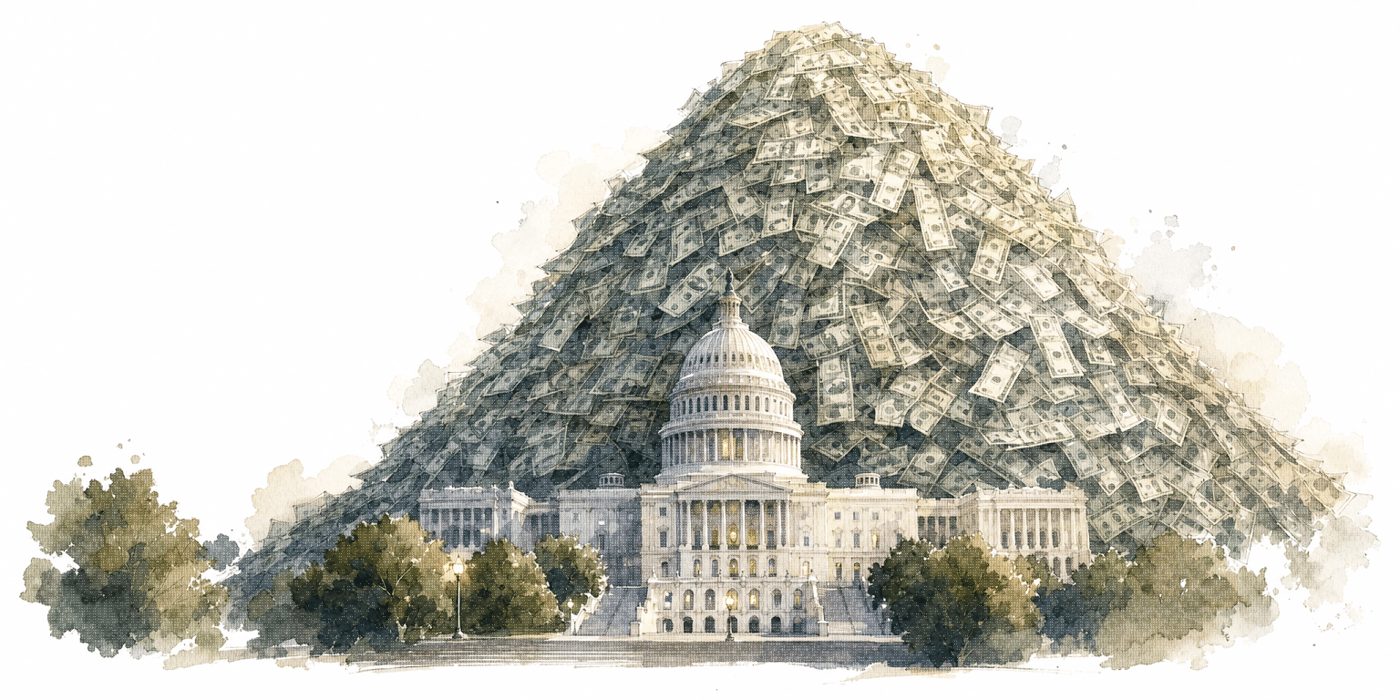

The federal government spends an extraordinary amount of money every year. Most Americans understand why much of it exists. Washington funds the military, Social Security, Medicare, Medicaid, infrastructure, and thousands of other programs Congress created.
But spending money and accounting for it are not the same thing.
As government grows, so does the difficulty of knowing exactly where its money goes, who receives it, and whether recipients are actually entitled to it. That problem is usually discussed as fraud. Sometimes it is. But fraud is only one part of a much larger problem.
The latest crackdown on Affordable Care Act enrollments offers a useful example.
The Centers for Medicare and Medicaid Services announced in September that it had canceled approximately 315,000 unauthorized marketplace enrollments covering more than 760,000 people. CMS expects the cancellations to return roughly $2.2 billion in federal premium subsidies. The agency has also terminated or moved to terminate hundreds of agents and brokers over enrollment practices and incomplete applicant information.
Those numbers are significant. But the more important question is what they reveal.
A government program cannot function properly if the government does not know whether people receiving its benefits are actually eligible. The problem becomes even more serious when unauthorized enrollments can persist long enough for billions of dollars in subsidies to be attached to them.
The Government Accountability Office estimates that federal agencies made approximately $186 billion in improper payments during fiscal year 2025. Since 2003, agencies have reported roughly $3 trillion in estimated improper payments.
But an important distinction matters. An improper payment is not necessarily fraud. It can be an overpayment, a payment made without sufficient documentation, a payment to someone who was not eligible, or another administrative error. GAO reported that most improper payments in fiscal year 2025 were overpayments.
Fraud involves deception. Waste does not have to. Congress can legally appropriate money, an agency can legally distribute it, and the entire process can comply with federal law. Taxpayers can still ask whether the program accomplished anything worth the money spent.
This is what makes the problem larger than catching people who cheat federal programs. Government must first answer basic questions about the money it distributes. Who received it? Why did that person receive it? Was he eligible? Was the payment correct? Did the program accomplish what Congress intended?
Those questions sound simple. When a government spends trillions of dollars through thousands of programs, contractors, grants, subsidies, and administrative systems, those questions become much harder.
Scale changes oversight. Every new program creates another set of rules to enforce. Every exception creates another eligibility determination. Every contractor or intermediary adds another point where money can be abused.
Fraud enforcement therefore addresses only one part of the underlying problem. Even if every fraudulent payment disappeared tomorrow, questions about improper payments, ineffective programs, and federal spending would remain.
The country also faces a broader fiscal challenge. The Treasury reported a $1.775 trillion federal budget deficit for fiscal year 2025, and the U.S. is $40 trillion in debt. Economic growth can improve that picture by expanding incomes, investment, productivity, and the tax base. Spending discipline addresses the other side of the equation.
Economic growth determines how much wealth America creates. Fiscal discipline determines how carefully government uses the portion it collects. Fraud is simply the clearest place to see the principle. Before debating how much more government should collect or spend, Americans should at least know where the money already being spent is going.