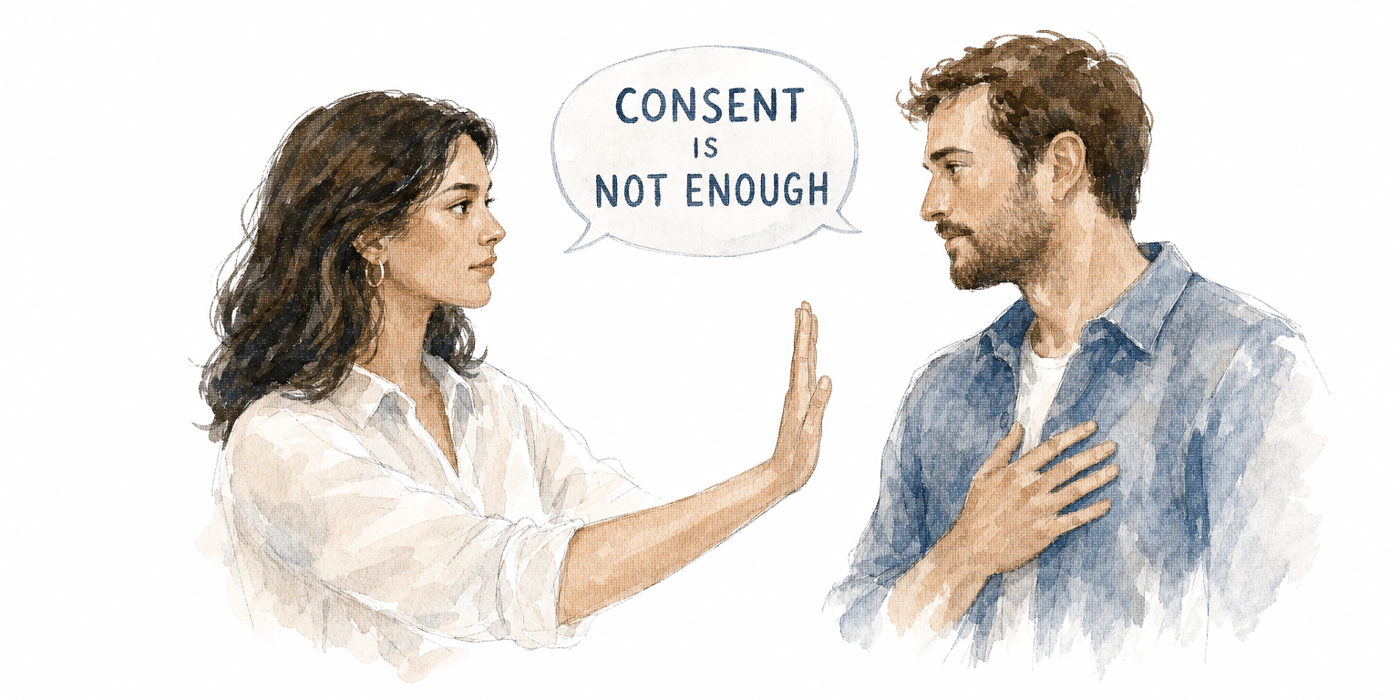

The Cornell 7 case should be Exhibit A for the failure of secular leftism and the sexual revolution. Sexual liberation isn’t freedom; it leaves misery in its wake. To understand what a failure it is for the sexual revolution feminists, we need to go back to what “consent” actually means.
Consent is a term that helps define the legal and sexual ethics surrounding an encounter of a sexual nature. According to Planned Parenthood, consent is defined by the FRIES model: “freely given, reversible, informed, enthusiastic, and specific.” And according to the Rape, Abuse & Incest National Network, consent is “a mutual agreement to engage in sexual activity. It should always be clear, voluntary, and communicated without pressure, manipulation, or fear. Everyone involved must be capable of giving consent. This means they are: Of legal age, Sober and alert, Not under coercion or threat.”
It should be noted, however, that the state of New York (where Cornell University is located) doesn’t consider diminished capacity by drugs or alcohol to void consent given — and therefore what happened to Jane Doe wouldn’t be deemed rape if the text messages are to be believed.
The next question is, why do we even have “consent” as the standard anyway? Well, the sexual revolution is to blame.
Sex was intended by God as the ultimate expression of love within the confines of marriage, with the early years including hopes of potential procreation. Within this institution and its boundaries, men, women, and their children were protected, ordered, and free. The sexual revolution changed everything. With the invention of the birth control pill, one of sex’s natural and intended results — a child — became controllable and optional. Women could sleep around as much as men did and not have to worry (as much) about getting pregnant. It also opened the door to more sordid sexual behaviors.
The constraints of marriage, family, and morality were loosened when sex was taken out of its proper context. If morality is gone, what then shall dictate the sexual interactions between people? Consent — the lowest bar to clear, and yet the hardest to prove. Worse, consent can be changed retrospectively based on how a person feels later. So not only is a young man not expected to commit to a young lady, but he must also ensure that his sexual partner is not under the influence of drugs or alcohol, that she enthusiastically agrees, and that she won’t later decide it was sexual assault. Seems like an impossible task.
We are left with a dynamic, exemplified in the Cornell 7 case, in which some women are incapable of being responsible for their own actions and choices. At the same time, their lovers, who were equally drunk and intoxicated, are the villains. Why? Because she decided she was raped long after the fact.
If you look at the text message exchange between Jane Doe and the two young men with whom she originally had a threesome, you can see a tone shift between her and them. Even a week after the fact, Jane Doe was totally okay with what happened; what bothered her was that people were spreading dirty rumors about her. Then she got disinvited from a Halloween party at the fraternity house where it all went down and started going after these guys.
Did she have a genuine realization that she had been sexually assaulted? Or was she bitter and angry at the social consequences for consensually engaging in sexual taboos?
Based on the evidence thus far, Jane Doe is only the victim in this case because of the victimhood hierarchy. Men who are white are perceived as the oppressors, and women of any stripe are the oppressed. All of them are genuine victims of the lack of sexual ethics and a moral compass that our culture has engendered.
Two years after the incident, Cornell University has addressed the problem by shutting down all frat parties on campus for the rest of this year and by hiring more administrators to oversee complaints like Jane Doe’s. Yet shutting down frat parties won’t stop the activities that happened in the Chi Phi frat house. Students will merely change locations. The problem isn’t entirely the drugs and alcohol, though they certainly don’t help; the problem is wayward hearts and disordered morality.
Perhaps students shouldn’t be encouraged to sleep around, with consent being their only protection from lawsuits. Perhaps putting sex back in its proper sphere of marriage and encouraging young people to wait for that commitment will fix what was broken. It cannot continue as it is now because consent is too flimsy a cover to protect anyone.
Our Weekly Verdict podcast team discussed this. Don’t miss out!