
Most adults probably remember a moment in an elementary school U.S. history class when they heard perhaps the most famous words spoken before the American Revolution. But there’s more to the story, and I love a good story.
If the Adams cousins were considered “firebrands” in the cause of liberty, the young Patrick Henry might have earned that title for the Virginia colony. It was March 23, 1775, and the Virginians were meeting at St. John’s Church in Richmond, Virginia, while the Second Continental Congress debated revolution in Philadelphia. Henry stepped forward to propose a resolution requiring every Virginia county to organize a militia unit in preparation for a potential armed conflict with their Mother Country. While others were hesitant, arguing that peaceful reconciliation was still possible, the young Virginian disagreed. In his most competent courtroom style, Henry cataloged a decade of ignored petitions for policy changes and the King’s increased deployment of British ships and armies to enforce those punishing laws.
Henry understood that his audience comprised seasoned leaders, and his eloquence paid tribute to the assembly. He began, “No man thinks more highly than I do of the patriotism, as well as abilities, of the very worthy gentlemen who have just addressed the House. But different men often see the same subject in different lights; and, therefore, I hope it will not be thought disrespectful to those gentlemen if, entertaining as I do opinions of a character very opposite to theirs, I shall speak forth my sentiments freely and without reserve. This is no time for ceremony. The question before the House is one of awful moment to this country.”
Then he launched into an emotional justification for action. “They tell us, sir, that we are weak; unable to cope with so formidable an adversary. But when shall we be stronger? Will it be the next week, or the next year? Will it be when we are totally disarmed, and when a British guard shall be stationed in every house?”
Imagine the audience listening to the young attorney. George Washington, Thomas Jefferson, Peyton Randolph, Richard Henry Lee, Edmund Pendleton, Benjamin Harrison V, and Richard Bland — varied ages but patriots all, even if hesitant in war — were among the 125 delegates and the balconies were filled with local citizens anxious to watch the debates.
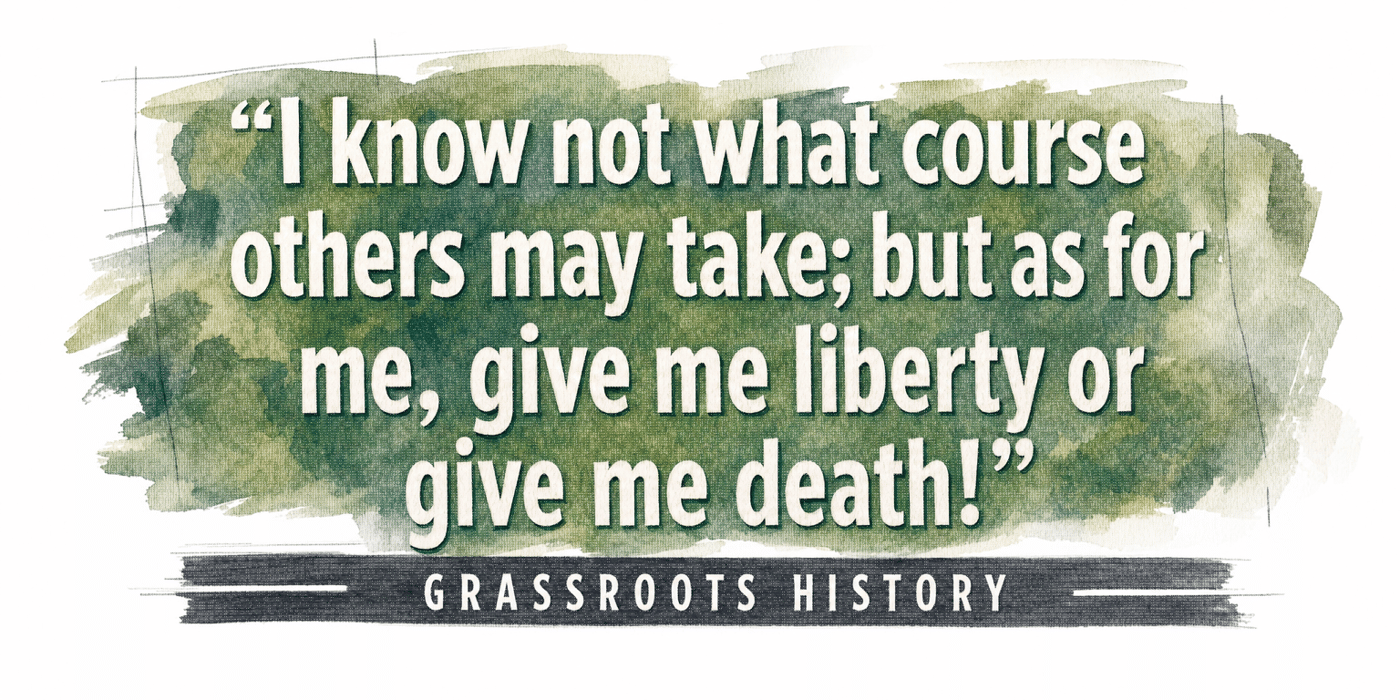
His final words rang through the church. “Peace— but there is no peace. The war is actually begun! The next gale that sweeps from the north will bring to our ears the clash of resounding arms! Our brethren are already in the field! Why stand we here idle? What is it that gentlemen wish? What would they have? Is life so dear, or peace so sweet, as to be purchased at the price of chains and slavery? Forbid it, Almighty God! I know not what course others may take; but as for me, give me liberty or give me death!”
That final sentence hung in the air as he quietly stepped down and took his seat. The church fell silent. Edmund Randolph later recalled that no one wanted to speak next because “the crowd was so thoroughly transfixed.” A favorite moment of mine occurred when, outside the church and listening through a window, local citizen Edward Carrington was so emotionally overcome that he declared aloud, “Let me be buried at this spot!” Years later, his widow would honor that request.
Once the moment passed, the convention voted on Henry’s resolution to organize militias and it passed by a narrow 65 to 60 margin. A committee was organized with Henry as chairman and Lee, Washington, and Jefferson as members. (Imagine those conversations!) They worked quickly and two days later, the convention unanimously approved the militia plan.
Within a month, Lord Dunsmore realized that the Virginians were arming for self-defense. The growing unrest threatened his hold on the colony and he ordered British marines to remove the colony’s gunpowder from Williamsburg. While the British military attempted to obey his command, Henry immediately led his newly formed Hanover County militia toward Williamsburg, confronted the governor, demand the gunpowder returned and forced a financial settlement.
The date: April 19, 1775.
Patrick Henry was correct. That same day, the first shots had been fired at Lexington and Concord. Perhaps the winds had carried the sound to Virginia.