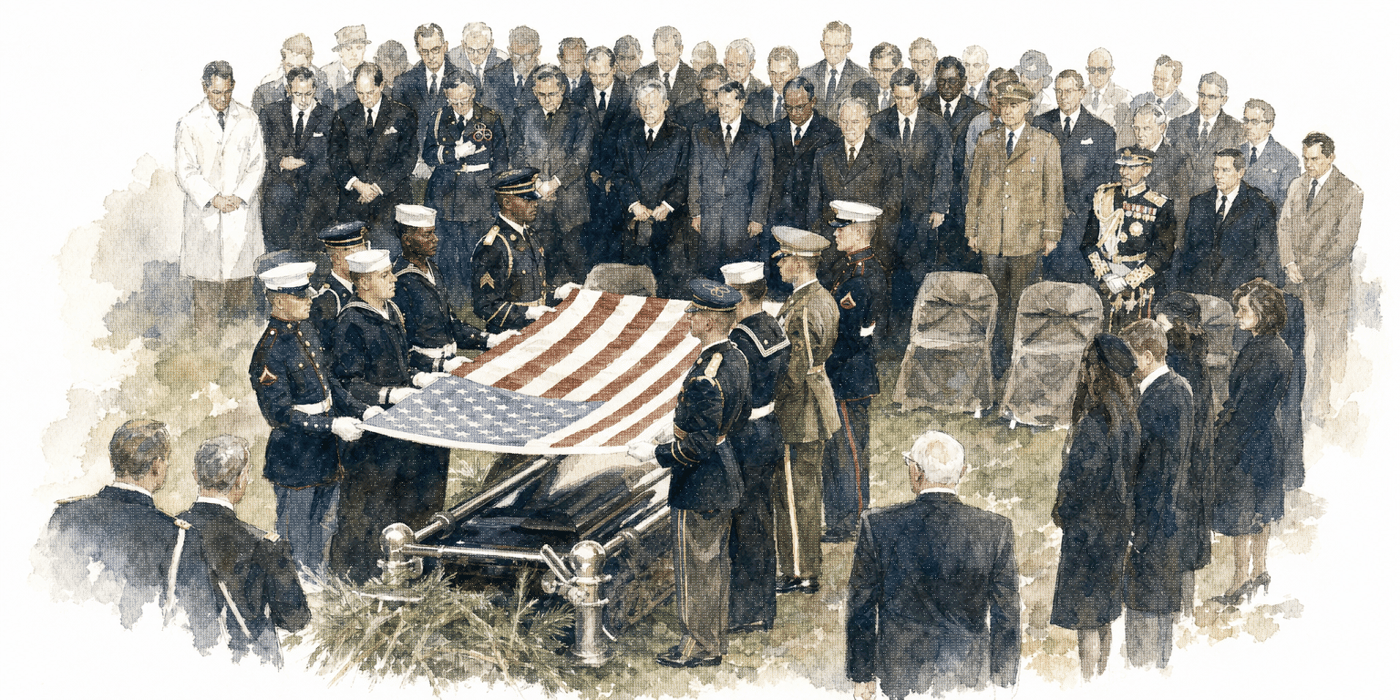

On the morning of November 25, 1963 — exactly 63 years ago today, three days after the assassination of President John F. Kennedy and three days before that year’s Thanksgiving Day — I found myself, as part of the U.S. Naval Academy Catholic Choir, standing on the White House steps singing the timeless Navy Hymn and the murdered president’s favorite Irish tune (Oh Danny Boy) to the grieving Jacqueline Kennedy, the Kennedy family, and the many leaders of the free world assembling that morning for the day’s somber events. John F. Kennedy was laid to rest in Arlington National Cemetery that afternoon.
It amazes me still that I somehow had even a small role in that momentous proceeding, watched by the entire nation. Our choir had been included in that day’s hastily assembled agenda, evidently at Mrs. Kennedy’s personal request. Kennedy had deep ties and obvious affection for the U.S. Navy and was a regular visitor to USNA — and I imagine that like so many Navy veterans, he’d been touched many times by the hymn’s plaintive refrain: Eternal Father, Strong to Save... oh hear us when we cry to thee, for those in peril on the sea...
It was an emotional, unforgettable day. The details come to mind often, particularly at this time of year. As the years go by, and as I think about the tumultuous years that followed and the ongoing uncertainties about our future, those memories take on more meaning than ever.
The juxtaposition in 1963 of the shocking loss of our president followed so quickly by our nation’s traditional, always enriching and upbeat Thanksgiving Day remains thought-provoking.
The “giving thanks” part of Thanksgiving goes without saying. The legendary (probably embellished) initial celebration by the Pilgrim settlers offered thanks to their creator for carrying them through the trials of their first year in this unforgiving wilderness and for their first successful planting season — they’d eked out a foothold in the rugged new world and for the first time felt confident that it could be sustained.
But their celebration must also have included hopefulness and renewed resolve to take on the challenges ahead, particularly the brutal New England winter close at hand. They were right — from that tenuous beginning on North American soil, our great nation ultimately emerged.
I recall Thanksgiving 1963 as being far more somber than hopeful. Our nation had lost its beloved president — what seemed like a bright future was suddenly taken from us. We’d paid little attention to Kennedy’s vice president, Lyndon Johnson, and we had no way of knowing if he was up to the task. And looking back at it, 1963 was the springboard into the tumultuous sixties: growing civil unrest, beginning with the Watts riots in the summer of 1965, the seeds of the Vietnam War, and then the assassinations of Martin Luther King and Robert Kennedy in 1968.
In large measure, the Jack Kennedy America mourned was a well-crafted and fiercely protected persona. As we’ve learned over the years, Kennedy the man was a jumble of contradictions. He was in poor health and in constant pain — his outward youthful vitality was the product of a daily cocktail of painkillers and uppers. He was a truly dedicated family man, but at the same time a compulsive, insatiable womanizer.
Aha — another imperfect president! But at the core, Kennedy was a brilliant, insightful, inspirational, and effective leader. I believe his greatest strength was his remarkable (and truly rare among politicians) capacity for self-reflection, and his willingness to take responsibility for and to learn from his own mistakes, and his readiness to alter course accordingly.
The archetypal example was his reaction to the infamous Bay of Pigs debacle. He blamed himself for accepting the CIA’s ill-conceived plan to overthrow Fidel Castro, and he took personal responsibility for its ensuing collapse. One year later, his leadership during the Cuban Missile Crisis — once again involving a proximate threat to our nation — deftly dodged armed conflict with the Soviet Union, quite possibly averting world war.
Even in his role as a young Naval officer in the Pacific, Kennedy had demonstrated that same resilience. Having allowed the vessel (PT-109) under his command to be rammed and sunk by a Japanese destroyer, he showed extraordinary courage and endurance in getting his surviving crew members to shore in hostile territory and then enabling their rescue from under the noses of nearby enemy forces.
And based on his handling of those challenges, I will always wonder if Kennedy — had he not been assassinated — would have soon awakened to the deep, dark hole into which our Vietnam engagement (which he had championed) was headed. At the time of his death, the U.S. troop presence in Vietnam was about 16,000 — most in an advisory capacity. Within two years, our military presence had increased tenfold and was actively shifting to direct combat operations.
I’m inclined to believe that JFK, if still with us, would have put on the brakes. Instead, every time the Joint Chiefs told LBJ that committing just one more division of U.S. Armed Forces would turn the tide, he assented. By the late ’60s, there were over 500,000 American troops in Vietnam — and by the war’s end, 58,000 had been killed in the line of duty.
Of course, we’ll never know. We can only mourn our losses — and recognize, once again, the importance of sound presidential leadership.
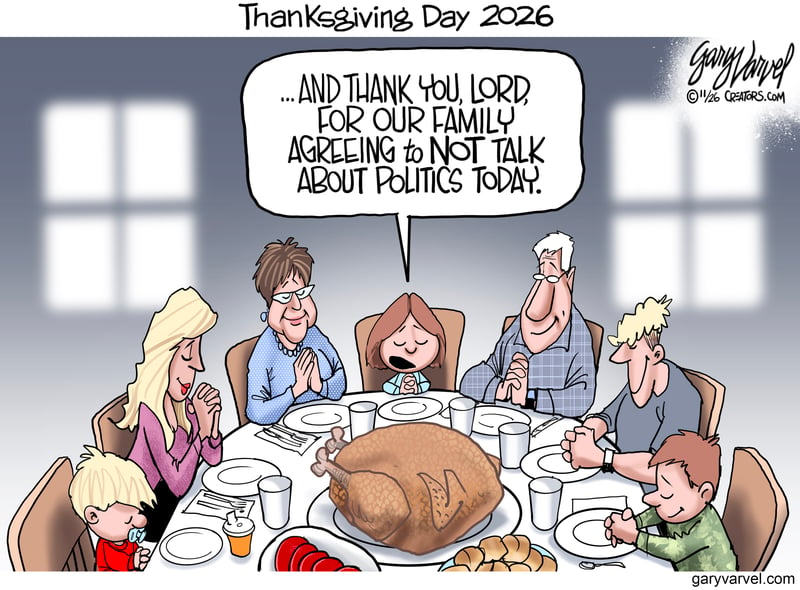
What about 2026? Can we find a way to bring hopefulness and resolve this Thanksgiving Day?
Uncertainty abounds. We’ve just seen a political sea change, with Democrats winning leadership across the board in federal and state governmental positions, and only the lame-duck President Donald Trump holding back the tide. Meanwhile, the devastating hot war between Russia and Ukraine (of which we are complicit for not preventing) continues unabated; the war with Iran currently has no acceptable exit route available; many worry about the explosive expansion of cyber technology, deficit and debt are rising, and hyper-partisanship continues to tear our elected government apart — to the nation’s detriment.
Yes, we can be hopeful about the future, but only if both of our major political parties accept and act on the simple principle that their sole charge is to do what’s right for our country. The American public has little taste for intra-party warfare.
Message to Democrats: Your crushing defeat of GOP opponents this month will not be an enduring win unless it yields positive results for our country. Retribution achieves nothing and will not be rewarded by the 2028 electorate. Instead, make use of your commanding majorities to do the things you promised in your campaign.
Message to Republicans: All is not lost; we’ve seen dramatic shifts in electorate views before. Convincing your hard-core supporters that you’re still tough is not good enough to reverse it. Instead, learn from the electorate’s midterm message; continue full bore on the parts of your agenda (there are many) that are well received in the public, and on others, assess and make course corrections as needed.
To both sides, channel John Kennedy after the Bay of Pigs. After all, he wrote the book: Profiles in Courage.