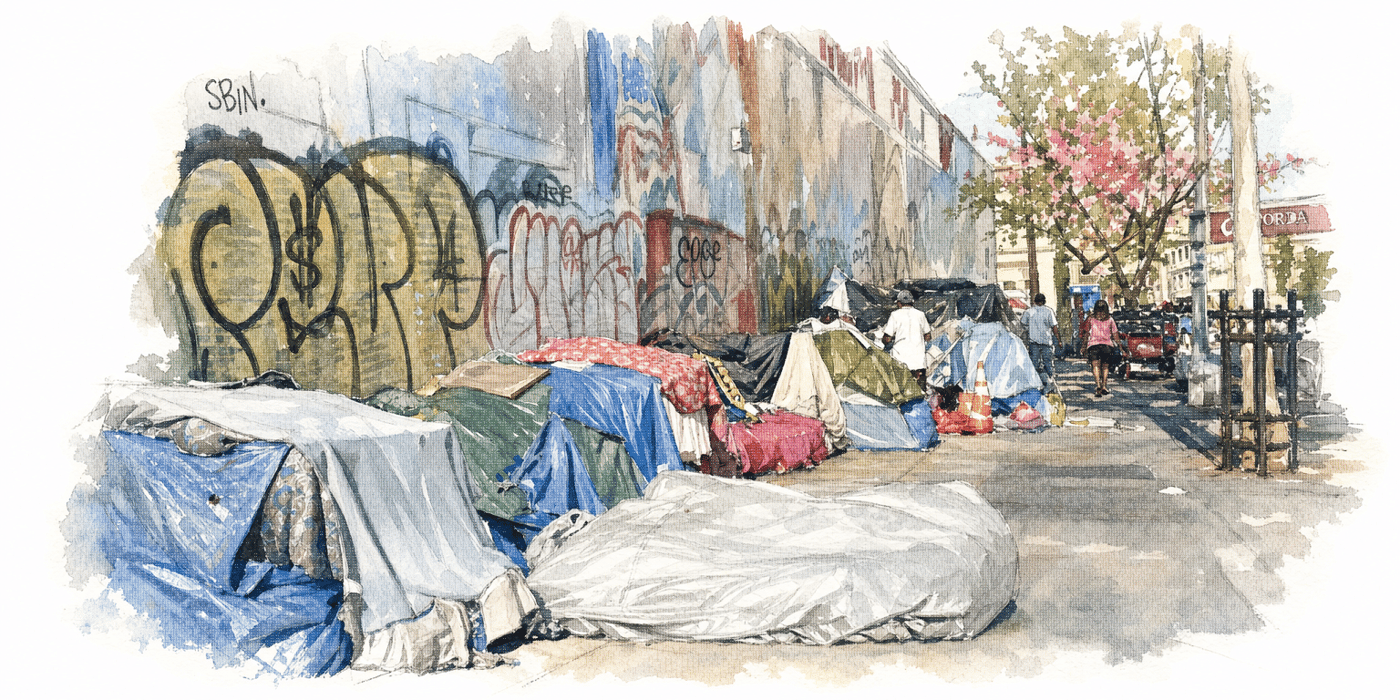

America doesn’t just have a homelessness crisis anymore. It has a homelessness industry.
Over the last decade, a sprawling network of government agencies, nonprofit organizations, consultants, contractors, and advocacy groups has grown alongside the homeless population. Billions of taxpayer dollars have poured into program after program as political leaders promise solutions — yet the crisis has only gotten worse in most of America’s largest cities. Encampments expand, public spaces deteriorate, addiction and overdose deaths increase, and residents wonder why so much money has produced almost no lasting progress.
Those who see the disconnect between spending and outcomes have defined the corrupt system as the “homeless industrial complex.” Not everyone working within it has bad intentions. But systems often respond to incentives, and when funding continues to increase despite declining outcomes, the incentive shifts from solving the crisis to managing it and even making it worse. A bureaucracy built around homelessness becomes dependent on the very problem it was created to eliminate. It wants to keep its victims for profit.
This particular issue became a central focus for former Los Angeles mayoral candidate Spencer Pratt, who examined the city’s homelessness policies and spending, arguing that the system rewarded the growth of the crisis more than its resolution. “People get rich by increasing homelessness,” Pratt explained during an interview with podcast host Andy Bachman. “It’s as simple as that. That’s what’s happening in California. That’s what’s happening in Los Angeles.”
California offers the clearest example of how the response to homelessness has shifted from solving the problem to sustaining the systems built around it. The state has spent billions of dollars on homelessness initiatives while continuing to struggle with one of the nation’s largest homeless populations.
The New York Post reports that despite spending nearly $3 billion annually on homelessness programs, it is expected that the population of those living on the street will increase again this year. At some point, the obvious question becomes unavoidable: if the spending continues to rise while the problem continues to grow, is the system really trying to accomplish anything positive?
Gavin Newsom appears to be acknowledging that concern, though we are in year 20 of Newsom’s 10-year plan to end homelessness. Recently, he announced that his administration would push harder for local governments to clear dangerous encampments and produce measurable results, recognizing that simply allocating more money without accountability is not enough.
After almost $40 billion spent since Newsom announced his plan to fix the issue — and over two decades later — he’s just figuring that out now?
The frustration surrounding homelessness did not appear overnight. Over the last decade, homelessness has evolved from a difficult social challenge into one of America’s most visible public crises. Encampments have spread across major cities. Parks, sidewalks, and public transit have become increasingly unsafe in many communities. Businesses have closed, residents have moved away, and entire neighborhoods have struggled with the consequences of open-air drug use and untreated mental illness.
Yet as the crisis grew, the public conversation changed just as dramatically.
Rather than emphasizing accountability, treatment, or measurable outcomes, much of the discussion and approach has shifted toward appeals to empathy and avoiding hurting the feelings of the “unhoused.” Policies are judged by whether they appear compassionate rather than whether they actually improve lives and promote safety and long-term results, both for the homeless individual and the community.
Meanwhile, much of the media framed efforts to clear encampments or require treatment as harmful, often giving greater weight to preserving the status quo than to restoring clean, safe public spaces. News coverage reinforced that narrative while ignoring the effects on innocent, law-abiding citizens affected by worsening living conditions.
Stories understandably highlight the struggles of individuals living on the streets, but they often devote far less attention to the families avoiding public parks, small businesses closing their doors, neighborhoods coping with persistent disorder, or the countless people trapped in addiction without meaningful intervention.
Compassion matters. Every homeless individual deserves dignity, and many suffer from circumstances beyond their control. But compassion without accountability enables harmful behavior. Allowing someone with severe addiction or untreated mental illness to slowly deteriorate on the sidewalk is not an act of mercy simply because it avoids difficult decisions.
That is why the conversation has begun shifting.
Across the political spectrum, more leaders are questioning whether the current approach is sustainable. Increasingly, the debate is no longer centered on how much money governments spend, but on whether the programs they propose are intended to succeed at all.
The Trump administration’s recently announced homelessness strategy reflects a much-needed change in thinking. It places greater emphasis on treatment, public safety, and court-ordered care for individuals suffering from severe addiction or mental illness while restructuring how federal homelessness funding is distributed.
Supporters argue that leaving severely impaired individuals to live indefinitely in encampments is neither compassionate nor humane, while critics raise concerns about civil liberties and housing affordability. Regardless of where one stands, the conversation itself illustrates a unifying understanding that what we’ve been doing isn’t working.
Ultimately, the overall question is remarkably simple.
How should success be measured?
For years, many governments measured success by how many grants they awarded, programs they launched, or dollars they spent. But that mindset isn’t how everyday Americans determine if measures are working. Are fewer people living on the streets? Are parks safe? Are businesses thriving? Are people overcoming addiction and rebuilding stable, independent lives?
Those are the outcomes that matter.
For too long, solutions promoted in the name of compassion have coincided with more encampments, more addiction, more disorder, and ultimately more suffering. If we truly want to solve homelessness, we must stop managing the crisis and start ending it — and stop pretending that being gentle is the only way to show our humanity.
Sometimes compassion means saying “yes.” Sometimes it means saying “no.” But real compassion always has a goal: helping people get back on their feet. That requires accountability, measurable results, and, when necessary, the tough love that offers a path out — not another year on the streets.