

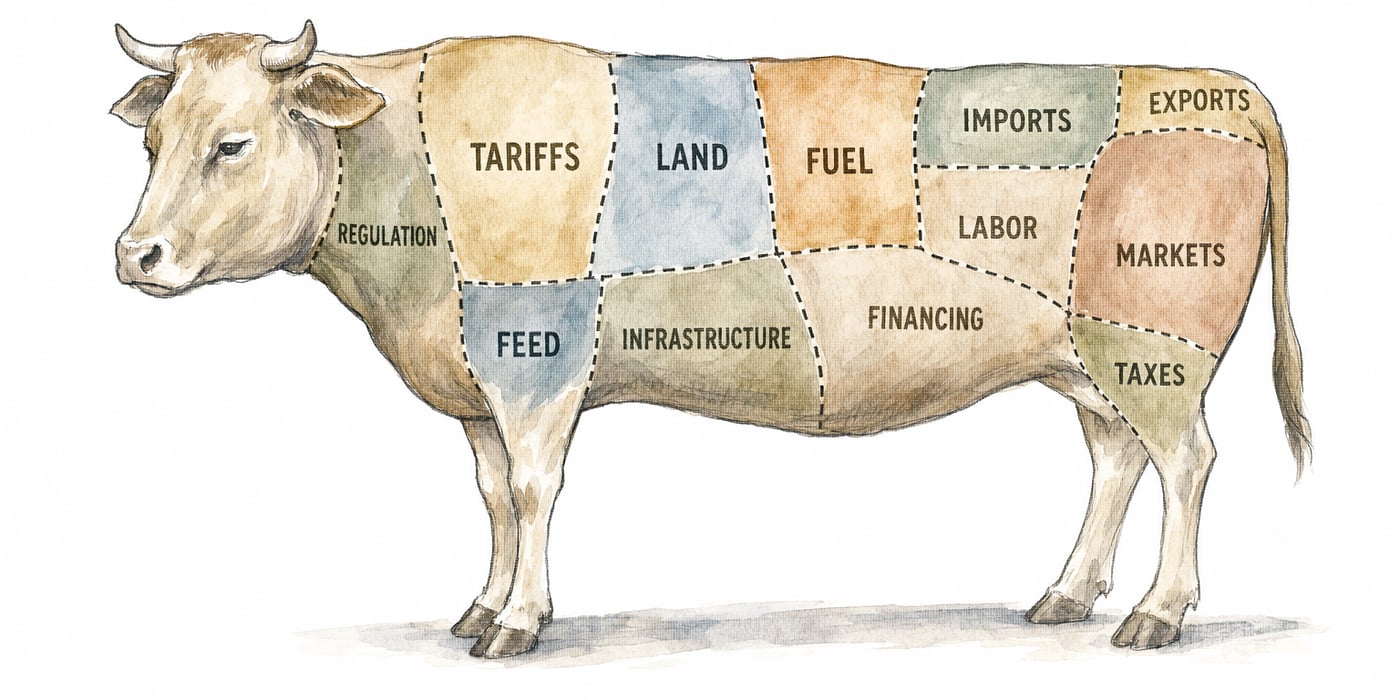

President Donald Trump has spent the last two years insisting that tariffs level the playing field with other nations without raising prices for American consumers. The second half of that assertion is simply not true. Tariffs are taxes, and taxes make things more expensive.
He implicitly acknowledged that in a Truth Social post:
Today, I concluded a deal to substantially lower the price of ground beef for working American families. As everyone knows, under President [Joe] Biden, beef prices soared at their fastest rate and the American beef herd fell to its smallest size in modern history. As we work to rebuild this herd and help our ranchers, for the next 90 days, the United States will allow up to 300,000 metric tons of product for ground beef to be imported with no out of quota tariff. We have a commitment that this beef will be sold at 25 percent below current market prices. This deal will reduce prices for Americans while giving space for our Great American Beef Herd to grow again. Thank you for your attention to this matter! President DONALD J. TRUMP
Don't get me wrong: tariffs are not the reason beef prices are higher. But Trump at least tacitly admits that tariffs don't make things cheaper, so, for political expedience, his order to ease prices extends through the election.
Trump is right that Biden launched inflation with his profligate spending. (For more, see our nation's $40 trillion in debt.) Biden pumped government spending into an already overheated economy, which made prices skyrocket for everything that goes into a pound of beef — land, supply chains, fuel, feed, you name it.
Trump was also right about herd sizes. Farmers often responded to the pandemic and inflation by reducing the number of cattle they kept and sending them to slaughter. That reduced prices for a while, but now we're paying the price — literally — of historically smaller herds.
Reduction in supply amidst increased demand makes beef more expensive. It's Economics 101.
In 2019, a pound of beef averaged $3.82. It recently hit $6.90, or an increase of about 80%. Good thing inflation is only 3.4%!
Because his prescription is little more than a Band-Aid, President Trump is running into opposition from other Republicans.
"Beef prices are too high for a simple reason: Our cattle herd is too small," said Arkansas Republican Senator Tom Cotton. "Imported beef below market prices will only put more pressure on our cattlemen."
Cotton is right, but imported beef wasn't just unloaded from the chuckwagon yesterday.
Washington, DC, chef Bart Hutchins notes:
It started in 2002, when Congress passed a law that seems almost quaint now. You had a right to know where your beef came from. Born here, raised here, killed here, it said so on the label. Then, in 2015, under pressure from Canada and Mexico and a World Trade Organization ruling threatening over a billion dollars in retaliatory tariffs, Congress repealed it. Beef and pork lost their labels. Politics was a little boring back then, so hardly anyone noticed. The scrap room became a legal place to hide.
That repeal opened the door for mixed ground beef, and American ranchers started selling their cattle into a system that would cut it with whatever was cheapest that week, from wherever it came. With the economic incentive gone, the American herd began to shrink. A percentage drop here, a percentage drop there, and almost no one noticed. Then, in 2025, it became harder to ignore.
In short, policymakers have spent many years now undercutting American ranchers. Trump's tariffs overcooked them, which is why he's suspending particular tariffs. But that doesn't fix the underlying and systemic problems affecting cattle ranchers. In fact, opening the floodgates for imported beef may actually make it worse. Ranchers who have already made adjustments to production and herd size will respond to this new market shift by continuing along the path that led us to the current situation.
The Federalist's Sean Davis points out:
This is already happening in the United States. Tyson, one of the biggest beef processors in the country, just announced it’s shutting down a massive facility in Utah due to lack of supply to process. It’s closing another facility in Illinois and selling off a third one in Washington. JBS, another massive processor, shut down plants in Pennsylvania and Tennessee earlier this year. The biggest domestic processors are radically reducing their processing capacity because the long-term stock is too low to support it.
If President Trump truly wants a burger on every plate, he will incentivize growing herds and the beef supply, not just mess around with tariffs.


