
What follows is an account of an Israeli attack on a U.S. Navy ship that still defies adequate explanation...
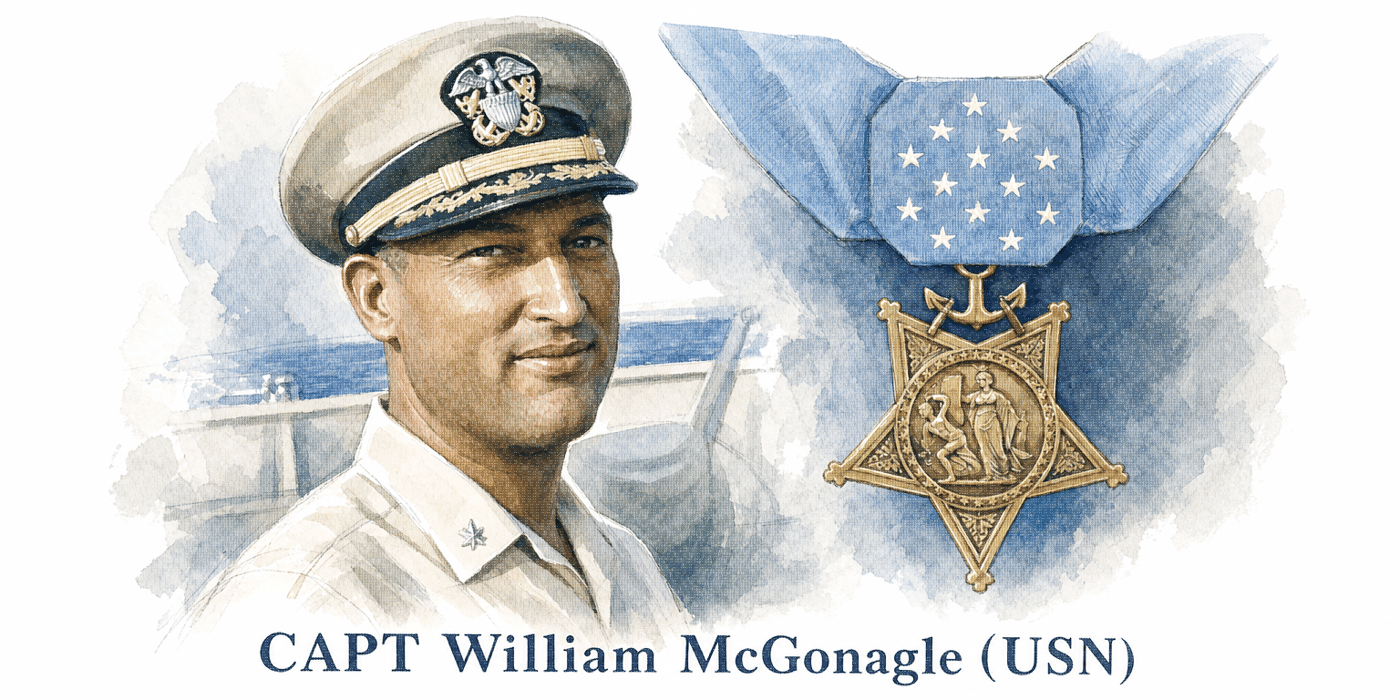
William McGonagle was a sharecropper’s son born in Wichita, Kansas. After attending college in California, he enlisted in the Navy in 1944 and spent three years in a University of Southern California Navy training program. He was commissioned in 1947 and assigned to the USS Frank Knox (DD-742), then to the minesweeper USS Partridge (AMS-31). He then served on the minesweeper USS Kite (AMS-22) during the Korean War and, for the next 15 years, held ship and shore assignments.
In April 1966, he took command of the USS Liberty (AGTR-5), an intelligence-gathering ship. A year later, at the height of the Six-Day Arab-Israeli War between Israel and Egypt, McGonagle was commanding the Liberty, code-named “Rockstar,” in international waters in the Eastern Mediterranean.
On 8 June 1967, the Liberty, a Belmont-class “research” ship with only light armor and a few .50-caliber machine guns, began a slow patrol 12 miles off Gaza, north of the Sinai Peninsula. The National Security Agency tasked it with collecting information on Soviet MiG fighters provided to Egypt.
At about 1400 that day, the Liberty was mistakenly subjected to air attack and then by torpedo boats from our longtime ally, Israel, which assumed the ship was an Egyptian or perhaps Soviet vessel supporting Egypt. The attack by the Israel Defense Forces went on for 17 hours.
McGonagle was severely wounded during the initial air attack when the bridge was struck. Though he suffered shrapnel and burns, he refused to leave his post and remained in command through the night, directing fire and flood control, and care of casualties. At one point he issued the order to “prepare to abandon ship” but as lifeboats were lowered into the water, Israeli torpedo boats closed in and fired on the lifeboats and deck personnel, disabling the boats.
In the fog of the attack, McGonagle issued multiple messages to the Fleet: “Any station, this is Rockstar. We are under attack.” Although air cover was launched from both the USS Saratoga (CV-60) and USS America (CVA-66) operating nearby, the planes never arrived to defend the Liberty — reportedly being recalled on orders from VADM William Martin and the Pentagon, in order not to escalate the incident.
LCDR James Ennes recalls: “I saw [McGonagle] on the bridge during the height of the battle. He was just running through the fire and flying shrapnel and rocket parts, and he just ignored them. He just walked along yelling orders and doing his job. He went onto the starboard wing of the bridge just as a napalm bomb hit. I thought he was gone. And he just walked through the flames like a fireman in an asbestos suit, trying to save his ship.”
According to McGonagle regarding his injuries, “I would lay down on the deck, and put my leg on the captain’s chair to stem the loss of blood.”
Finally, at daybreak on 9 June, two U.S. destroyers arrived to assist the Liberty, and only then did McGonagle leave the bridge and turn over command of the ship.
Though there was a gaping 39x24 foot hole in Liberty’s side, the crew kept the ship afloat and once relief arrived, were able to leave the area under its own power. Additionally, the ship’s hull had 821 rocket and machine-gun holes, and ultimately the damage was so extensive that she was scrapped.
The combined air and sea attack killed 34 Liberty crew members, including two Marines and a civilian, and there were 171 wounded.
For its part, Israel issued official acknowledgments and apologies for the attack and paid reparations to the United States. Both nation’s conducted inquiries and issued assessments excusing the attack as fog-of-war confusion, despite the fact the ship was “in international waters, properly marked as to her identity and nationality, and in calm, clear weather when she suffered an unprovoked attack,” according to the U.S. report.
For his actions, McGonagle received the Medal of Honor, but due to the circumstances, it was presented by the Secretary of Navy in a secret ceremony at a secluded location of the Navy shipyard near Washington, DC.
According to his MoH citation:
Despite continuous exposure to fire, he maneuvered his ship, directed its defense, supervised the control of flooding and fire, and saw to the care of the casualties. CAPT McGonagle’s extraordinary valor under these conditions inspired the surviving members of the Liberty’s crew, many of them seriously wounded, to heroic efforts to overcome the battle damage and keep the ship afloat. Subsequent to the attack, although in great pain and weak from loss of blood, CAPT McGonagle remained at his battle station and continued to command his ship for more than 17 hours. It was only after rendezvous with a U.S. destroyer that he relinquished personal control of the Liberty and permitted himself to be removed from the bridge. Even then, he refused much-needed medical attention until convinced that the seriously wounded among his crew had been treated.
His citation concludes: “CAPT McGonagle’s superb professionalism, courageous fighting spirit, and valiant leadership saved his ship and many lives. His actions sustain and enhance the finest traditions of the U.S. Naval Service.”
(Listen to the events of that day in an interview with CAPT McGonagle.)
CAPT McGonagle continued his Navy career holding several more commands until retiring in 1974.
In the years following the attack, Liberty crew members disputed the fog-of-war findings, claiming the attack was deliberate for reasons that were, and remain, classified.
At a 1997 anniversary gathering with Liberty survivors, McGonagle declared: “I think it’s about time that the state of Israel and the United States Government provide the crew members of the Liberty and the rest of the American people the facts of what happened, and why the Liberty was attacked 30 years ago today. For many years I have wanted to believe that the attack on the Liberty was pure error. It appears to me that it was not a pure case of mistaken identity. It was, on the other hand, gross incompetence and aggravated dereliction of duty on the part of many officers and men of the state of Israel.”
William McGonagle died in March 1999, and following Post Chapel services at Fort Myer, Virginia, he was buried at Arlington National Cemetery with many members of the Liberty crew in attendance.
Richard Brooks, who was a 32-year-old master chief machinist’s mate at the time of the attack on the Liberty, said: “He was a gentleman, one of the best skippers the Navy ever had to command a ship, and most of all a dear friend. I keep my shipmates, my skipper and my ship in my heart every day.”
Ernie Gallo, who was a 22-year-old communications technician on the Liberty, said: “It started with him. And these guys kept us alive. I wouldn’t be here today if it wasn’t for him and these guys.”
William McGonagle was interred near the common gravesite of six other members of the Liberty crew.
CAPT William McGonagle: An ordinary man faced with extraordinary circumstances, he summoned the greatest measure of courage to place his life in imminent peril to save others. His example of valor — a humble American Patriot defending Liberty for all above and beyond the call of duty — is eternal. Live your life worthy of his sacrifice.
“Greater love has no one than this, to lay down one’s life for his friends.” (John 15:13)
Join us in daily prayer for our Patriots in uniform — Soldiers, Sailors, Airmen, Marines, and Coast Guardsmen — standing in harm’s way in defense of American Liberty, and for our nation’s Veterans, First Responders, and their families.
(Read more Profiles of Valor here.)
Semper Vigilans Fortis Paratus et Fidelis
Pro Deo et Libertate — 1776
Please consider a designated gift to support the National Medal of Honor Sustaining Fund’s character education initiatives through Patriot Foundation Trust’s online donor page, or by check payable to “NMoH Sustaining Fund” and mail it to:
Generosity Trust
National MOH Sustaining Fund
345 Frazier Avenue, Unit 205
Chattanooga TN 37405
Thank you for supporting The Patriot Post, our nation’s premier journal of American Liberty.