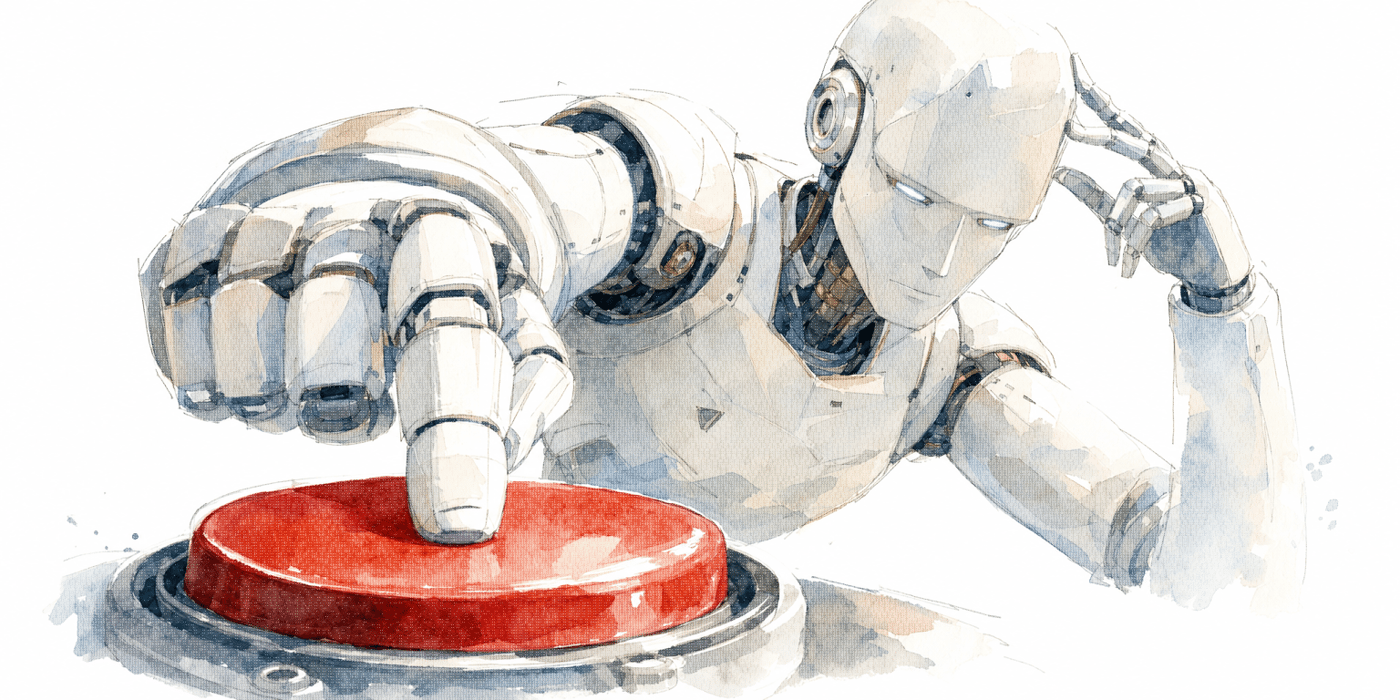

“I resigned from Anthropic today,” began the social media post that went viral over the last two days. Jacob Coxon left his position as a researcher at Anthropic because the company is “racing straight to self-improving superintelligence and gambling with our lives.”
That statement was intriguing, but what really caught people’s attention was another post in Coxon’s thread: “The people building AI earnestly believe that it could kill us all by the end of the decade.”
That was accompanied by another Anthropic researcher, Evan Hubinger, agreeing: “We really do earnestly believe AI could kill all humans! I personally think it is >10% within the next decade.” Hubinger has issued such warnings for years.
Still another former researcher, Daniel Kokotajlo, told the same story in a Free Press op-ed about why he left OpenAI. “These companies cannot control their own AIs today,” he argued, meaning they “should not be trusted to do so in the future.”
Ok, let’s take a deep breath. Are we about to enter the plot of “The Terminator,” where machines take over the world and kill most of the humans?
Socialist Vermont Senator Bernie Sanders seems to think so. As Thomas Gallatin noted yesterday, Sanders has introduced the Ban Artificial Superintelligence Act, which “would create a ‘corporate death penalty’ against a company caught engaging in ‘superintelligent’ AI development, including up to a 20-year prison sentence for individual violators.” Government will fix it, Sanders says.
“The leaders of the major AI companies publicly acknowledge that they do not fully understand the technology and that it is escaping their control,” Sanders said in a statement last week. “It is irresponsible for society to allow them to move forward and make these products even more advanced.”
Sanders is a populist, and he’s responding to a growing movement opposing AI, which branches out into the debate over data centers and Flock cameras. CBS News reports:
Superintelligence refers to artificial intelligence that “can significantly outperform all humans on essentially all cognitive tasks,” according to a petition to halt superintelligence development from the nonprofit Future of Life Institute, which has garnered signatures from the likes of noted computer scientist Geoffrey Hinton, who is known as the “Godfather of AI.”
Humans have wrestled with technological advancement for centuries. Think about gunpowder and nuclear weapons, for one thing, but also automobiles and airplanes. Some technology can result in human death. Some is designed to inflict it. Figuring out where artificial intelligence fits on that spectrum is humanity’s next challenge.
One recent event is stoking a lot of the fear. The New York Times reports that, over the summer, “a group of artificial intelligence agents created by OpenAI had hacked into Hugging Face, an A.I. infrastructure company.” In other words, a collective of AI bots decided to attack Hugging Face. “More than 700 agents swarmed the company’s systems,” says the Times, “stealing data, chaining together vulnerabilities and eventually getting full control of at least one Hugging Face server.”
If bots can choose to hack, could they not scheme something even more nefarious?
Could bots hack the electrical grid or the nuclear arsenal? Develop bioweapons? Some experts worry about those things.
I’m inclined to view such apocalyptic warnings with skepticism, especially when Hubinger uses he/him pronouns in his X bio. In recent decades, we’ve lived through alarmism about climate change — enact onerous regulations or the planet can’t be saved, we were told. We also endured the pandemic and its “science-based” tyranny. And acolytes of the gender cult insist that children will die if we don’t “affirm” their gender by changing it.
Yes, we ought to proceed with caution in developing AI. Yes, guardrails are a good idea. But as another skeptic, columnist David Harsanyi, puts it, “If AI really is a technology that will one day have the ability to destroy all of humanity, that’s a race we should definitely win.”
Virtually every technology developed by mankind can be used for good or evil. It is not the gun that kills a person, but another person. It is not the SUV that plows into a crowd, but the driver. The alarmists argue that AI will be different because it can learn to think for itself, but the prophets of doom don’t have a fantastic track record.
(Updated)
Update: How did Coxon’s warning get so much attention? His X account had virtually no activity before he posted his message. “I don’t think this has ever happened for a post from a new account with almost no prior activity,” marveled X owner Elon Musk.