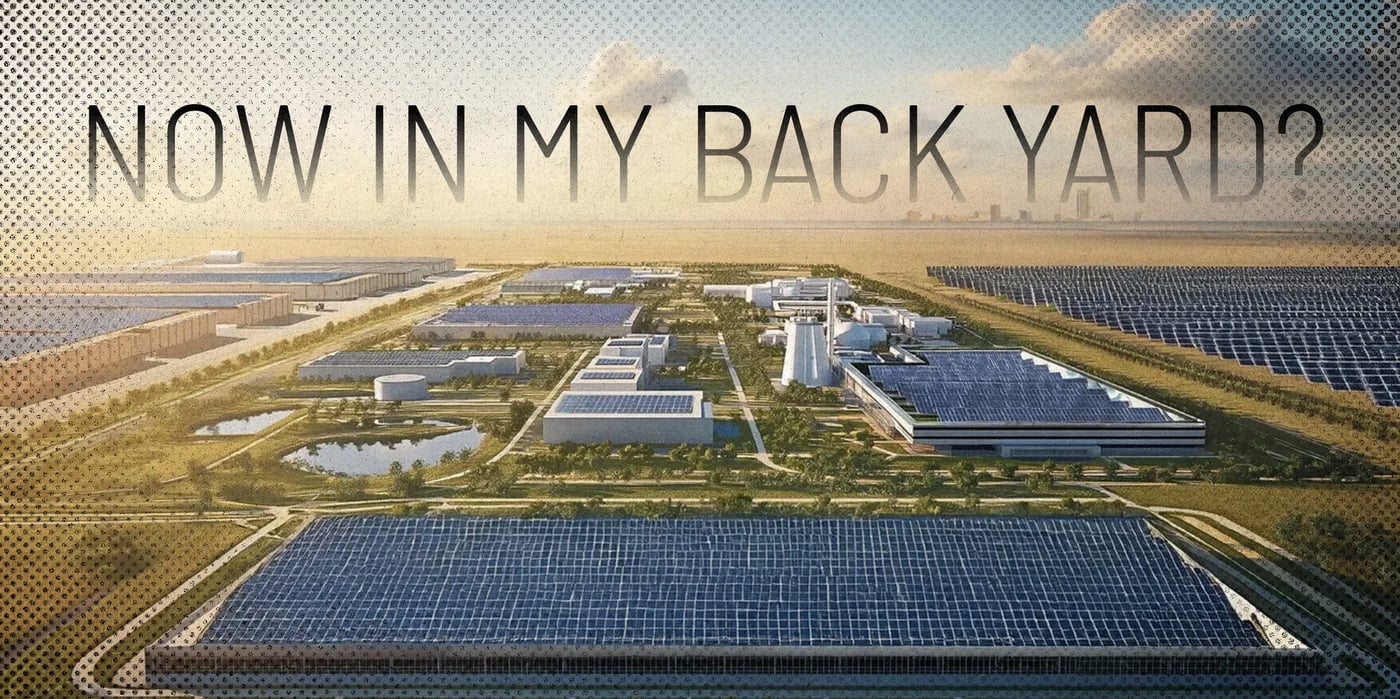

The burgeoning Artificial Intelligence industry requires gobs of computing power, which in turn requires gobs of energy. As new technology develops and spreads, so too has a new conflict emerged, pitting small towns and residential areas against the construction of data centers.
New industries have long clashed with the old ways. In America, it’s a tale as old as our nation. But that doesn’t make the reality of it any easier to navigate.
To make matters worse, the conflict has become ripe for political opportunism. Taking a hard-line stance against the construction of AI data centers is becoming a national campaign issue.
Case in point, socialist Senator Bernie Sanders has made blocking data centers his latest policy crusade. “We have not a clue. We are totally unprepared for what is coming,” Sanders warned regarding the expanding AI industry in a recent interview with MS NOW (formerly MSNBC). The 84-year-old declared, “We’ve got to slow this thing down.”
Fellow socialist Representative Alexandria Ocasio-Cortez has also jumped aboard the bandwagon. The two of them have teamed up to introduce legislation to stop the proliferation of AI data centers in their tracks.
“More than 100 local communities across 12 states have already enacted local moratoriums on data centers,” Ocasio-Cortez noted, “and Congress itself has a moral obligation to stand with them and stop Big Tech from ruining their communities.”
Sanders echoed that. “A moratorium will give us time — time to understand the risks, time to protect working families, time to defend our democracy, and time to make sure this technology works for all of us, not just the very few,” he asserted. “People who know more about it than anybody else in the world are telling us that within a few years, it is likely that AI will be smarter than human beings, that human beings may lose control over AI with possibly catastrophic impacts. We need a sense of urgency to address these issues.”
In fact, just yesterday, Maine’s legislature passed the nation’s first temporary ban that now heads to Democrat Governor Janet Mills’s desk for signature. She’s trailing Graham Platner, the Nazi tattoo candidate, in the U.S. Senate race, so we’ll see where her political calculations take her.
Even the Trump administration has sought to address a growing frustration from across the country over AI data centers. The White House released the following statement: “The administration recognizes that some Americans feel uncertain about how this transformative technology will affect issues they care about, like their children’s well-being or their monthly electricity bill. These issues, along with other emerging AI policy considerations, require strong Federal leadership to ensure the public’s trust in how AI is developed and used in their daily lives.”
But President Donald Trump has also recognized that the U.S. is in AI competition with China, and it is critical to national security that we don’t fall behind.
This issue does not fall along partisan lines, either. At a recent AI summit, Virginia Democrat Senator Mark Warner argued that any moratorium on AI development “would be idiocy” and would effectively allow China “to move quicker” in advancing the technology.
Even The Washington Post’s editorial board called Sanders’s push for an AI moratorium his “worst idea yet.” In a stinging rebuke, the Post writes, “A national ban on new AI data centers would make the Luddites look good.”
The frustration over AI data centers is understandable. Too often, they have been built in communities across the country without residents fully appreciating their potential negative impact. First and foremost is the issue of electricity. Communities have seen their power bills suddenly jump due to a new data center. There is also the issue of noise pollution, as data centers are notorious for their constant din, sometimes reaching 90 decibels.
Finally, there is the more significant concern of the potential negative impact that AI technology itself is having on communities. That’s true in employment, as it threatens to displace people from their jobs, and it’s true socially, since, ironically, we don’t yet fully understand how the technology might lead to more division, distrust, and mental health issues.
Unfortunately, stoking fears of AI is worse than the technology itself thus far, as a number of potentially deadly attacks against those involved in the industry and those who support it have begun. This alarmism, instead of leading to constructive policies for fairly regulating the promising technology, creates irrational fears that can lead some individuals to take unhinged actions.
Cooler heads must prevail, but that is difficult when few people really understand what the new technology is and what it is actually capable of.