
For months now, I’ve remarked on the unremarkable: that November’s midterm elections will determine the course and the effectiveness of the final two years of Donald Trump’s presidency.
At stake, though, is more than just the Trump agenda — more than just impeachment, congressional gridlock, and endless subpoenas and kangaroo committee hearings. Trump’s legacy is also at stake. And while much of that legacy has been cemented by the stubborn facts that he’s a two-termer, that he won the popular vote as a Republican, and that he’s just the second president in history to be elected to non-consecutive terms, leftist historians — but I repeat myself — will happily assess his second term as a failure if his party doesn’t hold Congress on November 3.
Fair or not — it isn’t fair; the Republicans’ House majority is razor-thin, and the sitting president’s party has lost seats in 18 of the past 20 midterms — that’s the grim reality. And that reality was bolstered this week by our “conservative” Supreme Court’s failure to conserve the in-person electoral model that served our nation extraordinarily well until the Democrats introduced their bulk-mail ballot fraud scheme in 2020.
If the Trump administration had simply failed to make its case for election integrity — that is, if the Supreme Court had simply ruled Monday that it was unconstitutional to require that the envelopes of all mail-in federal ballots be affixed with an electronically scannable logo and that each of those ballots was assigned a unique barcode — that’d be one thing. But that wasn’t the case. As it turns out, at least one justice did indeed see merit to the Trump administration’s case, but, golly, they just took too long to make it.
Only Justices Clarence Thomas and Samuel Alito dissented from the High Court’s seemingly resounding 7–2 majority, but that majority clearly wasn’t unanimous in its conviction that the plaintiffs had made a better legal case — only that they’d done an effective job of stringing the case out in the courts so as to conflict with early voting in Alabama and North Carolina. In a brief majority concurrence, Justice Brett Kavanaugh wrote this:
In my view, based on the briefing the Court has received at this interim stage, there is at least a fair prospect that the final rule falls within the Postal Service’s statutory authority. … But applying the rule in the 2026 elections would be arbitrary and capricious in violation of the Administrative Procedure Act because state and local election officials do not have sufficient time to reasonably implement the rule before the elections. ... For that reason, I concur in the denial of the application for stay.
For that reason. Not because the U.S. Postal Service has no legal right to require more secure, more fraud-resistant mail-in ballots, but because the USPS had run out of time for implementing those measures.
Back in March, President Trump signed an executive order directing federal agencies to tighten up our fraud-friendly mail-in voting system. Then came the blue-state lawsuits. As SCOTUSblog reports: “A group of 23 states, led by California, and the District of Columbia went to federal court in Massachusetts to challenge the government’s efforts to implement the executive order. They argued that the order clashes with provisions in the Constitution that give states the power to determine voter eligibility and to set the ‘Times, Places, and Manner’ of holding congressional elections.”
Then, on June 25, U.S. District Judge Indira Talwani, an Obama appointee, issued an order “temporarily prohibited the federal government from implementing parts of Trump’s executive order on or before the upcoming November elections in California, the states joining the lawsuit, or D.C.”
Finally, on August 24, the Supreme Court sided with the Trump administration and put Talwani’s order on hold — but only because the High Court ruled that the states weren’t allowed to challenge the executive order until it had been carried out (no injury, no standing). Undeterred, the leftist Talwani issued a new order, then a preliminary injunction, and, Whoa, lookie there! It’s September!
But all this wasn’t just the doing of one leftist judge. As The Federalist’s Shawn Fleetwood writes, she had some help. In a lengthy dissent, Justice Alito argued, among other things, “that the plaintiff states and federal courts — including SCOTUS — ‘bear a substantial share of the blame for the rule’s timing.’”
Fleetwood adds: “The justice chronicled the timeline of how the challenging states immediately sued the administration after Trump signed the contested order in late March, and how such litigation ‘cast a cloud over the Government’s ability to issue a final rule.’ He further observed how … Talwani strung this lawfare along by ‘enter[ing] several injunctions months later prohibiting the Government from undertaking that rulemaking.’”
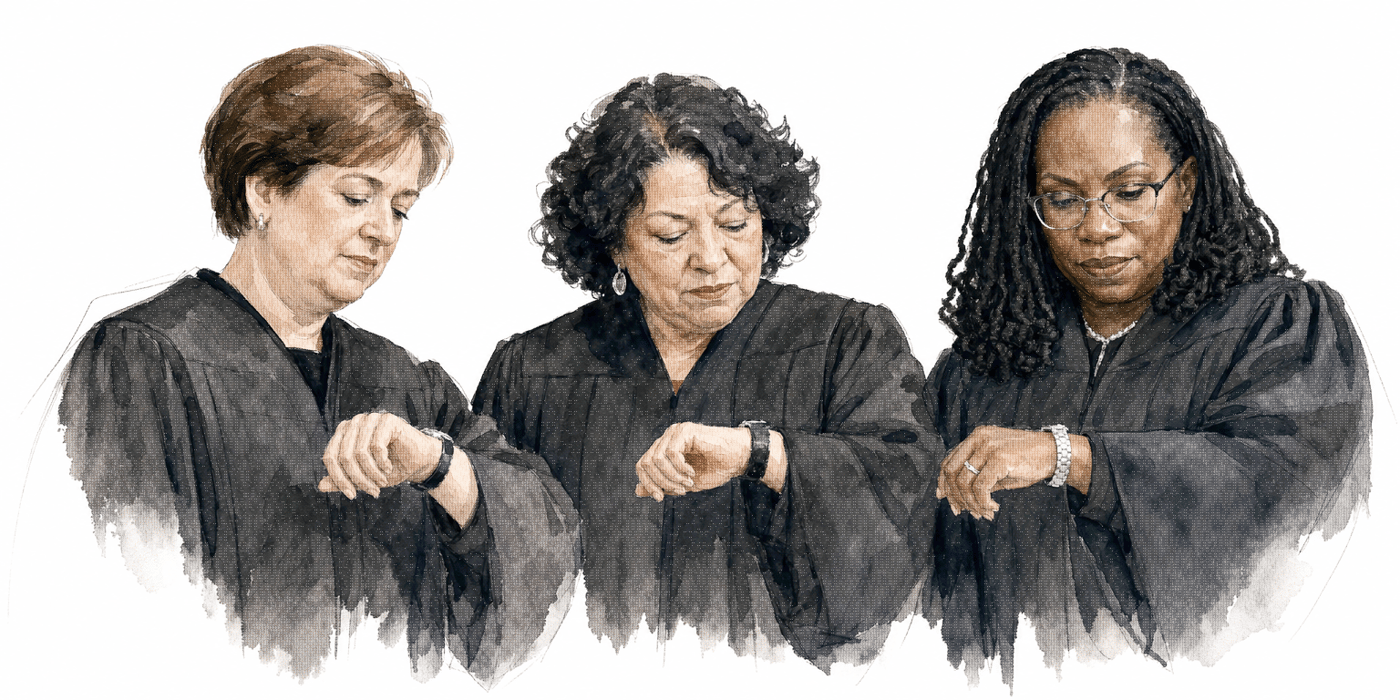
Not only that. Justice Ketanji Brown Jackson issued a whopping and apparently meritless 23-page dissent to the High Court’s August 24 ruling in the Trump administration’s favor, thereby further dragging things out.
As Alito put it: “Not only was the Government subject to months of premature litigation and a series of injunctions that this Court later determined were likely issued without jurisdiction, the Government had to wait nearly another full month for this Court to issue its decision so holding.”
So, as an election Nazi might put it: No election integrity for you.
This isn’t the first time in recent memory that the Left has resorted to slow-walking its way through the legal process.
As The Federalist’s Mollie Hemingway wrote in her biography of Alito, the liberal justices also slow-walked their dissents in the Court’s 2022 Dobbs decision, thereby giving their leftist fellow-traveling hooligans more time to terrorize the justices.
This is no way to run a country. And no way to run a third coequal branch of government.