

The dispute about Greenland between the U.S. (primarily President Donald Trump) and Denmark has died down. But it is necessary to understand what that discussion was, recognize Greenland’s strategic location, and appreciate the importance of that part of the world.
U.S. interest in Greenland dates to the 1951 Defense of Greenland agreement. The agreement gives the U.S. a legal and alliance framework to expand the use of Greenland militarily, when necessary, without changing its sovereignty as part of Denmark. Greenland is geographically part of North America, sitting northeast of Canada between the Arctic Ocean and the North Atlantic. Correcting some common misconceptions, the map below accurately shows Greenland relative to the land masses around it. Granted, Greenland is a huge island, but it is nowhere near as large as it appears on most maps, often about the size of Africa. Africa is fourteen times larger than Greenland. For scale, note that Greenland is about three times larger than Texas. A Mercator map depiction distorts its true size. Greenland is 836,330 square miles, with a north-to-south distance of 1,660 miles and an east-to-west maximum of 650 miles.
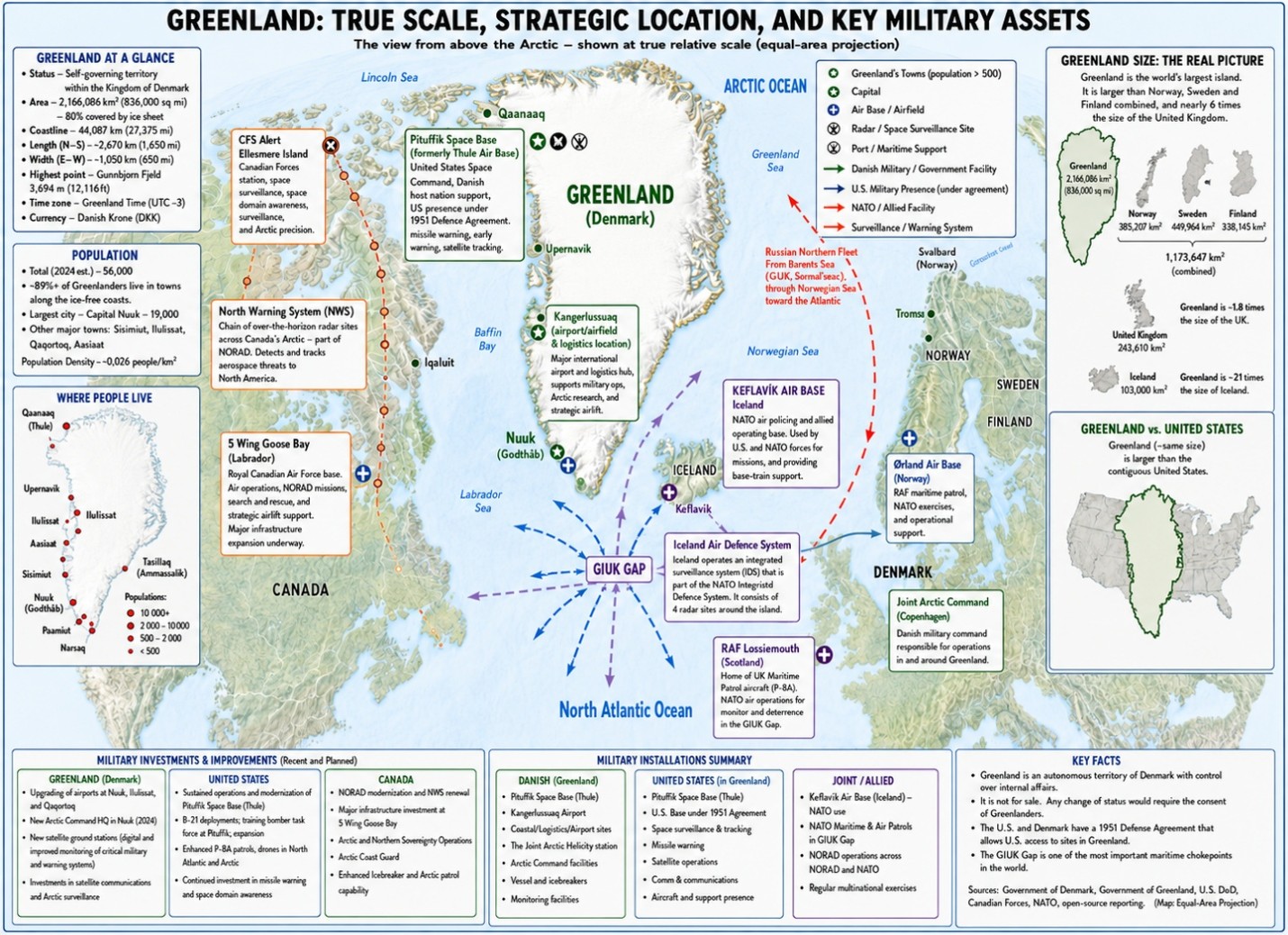
Two-thirds of Greenland is above the Arctic Circle and is mostly uninhabited except for some remote military outposts. Only coastal areas are free of ice: 81% of the island is the Greenland ice sheet. Greenland’s population, as of July 2026, is slightly under 57,000 people, half of whom live in the capital Nuuk. Politically, it is a self-governing part of the Kingdom of Denmark. Home rule came in 1979 and broader self-government in 2009. Denmark retains important responsibilities in foreign affairs and defense, although Greenland’s government has an increasingly significant role in decisions directly affecting the island.
Greenland’s geographic position makes it strategically and geopolitically important. It occupies the northeastern shoulder of North America near Canada across Baffin Bay and the Davis Strait, a mere eighteen miles at its closest point. Greenland is on the path to America from the Arctic Ocean. Therefore, it is on the route of both approaches to North America from the Arctic by air or by sea. The sea path to America is the Greenland-Iceland-United Kingdom, or GIUK Gap, the most critical sea lane for Russian ships, both military and civilian. The GIUK Gap, an essential defense factor, elevates Greenland in importance to our defense from the north. Thus, Greenland’s strategic importance to the U.S. is a given. The military considerations for America’s defense strategy related to Greenland are:
- Missile defense: The shortest path for missiles attacking the U.S. is over the Arctic, passing over Greenland. The U.S. has maintained an early warning radar installation in Pituffik, Greenland, since the 1950’s. Approximately 200 U.S. Space Force and Air Force personnel live there. Their sensors will detect any ICBM or submarine-launched ballistic missile threats from any adversary and report those threats to the U.S./NORAD warning system. Both Russian and Chinese ICBMs would follow a polar route over Greenland for east and central U.S. targets. Northern Command now includes Greenland under its purview instead of European Command, a change made in 2025 recognizing its strategic location as part of the north. This forward early warning base is critical to the defense of the homeland, as every second counts when missiles are inbound.
- The GIUK Gap is a vital sea lane for Russian ships, both military and civilian. Some strategists argue the gap is obsolete. That is not so. It is the primary route for both Russian attack and guided missile submarines to travel to the Atlantic to be closer to America and make an attack on us easier and quicker. In a newer development, reports document Russian development of its Poseidon, a nuclear-powered, nuclear-armed autonomous underwater weapon capable of traveling thousands of miles at great depth, rumored at over 100 knots. Its specialized carrier submarines include Belgorod and the newly launched Khabarovsk, which began sea trials in August 2026. Unlike a ballistic missile, Poseidon would approach our shores underwater, making traditional missile defenses irrelevant. Detecting and tracking Russian submarines before they get through the GIUK Gap is paramount if we are to neutralize them. While Russian ballistic missile submarines have the range to strike the U.S., those subs are not all that Russia has. Its attack submarines and Navy, should they remain undetected through the GIUK Gap, could threaten U.S. and allied assets in the Atlantic, including convoys from the States. Potential targets from the Russian Navy are U.S. surface forces in the Atlantic, U.S. East Coast cities, and installations from the sea using cruise missiles, our submarines, and our undersea cables. Having the Russian Navy in the Atlantic forces the U.S./NATO to devote ASW resources to protect the Atlantic. The GUIK Gap remains a critical choke point.
- Space operations conducted from Pituffik entail communications to polar-orbiting satellites. Telemetry, tracking, and command of U.S. and allied satellites are conducted from our Greenland base. Pituffik is located on Greenland’s northwest coast, 750 miles north of the Arctic Circle and only 947 miles from the North Pole. It is the former Thule Air Force base, renamed in 2023. It features a 10,000-foot runway and the northernmost deep-water port. The port is icebound much of the year, but the airfield operates year-round. Since 2025, the U.S. has quietly made upgrades in Pituffik, including enhancing the power system, improving the runway, and renovating housing, utilities, and fire protection facilities. The Space Force has said publicly that Pituffik is being modernized so that it can sustain space operations and provide agile force protection. Importantly, in March 2026, NORTHCOM Command General Guillot told the Senate Armed Services committee that the U.S. was interested in developing three more locations in Greenland. These sites would involve space missile defense missions, fighter and tanker operations from Greenland, cruise missiles, and Navy and special operations forces. Stay tuned.
One speculates that because of President Trump’s statements about Greenland and the kerfuffle that ensued, Denmark took a renewed interest in the strategic importance of Greenland to NATO and the West in general. For whatever reason, research reveals that improvements have occurred since that attention from our President. Denmark’s defense of Greenland is through its Joint Arctic Command. They are primarily located in Nuuk, the Greenland capital, but also have a small presence in other key locations such as Kangerlussuaq, Station Nord, Daneborg, and other locations. Their Arctic-class patrol ships routinely operate around Greenland, primarily concerned with sovereignty enforcement, fishery matters, surveillance of traffic, and search and rescue when needed.
Notably, since the U.S. attention on Greenland, Denmark has increased its investment in Greenland in a host of projects totaling more than $13B. Included in their investment are:
- Five new Arctic vessels
- Adding maritime patrol aircraft
- Increasing use of both long-range and short-range surveillance drones
- Expanded satellite surveillance
- Two Greenland coastal radars that will improve surveillance of the GIUK gap
- An East Greenland air surveillance radar
- Strengthening of their Greenland special operations patrol
- Creating a specialized Arctic military unit
- A new permanent military unit under Joint Arctic Command
- Expanded training for all military personnel used in Greenland operations
- Development of Greenlandic Rangers
- Icebreaking capability
- A new Joint Arctic HQ in Nuuk
- A new quay in Nuuk
- A new undersea communications cable to Greenland
- Airport improvements: In 2025, Denmark approved funds to increase security and improve the runway, hangars, and admin facilities
Additionally, Denmark has stated the objective of operating its F-35 fighter aircraft from Greenland. The U.S.-built F-35 is the world’s most advanced fighter aircraft. With a new quay, Nuuk will become a military logistics hub for Greenland.
Greenland’s importance does not rest on its considerable size but on its critical strategic location. The island itself stands as the northeastern natural barrier to North America. Located beneath the polar routes potentially used by our enemies to attack with ballistic missiles or surveil us via satellites, it is critical to missile defense and satellite communication. It anchors the GIUK Gap and grants security and intelligence about seaborn or undersea threats to our Atlantic Coast. U.S. and Danish military investment, prompted by President Trump bringing high visibility to Greenland, has resulted in many needed improvements and new investments that will strengthen Greenland greatly and help protect our homeland in the future.
Originally published at RealClearDefense.