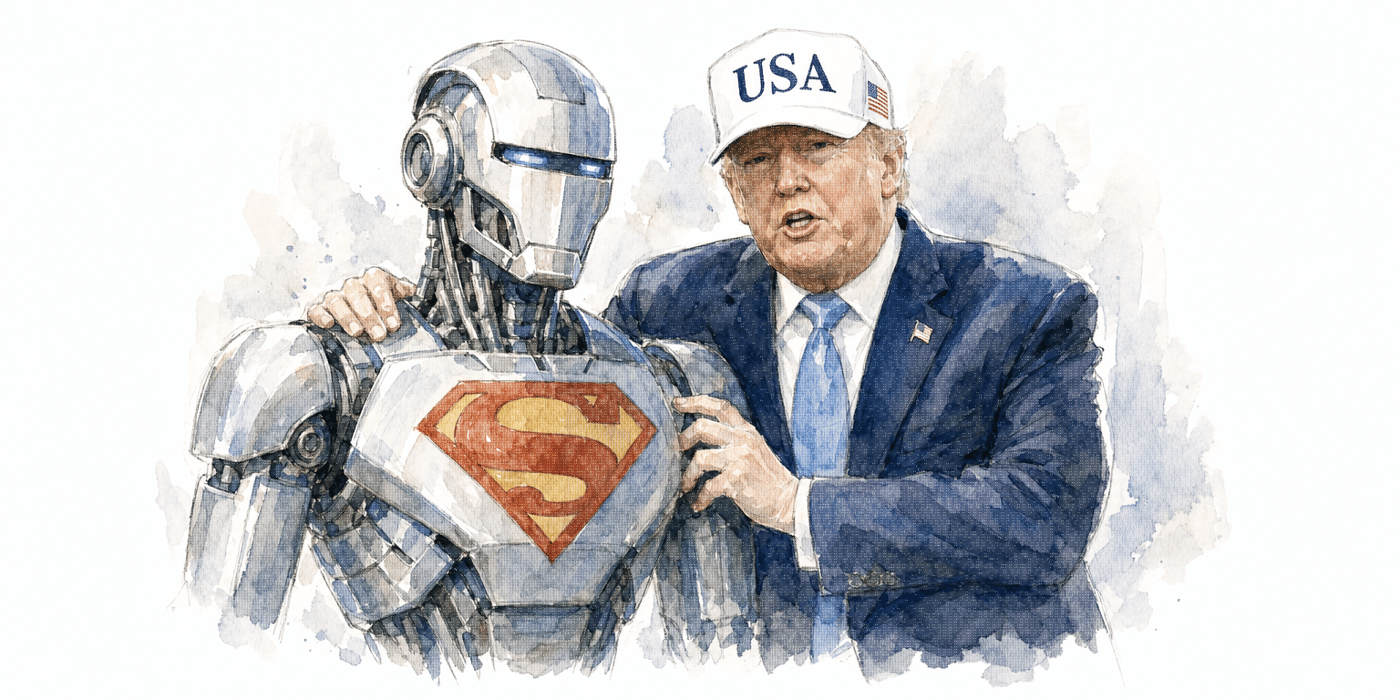

President Donald Trump loves to rename things. The Trump-Kennedy Center. The Gulf of America. Lake America. What’s surprising is that he blew the opportunity to call AI American Intelligence.
Sad!
Instead, President Trump signed an executive order yesterday officially rebranding Artificial Intelligence as Super Intelligence for all government references and terminology. It says:
The extraordinary technologies being pioneered by American innovators far exceed what was envisioned when the term “Artificial Intelligence” first came into use. The capabilities of today’s frontier systems do much more than imitate or automate discrete aspects of human intelligence. They increasingly amplify human ingenuity and unlock new forms of creativity, empowering Americans to achieve what was previously impossible across science, medicine, and nearly every other domain of human endeavor. As these capabilities continue to improve, they increasingly represent not merely artificial intelligence, but a new era of Super Intelligence.
Trump didn’t come up with that moniker out of the blue. After meeting with several tech titans on Tuesday, Trump said, “The name has been officially changed by the biggest, the smartest, the greatest people anywhere in the world.”
“Super Intelligence” has been used to describe both human intellect and superior AI technology. Vermont Socialist Senator Bernie Sanders recently introduced the Ban Artificial Superintelligence Act.
The president clearly doesn’t agree. In fact, he called Democrat fearmongering and demand for an AI shutdown a “hoax,” adding, “Just like it was a hoax for 12 years for global warming.”
My joke about American Intelligence notwithstanding, the administration’s fact sheet does correctly argue, “The United States is the birthplace of Artificial Intelligence and is pushing this frontier forward, having led the world in its development and deployment for over 70 years since its inception as a field of research.”
Indeed, the big picture on Trump’s AI actions throughout his second term is to keep America at the forefront of its development, which is a national security imperative.
On Tuesday, the Trump administration also launched America.gov, an AI-driven (or is that SI-driven) portal that provides what Trump called “one front door for every single question” about what the government does — Medicare, Trump Accounts, bookings at National Parks, you name it. “With America.gov, the federal government no longer stands in your way. It stands only at your service,” Trump said. “We’re simplifying it, we’re glamorizing it, we’re making it what it should be.”
Yet the much more important news than rebranding or a website launch is Trump’s Tuesday meeting and agreement with Big Tech giants. The result of that meeting was the document they signed that imposes what Trump called “morally binding” guidelines for the development and use of AI/SI.
The “White House Accord on Superintelligence: A Joint Commitment on Frontier SI Responsibilities” is not legally binding, but Trump said, “It’s almost like a constitution in a way,” and “it really is a form of protection.”
“We automatically have regulation with the Department of Justice, the FBI, all of that,” he added. “But the self-regulation is very important.” He also called it “tremendous self-policing.”
Speaking of policing, Missouri Republican Senator Josh Hawley announced yesterday in a Washington Post op-ed, “I am introducing legislation in Congress to make the corporations liable for the actions of their agents when they design the agents in a reckless fashion. My legislation would also make users liable when they deploy the agents in a reckless way.” He added, “This plan builds on a fundamental principle of American law: You are responsible for the damage you cause.”
As for the document Trump and the tech titans signed, it begins, “In order to build a positive future for the American people and the world, we believe every company is responsible for developing its own technology safely and in a way that builds trust with customers and the public.” That’s all well and good, but the vast majority of Americans already don’t trust the technology or the companies, and that’s going to be tough to reverse.
It includes what it calls “four layers of controls and audits”:
- Implement robust internal controls to monitor the capabilities and alignment of its models during training and deployment around areas like cybersecurity, biosecurity, and chemical threats, and to ensure that its models do not hack or access technical systems in unintended ways.
- Empower an internal team to ensure all of the controls, monitoring, and detection are operating as intended, and that any issues are remediated.
- Partner with an independent external auditor or evaluator to carry out independent assessments of whether the controls, monitoring, and detection are operating as intended.
- Designate an independent committee of the board of directors to oversee and receive reports from the teams operating the controls and the internal and external auditors and evaluators, as well as to ensure any issues identified are remediated.
Signatories include Anthropic CEO Dario Amodei, Tesla and SpaceX CEO Elon Musk, OpenAI President Greg Brockman, Google CEO Sundar Pichai, Meta CEO Mark Zuckerberg, and Nvidia CEO Jensen Huang.
As you may recall, earlier this month, Amodei called for the industry to slow down for humanity’s sake. That followed apocalyptic warnings from some AI developers about the existential threat the technology poses.
Trump aims to slow down the hysteria.
But it will take more than rebranding AI as SI, along with a “trust us” agreement, to overcome growing skepticism, fear, and outright opposition to the technology. That said, Trump’s position, unpopular as he and AI are, is the correct one. The government already has a poor regulation track record, and it should not issue a stack of Byzantine regulations on a technology few truly understand.
“I’m not going to stifle growth of something that will be bigger than the Industrial Revolution,” Trump said Tuesday.
The press may roll its collective eyes about a “morally binding” agreement, but there’s something to be said for expressing and agreeing to a value system instead of turning the whole enterprise over to the regulatory commissars.