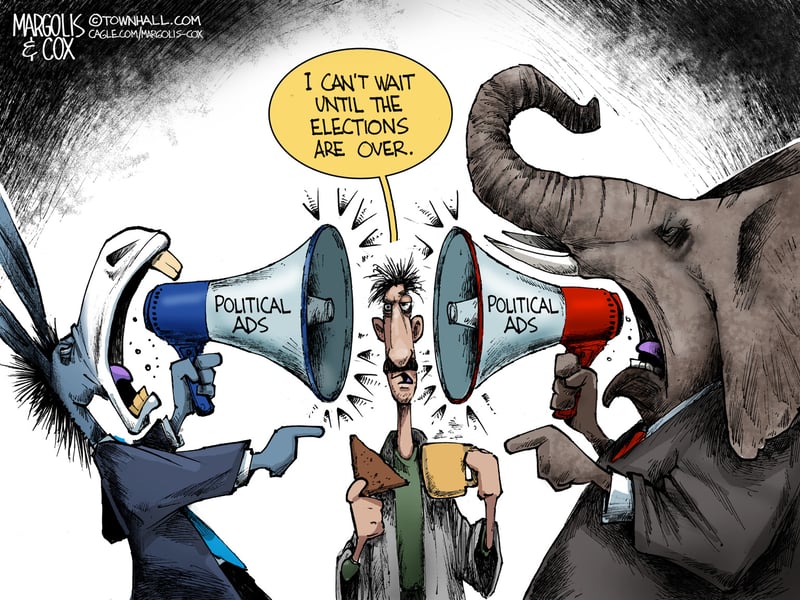

I’m writing this column on Election Day 2026. Right now, of course, I don’t know the election outcome; by the time this column hits the street, the whole world will know.
Per our usual practice, my wife Peggy and I were at the polling place this morning when it opened for business at 7 a.m., about tenth in line. While chatting with the other first-thing voters, we chuckled at the memory of being first in line with our son Thom on Election Day 2000 in Half Moon Bay, California, casting our votes to give George W. Bush a commanding 3-0 lead. It didn’t hold up very well. By the end of that day, Al Gore had won that precinct by over 90%. No matter, we’d gotten it started down the right track.
For us, today was yet another reminder of the merits of same-day (i.e., Election Day) voting. Inevitably, things happen in the days just prior to every election that might influence voters’ thinking about how best to exercise their fundamentally important role in our Republic.
As examples, just this week media was abuzz with the electrifying news that in Michigan, Democrat congresswoman and prior Senate candidate Haley Stevens endorsed Republican Mike Rogers, instead of the high-profile Democrat nominee Abdul El-Sayed. And just the week before, The New York Times broke the news that the mysterious presence of two Dan Sullivans on the ballot for the critically important Alaska U.S. Senate race was no coincidence; it was a coordinated, carefully executed scheme by the Mary Peltola team to siphon (i.e., steal) votes from her opponent, GOP incumbent Senator Dan Sullivan, in what is expected to be a very tight contest.
Either of these late-breaking events might have prompted second thoughts among Michigan and Alaska voters who’d already cast their votes, and possibly among early voters in other states who consider nationwide trends when deciding how to vote.
And in every cycle, voting decisions can take time and careful deliberation. I recall in 2016, arriving early at the polls but sitting in my car in the parking lot, wrestling one more time with my decision to support upstart GOP presidential candidate Donald J. Trump.
Regardless of my own views on early voting, it becomes more and more popular each election cycle. Clearly, American voters value the convenience and the opportunity to avoid the crowds — and to tune out the weeks of pre-election noise — afforded by early voting and mail-in voting. And most know well in advance how they plan to vote. But I’m not quite ready to give up on this one — one day, enough election-eve surprises might change the picture.
Perhaps even more important than what happens before Election Day, is the matter of what happens in the days after. The outcomes of many recent tightly contested races have been delayed for days or even weeks to accommodate the tedious (and sometimes controversial) counting of the mail-in votes that continue to trickle in after the polls close.
Not only do these delays interfere with the efficient transition of elected leadership, they can sow widespread distrust within the electorate about the final declared outcome. At the heart of the Trump vs. Biden 2020 presidential election controversy was the seemingly magical appearance, in the wee morning hours after election night, of huge caches of mail-in votes with distinctly different make-up than those tabulated on Election Day.
Many voters watched the reported vote counts until late that evening, went to bed with Trump holding steadily widening leads in multiple key states — then awoke the next morning to find that in every case, the late deliveries had reversed those trends. With no one watching, the lackluster Joe Biden had taken an insurmountable lead and had somehow amassed eight million more votes than any presidential candidate in U.S. history.
The resulting furor was unnecessarily chaotic, and ultimately turned violent. But despite the sobering official assurances that the election had been “fair and transparent,” the distrust engendered by the dramatic shifts persists even now.
More broadly, perhaps the most important old-guy perspective on election outcomes is this: regardless of who comes out on top, the euphoria on one side and the devastation on the other won’t last. The political upheaval will subside, both sides will learn from the experience, and if history is any indicator the nation will be better off in the long run.
But the changes in leadership roles will have immediate effect. Suddenly, upstart winners must shift from rock-throwing mode to getting-the-job-done mode. The fervent supporters who shared their dissatisfaction with the last crowd will quickly expect to see the sea change of good things they’d been promised, and sometimes those good things turn out not to be as good as anticipated.
President Donald Trump’s 2024 deep dive into the U.S. immigration crisis serves as an instructive case in point. Trump’s predecessor had presided over an unprecedented flood of illegal immigrants into the U.S., at times numbering over 10,000 a day, and he’d insisted that nothing short of comprehensive bipartisan legislation would get that situation under control.
Instead, Trump took the bull by the horns and, working with his DHS team to enforce existing law, sealed the border within weeks — a breathtaking success story that exceeded even the hopes of his strongest supporters. But Trump was then left with the legacy of Biden’s four years of an illegal immigration tsunami, with somewhere between 10 and 20 million unknown, unvetted migrants residing here illegally — some who have become good neighbors, while others are violent criminals who have brought horrendous harm — assault, rape, murder, human trafficking, drug peddling — into our communities.
Lacking any good options, Trump’s response — aggressive as always — has been to remove as many illegal immigrants as possible, with first priority on those known to be violent or considered potentially dangerous, and all as quickly as possible. His efforts in that respect sparked controversy and howling political criticism, to the point that his overall handling of immigration, despite its spectacular success at the border, is now considered a failure grievous enough to justify sweeping changes in elected leadership through today’s election. Such is the real-life burden of leadership.
On the other side of the coin, painful losses in elections like today’s — devastating to dedicated politicians and their avid supporters — present an unwanted but valuable opportunity to step back, objectively assess their own successes and failures, and be better prepared for the next election cycle, a scant two years away.
And one more observation for this Election Day: Remember the absurd, endless warnings from the Left regarding the fierce dictatorial Trumpian actions sure to descend on us on this day — the menacing presence of armed Nazi-brownshirt-type thugs at polling places, and then Trump’s abject refusal to accept the election results? What total nonsense. Keep that in mind at the next “No Kings” protest.
Life goes on. And unless we lose our way entirely, count on both the exhilarating political successes and the devastating failures of every election to pave the way to a better future.