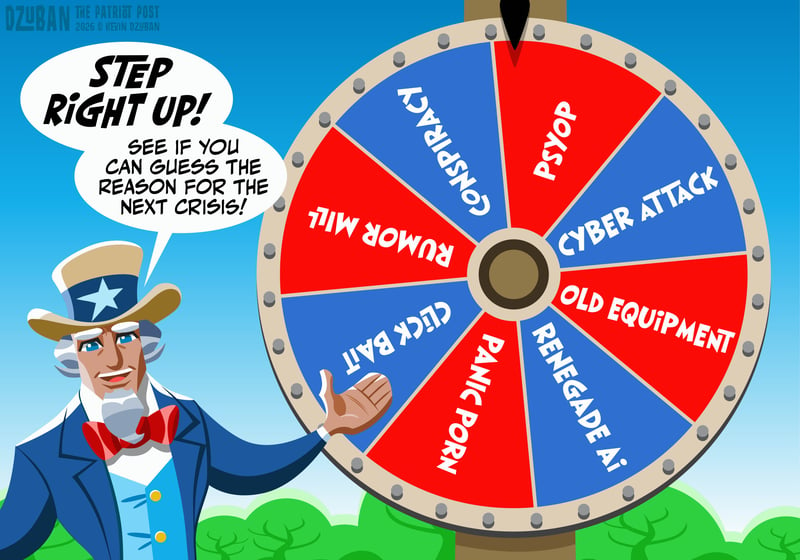
The Kafkaesque byzantinery that is the Federal Aviation Administration (FAA) was on full display this past weekend, as Secretary Patrick Duffy (whose Department of Transportation [DOT] oversees the FAA) directed a nationwide commercial air ground-stop lasting five hours on Friday. The reason: an abrupt failure of the FAA’s airspace control and telecommunications network, also known as the “FAA Telecommunications Infrastructure” (FTI). Secretary Duffy’s preemptive measure averted potential disaster but nonetheless resulted in massive disruptions and financial losses.
Secretary Duffy explained that the culprit was a newly installed router, which was transmitting roughly one thousand connection attempts every few seconds, overwhelming the FTI system. This may have been the proximate cause of the calamity, but the broader underpinnings of the failure have ripped yet another scab off a festering sore: the modernization — or lack thereof — of U.S. national airspace infrastructure. By “national airspace infrastructure” is meant the extensive network of telecommunications, datalinks, scheduling, information, and associated functions that enable aircraft to transit U.S. airspace safely.
L3Harris is the prime contractor responsible for transitioning FTI from its current state — a relatively low-bandwidth, “dial-up” era copper-wire-based network — into a modern fiber-optic-based system, and the contractor had recently installed a new router at a communications site in El Dorado, Arkansas, as part of the FTI upgrade.
Promptly throwing L3Harris under the bus, Secretary Duffy indicated he would investigate whether “incompetence” was to blame. “Our contractor didn’t meet the moment,” he said, “or the equipment didn’t meet the moment.” Aviation experts have also observed that the legacy and upgrade systems run on separate data sources and don’t fully integrate, posing further headaches for L3Harris and its subcontractors. More incredibly, the FAA migrated from vacuum-tube-based technology in many parts of its network only at the turn of the 21st century. Regardless, from a public-optics standpoint, L3Harris calls itself the “trusted disruptor.”
In the wake of this incident, may I humbly suggest this is a moniker L3Harris should try not to get tagged with moving forward?
Secretary Duffy also wasted no time using the occasion to raise his recent congressional ask from an additional $30 billion to $50 billion. And that’s after recently having received $12.5 billion under the so-called One Big Beautiful Bill. The FAA’s apparent funding motto? “Too much is almost enough!” Or as the late Senator Everett Dirksen colorfully remarked of the federal budget in the mid-1960s, “A billion here, a billion there, and pretty soon you’re talking about real money.”
But money — or at least money alone — isn’t the FAA’s biggest problem.
How do we know this? Both Duffy and the Government Accountability Office (GAO) highlighted this fact. In his press conference, Duffy noted that the original routers were purchased in 2001 and were “obsolete in 2006,” yet they are still being used. In its 2024 audit of the FAA, the GAO found that 105 of the FAA’s 138 (76%) air-traffic control systems were “unsustainable” or “potentially unsustainable” due to “availability of parts, growing airspace demand, and expanding mission needs.” A 2024 DOT Inspector General (IG) investigation further revealed that the FAA had granted 11 extensions to its original FTI upgrade contract in 2002, and that 10 of these were “improperly authorized” as noncompetitive contracts, resulting in a delay of 57 months and an additional $1.5 billion in spending. The IG hinted that the FAA “may be repetitively using these noncompetitive extensions for convenience and administrative ease,” with the counterproductive result of costing more and receiving less “than the best-quality results.” In other words, the FAA had likely been opting for the easy — but more costly, in the long run — way out.
Furthermore, the FAA both operates and regulates the U.S. national airspace system, a built-in conflict of interest. The National Transportation Safety Board (NTSB) made this exact case in its review of the FAA’s operations, in the wake of last year’s midair collision near Reagan National Airport between an Army helicopter and a regional airliner, which killed 67. The NTSB strongly recommended cleaving the operational airspace control component from the FAA, enabling the FAA to focus solely on oversight and regulation. Currently, as one FAA official quipped, “The whole FAA is a conflict of interest.” Unfortunately, nothing has been done with this recommendation.
Along with money management and the conflicts of interest inherent at the FAA, however, an even more fundamental problem plagues the agency: accountability. The Daily Wire’s Matt Walsh cynically illustrated this shortfall in a vignette of his youthful experience as a worker in a pizza restaurant:
>I remember when I worked at a pizza place as a teenager. One night, during the evening rush, the guy working the oven became overwhelmed or distracted or something, and a succession of pizzas ended up falling off the conveyor belt and onto the floor. This created a cascading effect that resulted in wait times of up to an hour or more. I never saw that guy again after that night, because when you cause an inconvenience for several dozen customers of a pizza place, you obviously get fired. That’s just basic accountability.
>Contrast that to the federal government, where a disastrous nationwide ground stoppage at all airports across the entire country, causing massive disruptions, losses of 66 million dollars an hour for the aviation industry, and major inconveniences for millions of people leads to... nobody getting fired at all! There is more accountability for teenagers at a random local pizza restaurant than for the people responsible for running the country.
He further noted that huge government bureaucracies such as the FAA make accountability impossible “by design.” To paraphrase Walsh, this lack of accountability is a “feature,” not a “bug,” as it were, of such monolithic bureaucracies.
Summarizing the dilemma, former House Speaker Newt Gingrich noted, “The primary problem isn’t a lack of money but a regulatory system so complex that money gets absorbed while almost nothing gets accomplished.”
In any case, while it’s easy to blame this mess on L3Harris or even the FAA, the problem is obviously more systemic. But since — for whatever reason — the current system of air traffic control has consistently failed to meet standards most aviation experts agree should have already been implemented, should we not explore other options?
For instance, National Review’s editorial board notes, “Unlike almost every other major country, the U.S. federal government funds and operates air traffic control directly.”
Reason Foundation’s recently released Annual Aviation Infrastructure Report also indicates that 96 countries have privately or self-funded air traffic services that do not operate as direct governmental agencies, unlike the FAA. The foundation also notes that only roughly 40% of recent FAA funding has been allocated to air traffic control modernization. The rest has apparently been assimilated into the FAA “Borg.”
So what’s stopping the U.S. from privatizing or otherwise changing (i.e., fixing) the current system? In government-speak slang, “rice bowls” (i.e., self-interests).
Congressional legislation to remedy air traffic control woes has consistently been shot down by the concentrated, coordinated efforts of both air traffic controller labor unions and wealthy (or at least influential in large numbers) private aircraft owners. The former fear losing fat-cat government jobs; the latter fear paying user fees, which commercial carriers currently foot for the FAA. Surely, these obstacles can — and should — be overcome, whatever the resolution.
Put another way, the U.S. commercial air market services roughly one billion passengers annually; the rest of the world’s combined services account for a little over nine billion. Further, the U.S. market accounts for well over a third of worldwide air carrier revenue. This, from a country with a little over 4% of the globe’s population. Thus, comparing the FAA’s issues with those of virtually any other country is like comparing apples with oranges. Still, “if it ain’t broke, don’t fix it” does not apply here. It is broke, and fixing it — whatever the solution — is long overdue.
Meanwhile, as if to underscore how technology-dependent we are as a nation, United Airlines’ weight-and-balance planning software system (required to safely load aircraft for flight) and the NSA’s top-secret, secure communication network, NSA Net, both went down within a few days of the airspace shutdown. In both cases, authorities denied that cyberattacks or other malicious actions caused the shutdowns, citing software-related issues instead.
If a major airline were to operate the way the FAA does in accessing funding and executing operations, that airline would never turn a wheel. Thankfully, last weekend wasn’t Thanksgiving weekend, so hopefully these events will serve as prophylactic wake-up calls before the holiday season kicks off.
If not, brace for impact — hopefully not literally.