
Back in 2018, former Republican Congressman and House Oversight Committee Chairman Jason Chaffetz literally wrote the book on a term that had only recently come into vogue. That term? The deep state. His book title? The Deep State. (Hey, I said literally.)
“The Deep State is real,” Chaffetz writes. “They don’t like exposure, accountability, or responsibility. They fight back, outlast, and work the system for their advantage. And they certainly don’t like disruptive forces such as Donald Trump.”
Chaffetz then explains why the Deep State — which is the 21st century’s more vicious and more subversive version of Woodrow Wilson’s administrative state — has been so effective: “Sometimes even conservatives talk about the Deep State as though the term refers to dumb, inefficient bureaucracy. In fact, it is the opposite. The Deep State is intentional, unconstitutional, and organized. It is about pure, unfettered power, and it gets very angry when it is even questioned.”
Chaffetz was clearly onto something, and the events of Donald Trump’s first term bore this out — from the phony Russia collusion conspiracy in which a deep-state FBI lawyer named Kevin Clinesmith got a mere wrist-slap for having falsified evidence to secure a FISA warrant for spying on the Trump administration, to a perfect phone call with the Ukrainian president after which Trump was impeached by the deep-state complaint of an ostensibly nonpartisan CIA whistleblower named Eric Ciaramella, who just so happened to be a registered Democrat.
The Democrats would like you to believe that there exists a network of “independent” and well-meaning agencies within the executive branch of government. That’s a purposeful lie. The truth is that these agencies are overwhelmingly populated by partisan Democrats, and their mission is to impose the will of Democrat administrations and sabotage the work of Republican administrations. As Breccan Thies writes at The Federalist:
Democrats over time have also made the power dynamic more acute by making it virtually impossible to fire the bureaucrats. The resulting American government works like this: If the American people elect Democrats, they get a super-charged left-wing state, where the bureaucracy is in lockstep with the political leadership to pursue the agenda. If the American people elect a Republican, the elected leadership is faced with clandestine action, leaking, and mechanical thwarting of the agenda.
Which is why the Supreme Court’s Trump v. Slaughter ruling from earlier this year was so important: because it affirmed the fundamental constitutional principle “that those who fall within the President’s ‘general administrative control’ must be removable by the President at will.”
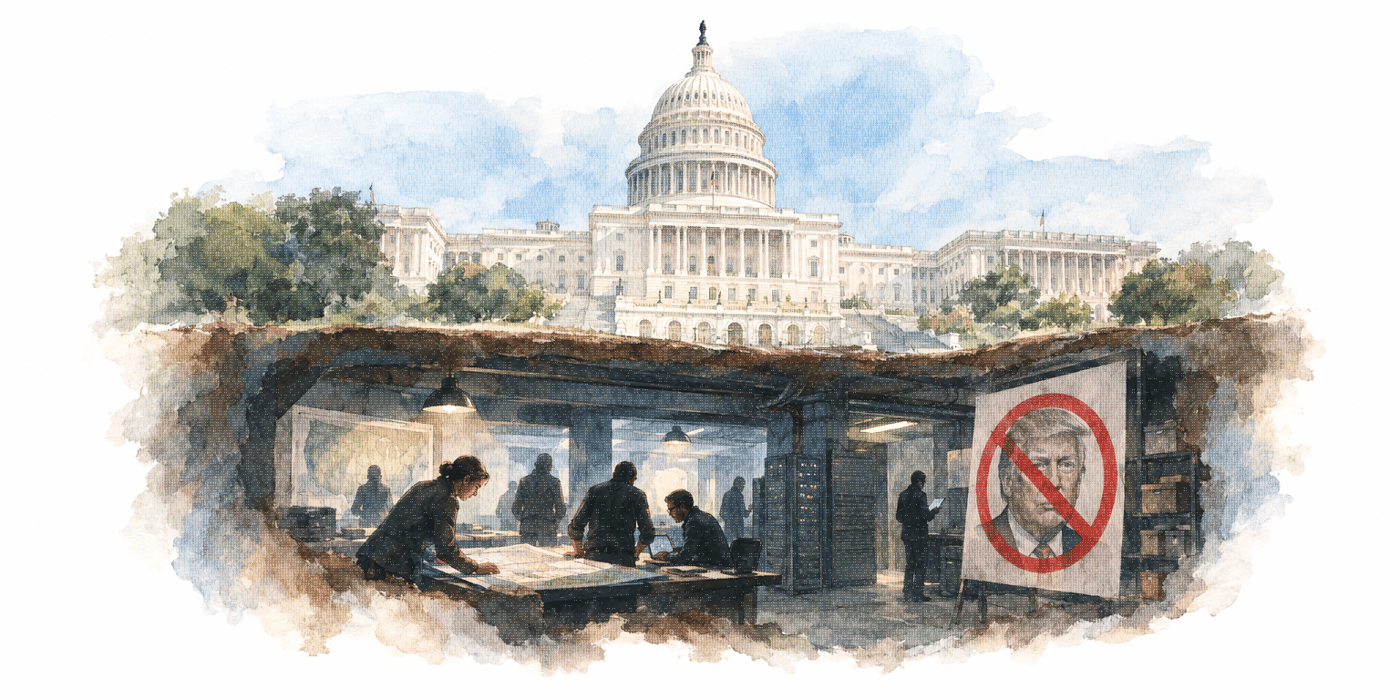
And which is why the deep state’s embodiment in the U.S. Senate, Michigan “Scummy Six” Senator and former CIA operative Elissa Slotkin, is so intent on protecting it. “We need to make sure,” said Slotkin at last week’s “What’s Next” Democrat rah-rah rally in Denver, “that a very unsexy group of people are thinking very hard about how to Trump-proof the government going forward so that no leader can do this again.”
That “very unsexy group of people” is, of course, the deep state. And it shouldn’t surprise us at all that Slotkin is so outwardly intent on protecting this vital Democrat-dominated institution. After all, she recently went on record to warn young Republicans against serving in the Trump administration. And before that, in another unguarded moment, she warned her fellow leftists that the wildly popular SAVE America Act “would literally allow [the Trump] administration to rig our democracy so that it would be hard for any Democrat in any state to win any election.”
Hmm... how’d that rigging, that “Death of Our Democracy” work out, Elissa?
Slotkin followed up on her comments by urging young Americans to “reimagine and rebuild” our society’s systems “after President Trump.” Uh-huh.
We know the truth. Slotkin doesn’t want anything to be reimagined. She just wants her dirty deep state to be reinvigorated and re-weaponized as soon as Trump leaves office.