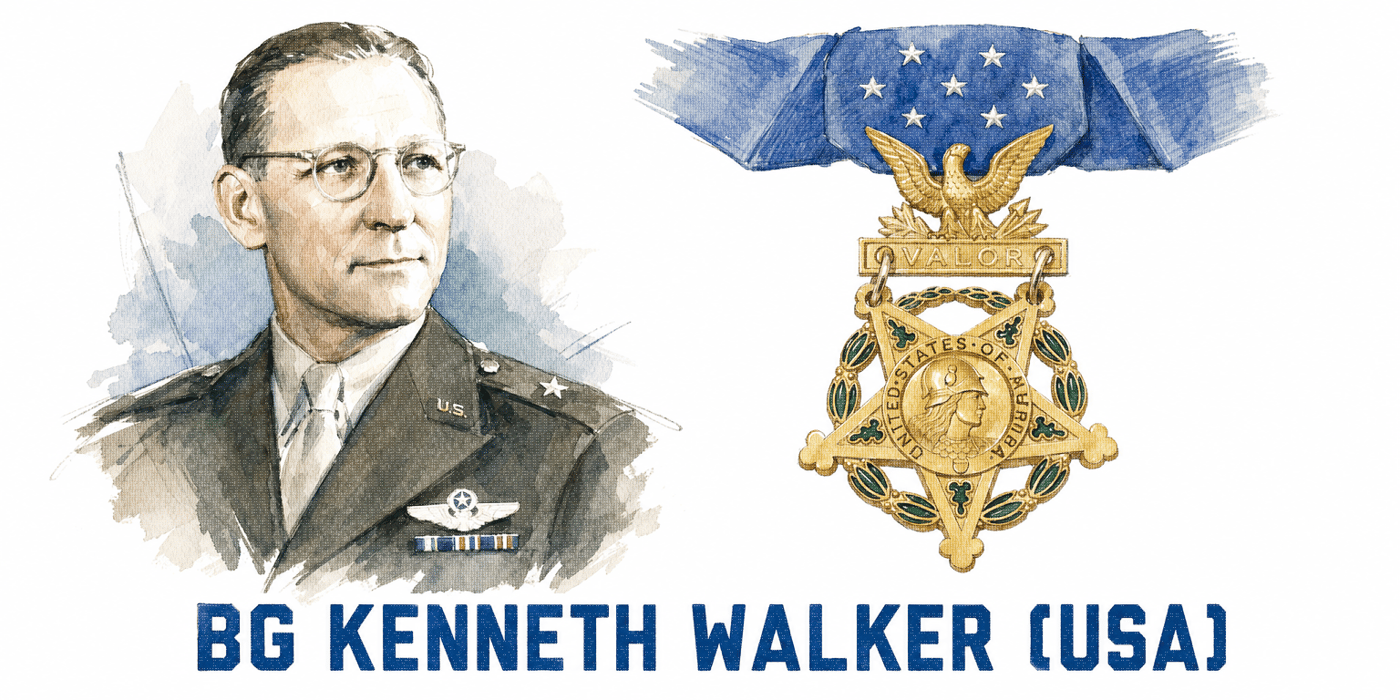

Ken Walker was born in Los Cerrillos, New Mexico, to Wallace and Emma. He grew up in Denver, Colorado, but graduated from Omaha High School of Commerce in Nebraska. He returned to Denver to study business at La Salle Extension University until enlisting in the Army in December 1917.
After completing initial flight training from the School of Military Aeronautics at the University of California, and then pilot training at Mather Field near Sacramento, he received his Aircrew Badge. From there he went to the Flying Instructor’s School at Brooks Field in San Antonio, Texas, and became an instructor pilot for the next four years at Post Field.
In 1922, he married Marguerite Potter, and the couple shipped out to the Philippines, where he was Commander of the Air Intelligence Section, before returning stateside and serving with various squadrons.
Among his most signifiant contributions were rewriting the Army Air Corps textbook on aerial bombardment and publishing seminal articles on aerial warfare strategy. He became a pilot at the dawn of aerial warfare, and he and his team of strategists were known at the “Bomber Mafia.” He is credited with what became known as the “creed of the bomber”: “A well-planned, well-organized and well-flown air force attack will constitute an offensive that cannot be stopped.”
Ahead of the attack on Pearl Harbor in December 1941, then-LTC Walker was assigned to the Air War Plans Division, where he was instrumental in developing the air assault plan against Germany. It outlined a force of 98 medium to heavy bomber groups with 6,834 aircraft, defended by 16 fighter groups. After the U.S. declared war on Japan and Germany, he joined the Operations Division (OPD) of the War Department General Staff before being promoted to brigadier general and deploying to the Southwest Pacific.
At daybreak on 5 January 1943, as Commander of 5th Bomber Command, Walker, who often flew combat missions in order to gain strategic expertise, was on board the lead of six B-17 “Flying Fortresses” from the 64th Bombardment Squadron, joined by six Consolidated B-24 “Liberators.” They were searching for an enemy ship convoy headed for the Japanese military base at Rabaul, New Britain — and they found it, hitting nine Japanese ships.
After striking their targets, his planes were attacked by a large contingent of Japanese fighters. Walker’s plane was hit and last seen over water several miles southwest of Rabaul, with its left outboard engine on fire. Walker and his crew of 10 airmen did not make it back to base that day, and after several search attempts, they were listed as missing in action. The crew was later reclassified as killed in action.
Fred Wesche, who flew another of the B-17s that day, recalled that “most of us thought it was a suicide mission.”
He added:
When it was announced that it was going to be done in broad daylight at noontime, as a matter-of-fact, at low altitude, something like 5,000 feet over the most heavily defended target in the Pacific almost ... most of us went away shaking our heads. Many of us believed we wouldn’t come back from it. No sooner had we dropped our bombs that my tail gunner says, “Hey, there’s somebody in trouble behind us.” We made a turn and looked back and there was an airplane, one of our airplanes, going down, smoking. ... There must have been 15 or 20 fighters — they gang up on a cripple, you know, polish that one off with no trouble, but he disappeared into a cloud bank and we never saw him again. It turns out it was the general...
BG Walker was the highest-ranking Army official reported MIA during World War II.
Hearing he was MIA at the time, GEN Douglas MacArthur declared, “If he doesn’t come back ... I’m putting him in for the Medal of Honor!”
And he did.
For his service and actions, Ken Walker was awarded the Medal of Honor, in addition to his Distinguished Service Cross, Silver Star, Legion of Merit, and Purple Heart.
In a March 1943 White House ceremony, President Franklin Roosevelt presented Walker’s oldest son, 16-year-old Kenneth Jr., his father’s Medal of Honor.
According to his Medal of Honor citation:
For conspicuous leadership above and beyond the call of duty involving personal valor and intrepidity at an extreme hazard to life. As commander of the 5th Bomber Command during the period from 5 September 1942 to 5 January 1943, Brig. Gen. Walker repeatedly accompanied his units on bombing missions deep into enemy-held territory. From the lessons personally gained under combat conditions, he developed a highly efficient technique for bombing when opposed by enemy fighter airplanes and by antiaircraft fire. On 5 January 1943, in the face of extremely heavy antiaircraft fire and determined opposition by enemy fighters, he led an effective daylight bombing attack against shipping in the harbor at Rabaul, New Britain, which resulted in direct hits on nine enemy vessels. During this action his airplane was disabled and forced down by the attack of an overwhelming number of enemy fighters.
Airpower historian Michael Patterson noted that Walker believed “airpower offered a revolutionary means to pressure an enemy into capitulation without first defeating opposing ground forces.” And for generations in some conflicts, it has done just that. Notably, that strategy is central to subduing Iran’s nuclear weapon ambitions today.
Walker’s son Douglas said of his father’s Medal of Honor:
There is a temptation for Americans to forget these MIAs, whose deaths seem so long ago. How we treat these missing, who cannot speak for themselves, says much about us. I hope our decision to honor our commitment to ‘Leave No One Behind’ means we realize the debt we owe our military- past and future. These were Americans who gave their lives for their country. They deserve to be brought back home. They would be surprised it was ever a question that they would be sought. They still matter to me and the other surviving family members and friends. We still care.
In his honor, Roswell Army Air Field in New Mexico was redesignated Walker Air Force Base, and at Maxwell Air Force Base in Montgomery, Alabama — home of the Air War College — there is Walker Hall.
BG Kenneth Walker: An ordinary man faced with extraordinary circumstances, he summoned the greatest measure of courage to place his life in imminent peril to save others. His example of valor — a humble American Patriot defending Liberty for all above and beyond the call of duty — is eternal. Live your life worthy of his sacrifice.
“Greater love has no one than this, to lay down one’s life for his friends.” (John 15:13)
Join us in daily prayer for our Patriots in uniform — Soldiers, Sailors, Airmen, Marines, and Coast Guardsmen — standing in harm’s way in defense of American Liberty, and for our nation’s Veterans, First Responders, and their families.
(Read more Profiles of Valor here.)
Semper Vigilans Fortis Paratus et Fidelis
Pro Deo et Libertate — 1776
Please consider a designated gift to support the National Medal of Honor Sustaining Fund’s character education initiatives through Patriot Foundation Trust’s online donor page, or by check payable to “NMoH Sustaining Fund” and mail it to:
Generosity Trust
National MOH Sustaining Fund
345 Frazier Avenue, Unit 205
Chattanooga TN 37405
Thank you for supporting The Patriot Post, our nation’s premier journal of American Liberty.
The Patriot Post and Patriot Foundation Trust — Liberty Fund, in keeping with our our Military Mission of Service to American Patriots in uniformed service and veterans, are proud to support and promote the National Medal of Honor Heritage Center, the Congressional Medal of Honor Society, both Honoring Their Sacrifice Foundation and Warrior Freedom Service Dogs aiding wounded veterans, Tunnel to Towers Foundation, the National Veterans Entrepreneurship Program, Folds of Honor, Officer Christian Fellowship outreach, the Air University Foundation and Naval War College Foundation, and the Naval Aviation Museum Foundation.