
Eight years ago, a fellow Tennessean and great friend, Gary Harrell, sat in on a strategy meeting formulating plans to establish the National Medal of Honor Heritage Center. He had a recommendation.
In 1985, Gary became an SF Operator with the Army’s 1st Special Forces Operational Detachment — Delta at Fort Bragg, generally known as “Delta Force.” In 1992, he became commander of C Squadron, Delta Force, and, among other assignments, on 3-4 October 1993, then-LTC Harrell was involved with Operation Gothic Serpent and the Battle of Mogadishu — later depicted in the film “Black Hawk Down.”
Gary was severely wounded in another Mogadishu battle, but recovered. He would become Deputy Commander of Delta, and then was a Commander for the 10th Mountain Division during Operation Enduring Freedom. He then served during Operation Iraqi Freedom and finally as Deputy Commanding General of the Army Special Operations Command. He retired as a Major General.
At that Heritage Center meeting in 2018, Gary planted a seed — suggesting that there be acknowledgment of the Battle of Mogadishu, and the 18 Americans killed and 81 injured that day. Among the casualties were two Medal of Honor recipients, MSG Gary Gordon and SFC Randall “Randy” Shughart, both Delta Force operators. Gary was instrumental in their Medal of Honor nominations, which were awarded in 1994.
Gordon and Shughart were the first Medal of Honor recipients since the Vietnam War.
Gary died young in February 2023, and I memorialized my friend in a Profile of Valor. As I noted then, Gary was a family man of strong faith, husband to Jenny and father to Andrea, Chad, and Amanda. He was a highly respected leader of warriors, a fierce defender of American Liberty, and a Patriot.
Our conversation about the Black Hawk Down exhibit had remained on a back burner in the years since he first mentioned it — until now.
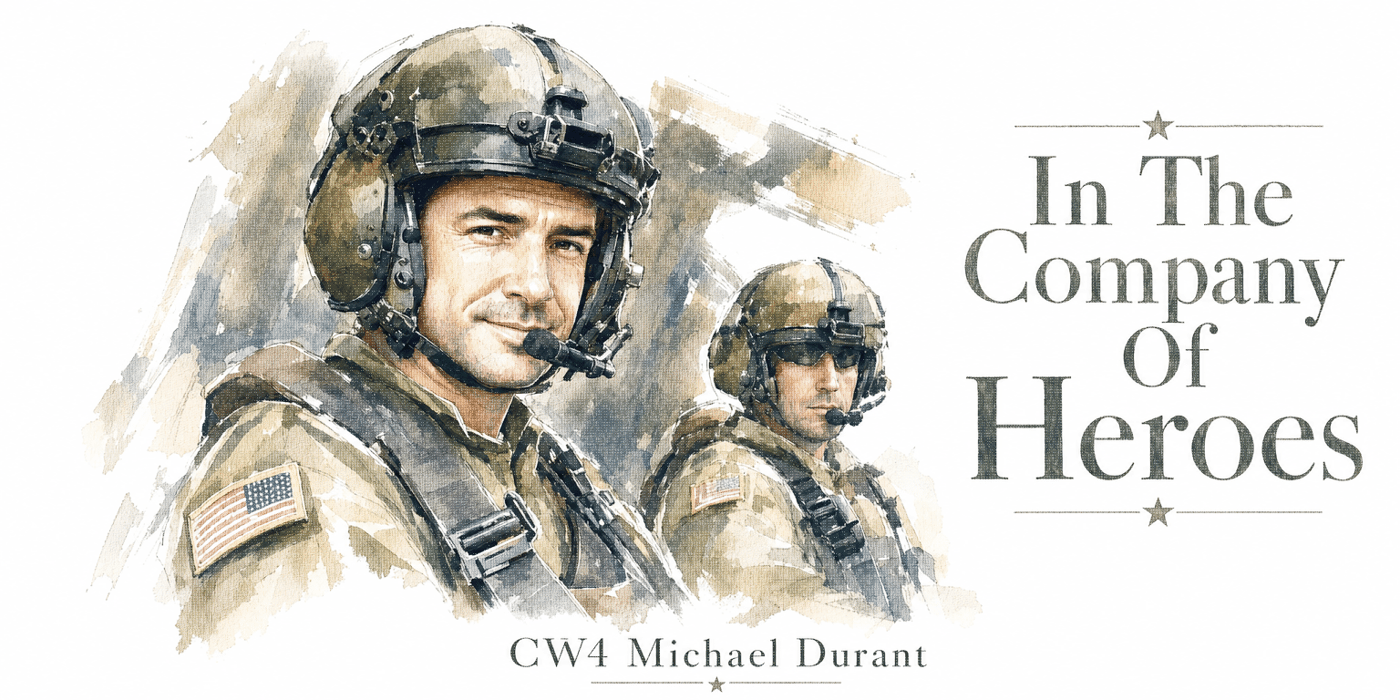
Perhaps the most visceral account of the Battle of Mogadishu is from CW4 Michael Durant (USA, Ret.), 160th Special Operations Aviation Regiment pilot whose MH-60L Black Hawk Super Six Four was the second helicopter shot down that day while trying to provide cover for the downed crew of Super Six One. Durant authored a detailed account of that day and night in his book In the Company of Heroes.
As he orbited above the crash site of Super Six One, above the dust and chaos, he recalled:
We’re having a heck of a time sorting out where everybody is. We’ve got these mini-guns that’ll fire over 4,000 rounds a minute. We don’t want to just go crazy, hosing down the countryside until we know where all the friendlies are. So, in the end, we never fired a round. And I don’t regret that at all. We never had sufficient understanding of the tactical situation to do it.
Then, Durant’s helicopter was spotted by a seven-man Somali RPG team moving toward the crash of Super Six One. One of those fighters took aim at Super Six Four’s tail rotor and fired, hitting the rotor but not immediately disabling the aircraft. But moments later it lost its rotor control and went into violent spin dropping 100 feet and crashing.
After that third pass, we were hit by the RPG. I was flying the helicopter and it felt like a speed bump, like when you’re going too fast in a parking lot. It hit the tail, just below the tail rotor, and it blew the gearbox apart. The tail rotor didn’t leave the aircraft immediately, but it decided to go pretty quickly, and when it did ... we started to spin violently.
On impact, Durant and his three crew members, Bill Cleveland, Ray Frank, and Tommy Field, were badly injured.
There were quite a bit of vertical G forces imparted on my body. It was enough to snap my right femur in half. It crushed vertebrae in my spine, not the discs but the bones themselves were crushed. That takes a fair amount of G forces to do that to a 32-year-old guy training for a marathon. Ray Frank had similar injuries, not exactly, but similar. My crew chiefs were hurt worse.
That began a series of desperate attempts by several Ranger units to rescue Mike and his crew, but the ground units couldn’t reach them.
After repeated denials of their requests to get on the ground and defend Durant and his crew, MSG Gordon and SFC Shughart were inserted by Super Six Two into a battleground with insurmountable odds of survival. Those odds were clear to all, but they went anyway.
Mike recalls:
We were on the ground 10 minutes when they arrived at the side of the aircraft. I didn’t personally know them, but I did know them from interacting from within Task Force Ranger. Together they lifted me out of the cockpit. They were not stressed. I mean, they were textbook special ops guys.
Over the next 10 minutes, Gordon and Shughart killed numerous Somalis before running out of ammunition and being killed.
Durant’s crew was deceased by the time the Somalis got to the helicopter. They nearly beat Mike to death before taking him prisoner and holding him captive for 11 days.
Mike received a Distinguished Service Medal for his actions, and says: “Without a doubt, I owe my life to those two men and their bravery. Those guys came in when they had to know it was a losing battle. If they had not come in, I wouldn’t have survived.”
The Somali’s desecrated the bodies of Durant’s crew and Gordon and Shughart, dragging them through the streets of Mogadishu like trophies. I will never forget those images, and notably, in a recent conversation, Medal of Honor recipient David Bellavia mentioned that he was inspired to military service after witnessing media coverage of the desecration of our men in Mogadishu.
This week, Mike Durant was in Chattanooga to join in the announcement of the official funding launch of The Courage to Go: The Battle of Mogadishu Immersive Theater Experience.
CW4 Michael Durant: An ordinary man faced with extraordinary circumstances, he summoned the greatest measure of courage to place his life in imminent peril to save others. His example of valor — a humble American Patriot defending Liberty for all above and beyond the call of duty — is eternal. Live your life worthy of his sacrifice.
Footnote: In one of Joe Biden’s last-minute actions as president, he announced construction of an aircraft carrier in 2027, CVN-83, which would be named the USS Bill Clinton. There are many reasons that should not happen, including the fact that Bill Clinton refused to kill Osama bin Laden on at least two occasions before the 9/11 Islamist attack on our nation. But his micromanagement of military operations was also directly implicated in the loss of American lives during the Battle of Mogadishu.
Join us in daily prayer for our Patriots in uniform — Soldiers, Sailors, Airmen, Marines, and Coast Guardsmen — standing in harm’s way in defense of American Liberty, and for our nation’s Veterans, First Responders, and their families.
(Read more Profiles of Valor here.)
Semper Vigilans Fortis Paratus et Fidelis
Pro Deo et Libertate — 1776
Please consider a designated gift to support the National Medal of Honor Sustaining Fund’s character education initiatives through Patriot Foundation Trust’s online donor page, or by check payable to “NMoH Sustaining Fund” and mail it to:
Generosity Trust National MOH Sustaining Fund
345 Frazier Avenue, Unit 205
Chattanooga TN 37405
Thank you for supporting The Patriot Post, our nation’s premier journal of American Liberty.