
Over the last few weeks, some of the loudest warnings about artificial intelligence have come from an interesting place: the companies building it. OpenAI is now calling for mandatory national AI safety requirements. Anthropic has argued that the federal government should have the authority to block the deployment of certain powerful models. And some of the biggest names in artificial intelligence are openly warning that the technology they are developing could become dangerous.
At first glance, this sounds remarkably noble. The people standing to make billions of dollars from artificial intelligence are supposedly asking Washington to restrain them for humanity’s good.
Some of that concern may be genuine. AI is developing extraordinarily quickly, and serious questions about biological threats, misinformation, and autonomous systems deserve serious consideration.
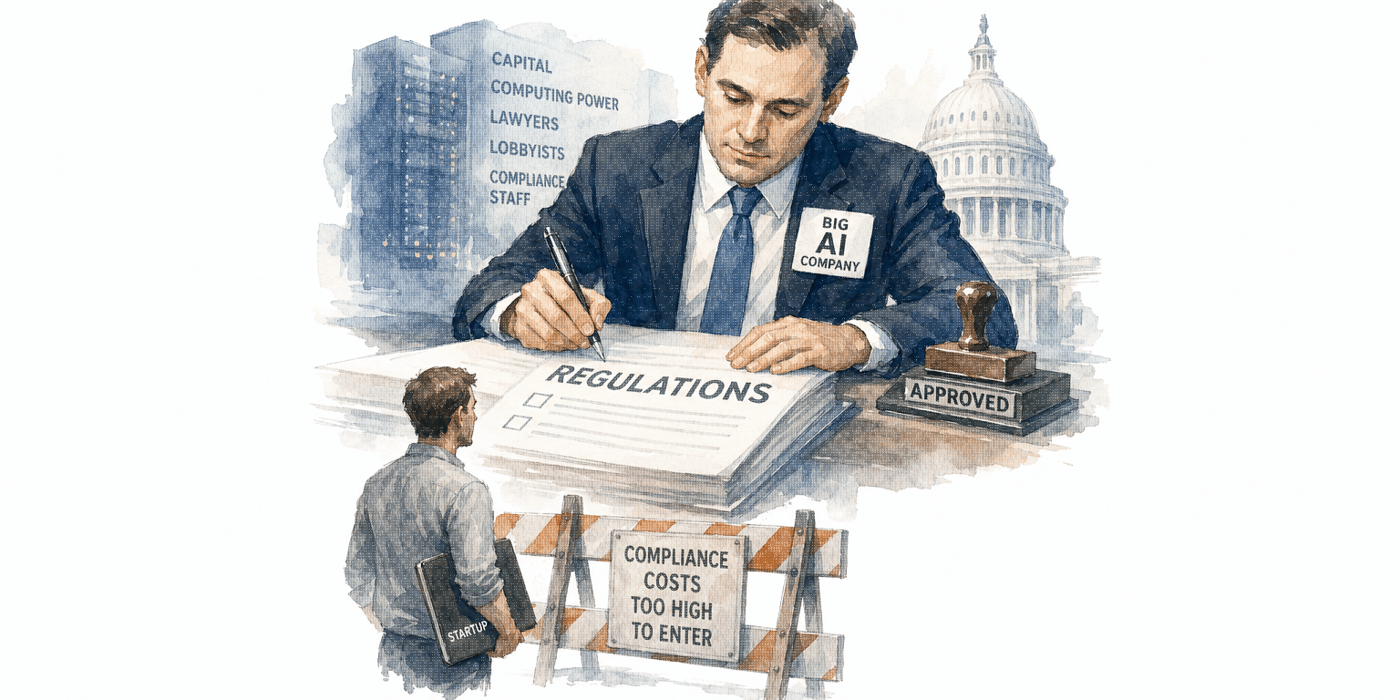
But Americans should not ignore another side to this conversation. When the companies being regulated help write the regulations, regulation can become an advantage rather than a burden.
Large AI companies already possess enormous amounts of capital, computing power, lawyers, lobbyists, and compliance staff. A complicated federal regulatory system may be expensive for OpenAI or Anthropic, but they can afford it. A startup trying to compete with them may not be able to.
The result could be regulations supposedly written to restrain Silicon Valley that instead make the largest companies even more powerful. Federal Trade Commission Chairman Andrew Ferguson recently raised a similar concern about AI companies simultaneously seeking additional regulation and special antitrust treatment, questioning whether such policies could create barriers protecting established companies from competition.
There is also another problem. The more responsibility Washington assumes for determining which AI systems are safe enough to release, the easier it becomes for companies to point toward government approval when something goes wrong.
If government becomes the ultimate referee deciding which models can be developed or deployed, companies can increasingly argue that they complied with the government’s rules. Responsibility becomes blurred between the corporation that created the technology and the regulators who permitted it.
Meanwhile, Washington faces an enormous dilemma. America cannot simply pretend AI does not matter economically. The national debt has now surpassed $40 trillion, while artificial intelligence has become an increasingly important source of investment, productivity growth, technological leadership, and competition with China.
That means any administration — Republican or Democrat — must consider the consequences of regulations that substantially slow American AI development while Chinese companies keep advancing.
Even the current debate inside Washington reflects that tension. Some policymakers emphasize catastrophic risks and stronger safeguards; others warn that excessive regulation could surrender technological leadership to China.
That is precisely why Americans should be skeptical whenever the industry’s biggest players enthusiastically invite Washington into their industry. Safety rules may be necessary. Companies developing incredibly powerful technology should absolutely be held responsible when they act recklessly.
But regulation should not become a shield behind which those companies can hide. If an AI company believes its technology is genuinely too dangerous to release, it does not need an act of Congress to stop releasing it.
Government has a role in protecting Americans. But companies also have a responsibility for the products they create. The worst possible outcome would be a system in which Washington gains enormous power over artificial intelligence, America’s largest AI companies gain protection from smaller competitors, and everyone can blame someone else when something eventually goes wrong.