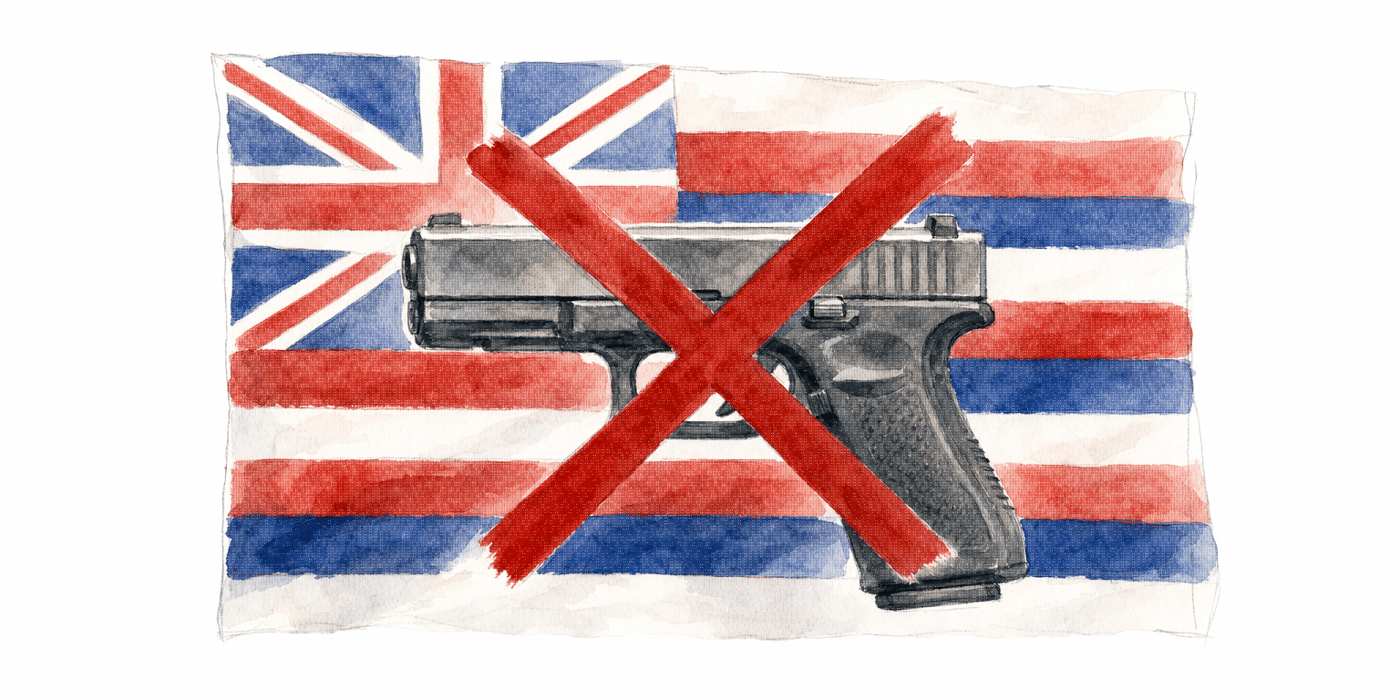

The Ninth Circuit Court of Appeals has upheld another Second Amendment-infringing law in Hawaii. Although the U.S. Supreme Court struck it down earlier this year in Wolford v. Lopez, the law effectively required residents to get explicit permission from store owners and other privately owned public access establishments to carry a firearm. The Democrat leadership of the Aloha State is hell-bent on denying its residents constitutionally protected rights.
This is nothing new for Hawaii, which has a history of repressive anti-firearm legislation. In truth, if it wasn’t for the Second Amendment, the island state would likely have banned all firearm ownership.
The law in question not only required residents to obtain a permit to buy a firearm, but also mandated that a gun not used for over 30 days would void the permit. The law also required applicants to present their firearms at a local police station.
In 2021, a lower court issued an injunction against the law in Yukutake v. Lopez, preventing the state from enforcing a restrictive limit on firearm ownership.
The Ninth Circuit has now lifted the injunction, reasoning that “the provisions impose only modest, procedural burdens, and do not materially impede Plaintiffs from acquiring firearms.” The majority even cited the Supreme Court’s Bruen decision, bizarrely asserting that Hawaii’s gun permitting regulation was well within the nation’s traditional gun ownership requirement.
Writing in dissent, Judge Ryan Nelson rejected that assertion as a dubious reading of Bruen, observing:
Footnote 9 did not create a gaping Second Amendment exemption for states to exploit with new creative restrictions that would otherwise fail Bruen’s test. The majority — like most lower courts — fails to grasp (or even acknowledge) these differences. Never has a single footnote in a Supreme Court opinion been so misread by so many lower courts to deny so many Americans their constitutional rights. The statements in footnote 9 are not the genesis of a different constitutional framework; they show merely how the framework the Court has established might be applied in particular circumstances.
Indeed, the Ninth Circuit majority effectively conflated concealed carry permits with firearm ownership permits. States have broadly applied the former; they have not the latter.
As the Court’s majority put it:
Because these licensing regimes do not require applicants to show an atypical need for armed self-defense, they do not necessarily prevent “law-abiding, responsible citizens” from exercising their Second Amendment right to public carry. Rather, these shall-issue regimes, which often require applicants to undergo a background check or pass a firearms safety course, are designed to ensure only that those bearing arms in the jurisdiction are, in fact, “law-abiding, responsible citizens.” And they likewise appear to contain only “narrow, objective, and definite standards” guiding licensing officials, rather than requiring the “appraisal of facts, the exercise of judgment, and the formation of an opinion,” — features that typify proper-cause standards like New York’s.
Interestingly, the Court’s majority recognized that their opinion would not withstand the Supreme Court should other Democrat-run states seek to enact similar legislation using these grounds, so they included the following caveat: “That said, because any permitting scheme can be put toward abusive ends, we do not rule out constitutional challenges to shall-issue regimes where, for example, lengthy wait times in processing license applications or exorbitant fees deny ordinary citizens their right to public carry.”
Another Ninth Circuit dissenter, Judge Lawrence VanDyke, blasted the majority decision, noting how often the Ninth has been on the wrong side of the Constitution on the Second Amendment.
Frankly, our court’s scorched-earth approach to the Second Amendment is getting exhausting. I haven’t even been on the bench for that long, and I’ve lost count of the number of dissents that I’ve written in cases like this one, which is just another verse of the same boring song. I highly suspect that, before too long, the name of this case will have a red flag next to it on Westlaw, just like so many of our court’s other Second Amendment cases do. But hopefully next time, when the Supreme Court plants that flag, it will do so with a little more bite than it has before. Until then, I will assiduously but wearily dissent.
Second Amendment cases are already piling up for the Supreme Court this coming term, and this one will likely become another addition to the docket.
To echo Judge VanDyke, these repeated attempts to infringe on the Second Amendment are getting tiresome; the good thing is that states like Hawaii, New York, and Illinois are ironically helping the Supreme Court establish strong legal precedent for protecting Americans’ Second Amendment rights. The more the Supreme Court strikes down these anti-gun laws, the more it strengthens Americans’ right to bear arms.