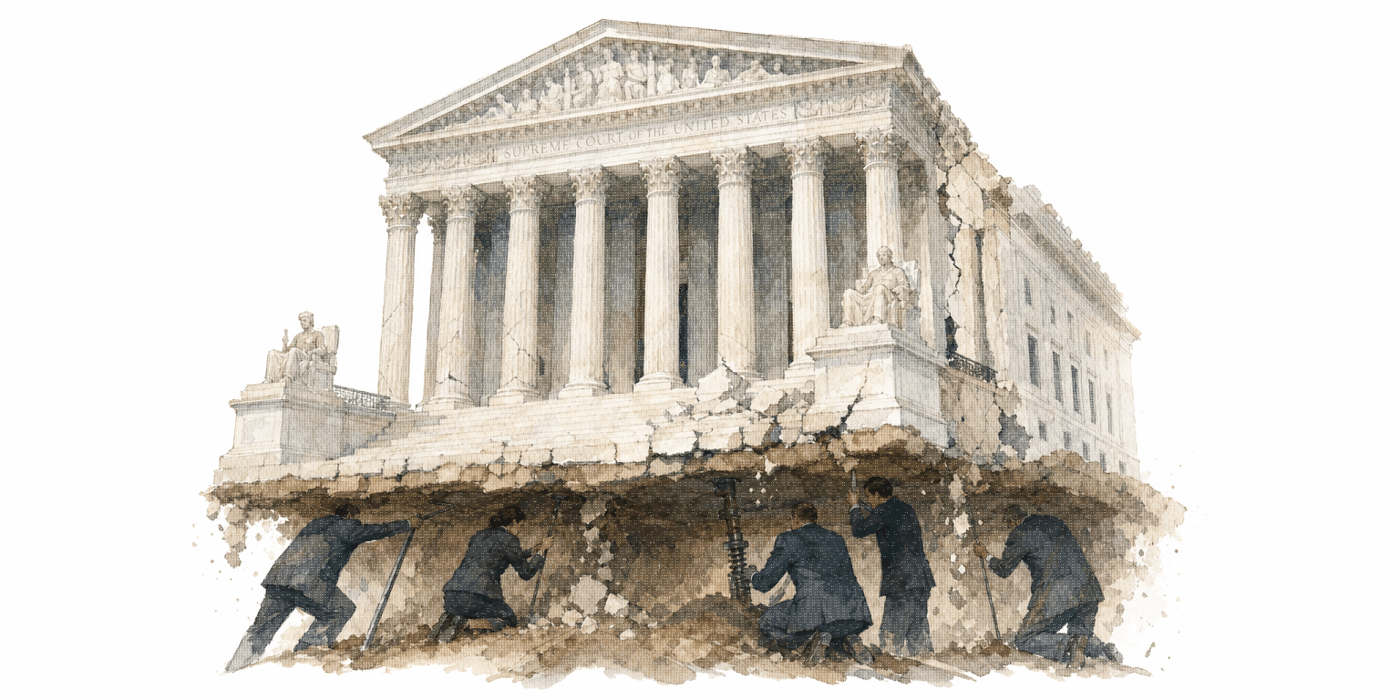

This week, the Supreme Court began a new term, and it is already fraught with conflict. Beyond a litany of daunting culture war cases, the justices seem embattled on all sides.
First, it is no secret that the radical Left would love to pack the Court and turn it into a partisan institution, whereupon it would officially lose all credibility. But it doesn’t help when President Donald Trump says counterproductive things.
When asked if he regretted the three appointments that he made (Justices Neil Gorsuch, Brett Kavanaugh, and Amy Coney Barrett), Trump responded, “Yeah. What can I do? I put them in. They voted against me too often. I ... gave them a position of a lifetime, and they vote against me often.”
As Washington Examiner contributor Arie Blitz pointed out:
A justice does not cast a vote for or against Trump. The fact that Trump appointed that justice should have no bearing on the legal analysis. The court decides cases involving statutes, constitutional provisions, executive power, precedent, and the arguments of litigants. Sometimes those decisions favor an administration. Sometimes they do not.
It is not personal.
The redeeming element of Trump’s comment came later. “No, I don’t want loyalty,” he added. “I want good decisions.” This reflects his genuine understanding that a Supreme Court justice should be loyal not to a particular party but to the Rule of Law and the Constitution.
Regardless, Trump would be better served shoring up the Court’s credibility instead of foolishly inveighing against his appointees. After all, many voters see those appointments as contributing to one of his greatest legacies: overturning Roe v. Wade.
Unfortunately, criticism from the president isn’t the only flagellation the justices have to endure. They also have to fend off personal attacks and unprofessionalism from one another. Florida State University political science professor Ryan J. Owens reports that Justices Sonia Sotomayor, Ketanji Brown Jackson, and Elena Kagan have all made personal allegations against their conservative colleagues; one suggests that emergency rulings aren’t legitimate, and another asserts that her role as a justice is to manipulate the law to bring about desired outcomes.
On September 16 at the University of Oklahoma, Sotomayor lamented the fact that students weren’t being taught civics and didn’t know their Constitution or how their government even worked. She then projected, “So that is my greatest fear: that people don’t understand our system of government. They don’t understand what the First Amendment means. Some of my colleagues don’t either, by the way. And I’m not joking about that.”
These are fine words of fearmongering that serve to delegitimize SCOTUS in the eyes of the students who were listening. According to a Marquette Law School poll, only 43% of respondents thought that the Court was doing a good job. Furthermore, a Reuters/Ipsos poll found that only 20% of Americans thought SCOTUS was politically neutral.
Part of that may be because many respondents don’t even know what the Supreme Court’s role is, and part of it may be because they are in lockstep with the Democrat justices’ ruling records. Either way, Sotomayor’s comments are not helping their cause.
Finally, we need to talk about Justice Samuel Alito. He is being badgered to retire, though at the age of 76, he is not the oldest justice on the Court; that would be Justice Clarence Thomas (78). Alito does seem to be considering retirement in the near future, but he believes he still has public service to perform. In an interview with CBS, he explained, “I think I can still make a contribution. And it’s hard to give up the opportunity to do something that I think will be good for the Constitution and good for the country as long as I’m able to do it.”
Some Republicans want Alito to retire before the midterms so he can be replaced with a similarly originalist-minded jurist and avoid being blocked by a potential Democrat-controlled Senate. Some worry that another Ruth Bader Ginsburg-like expiration could occur. Yet such badgering also undermines SCOTUS’s legitimacy as a nonpartisan entity.
Being a member of the highest court in the land is a pretty thankless job. It’s an even worse job when those who should be upholding its credibility actively undermine it. Hopefully we’re at rock bottom and things can only go up, but in the Washington, DC, swamp, that might be a vain hope.