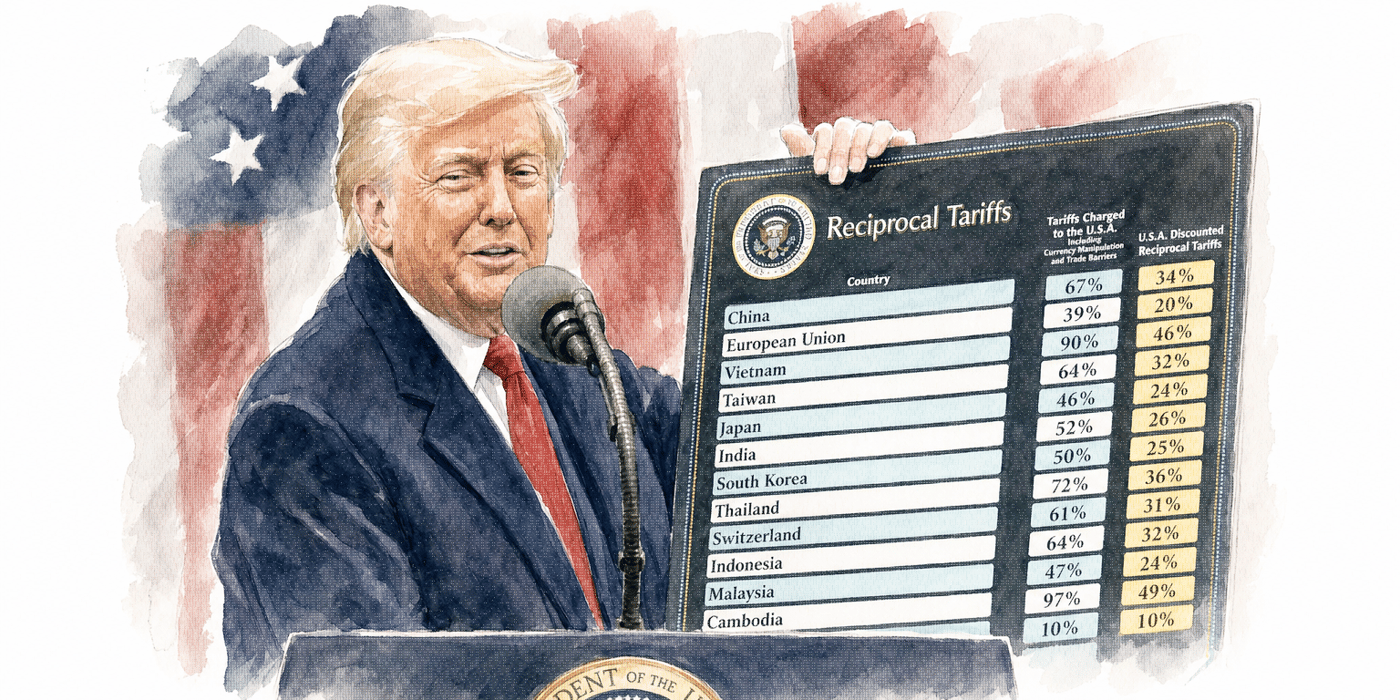

Back in February, the Supreme Court struck down President Donald Trump’s tariffs imposed through the International Emergency Economic Powers Act. But what has largely been ignored since the ruling is the extraordinary scale of those tariffs — and what that revenue could mean for American taxpayers.
Contrary to how the decision was often portrayed, the Supreme Court did not rule that Trump’s tariffs themselves were unconstitutional. The Court held that IEEPA did not authorize the president to impose tariffs. Congress created the law to give presidents broad economic powers during national emergencies, but the statute never expressly granted the president tariff authority. The Court concluded that such an enormous power could not simply be read into the law.
That ruling does not eliminate presidential tariff authority altogether. Numerous other statutes grant presidents the authority to impose tariffs under specific circumstances, including Sections 232 and 301, as well as other provisions of federal trade law. Even Justice Brett Kavanaugh, who dissented from the Court’s IEEPA ruling, noted that the decision might not substantially limit the president’s ability to impose tariffs going forward because other federal laws continue to provide that authority.
But the legal fight has overshadowed a much bigger economic story.
Companies are now seeking enormous refunds for tariffs paid under IEEPA. U.S. Customs and Border Protection has reportedly accepted approximately $128.7 billion in refund claims for processing — more than $128 billion that could be returned because the specific legal mechanism used to impose those tariffs was invalidated. And that represents only a portion of the revenue generated by Trump’s broader tariff policy.
In 2024, the federal government collected roughly $79 billion in customs duties. In 2025, tariff revenue surged to approximately $264 billion, despite many of Trump’s largest tariffs not taking effect until April and facing legal uncertainty throughout the year.
Democrats have spent years arguing that working Americans are struggling because billionaires and wealthy corporations do not pay their “fair share.” Their answer is almost always another tax increase followed by another government program.
Republicans should offer something much simpler: stop taxing working Americans so much in the first place.
Americans making $100,000 or less collectively pay roughly $275 billion to $300 billion each year in federal individual income taxes. Trump’s tariffs generated approximately $264 billion in 2025.
Those numbers are remarkably close.
If tariff revenue remained near that level — and Congress actually used the money to reduce taxes instead of creating another excuse to increase spending — it could theoretically offset almost the entire federal individual income-tax burden paid by Americans earning $100,000 or less.
That is a much more compelling working-class economic agenda than another debate over whether Washington should raise the top marginal tax rate.
The Left’s economic message increasingly relies on the claim that working Americans are struggling because the wealthy are not paying their “fair share.” But the top 1% already pay roughly 40% of all federal individual income taxes while earning a far smaller share of total adjusted gross income. Republicans should reject the Left’s obsession with taxing the wealthy more and instead focus on reducing how much Washington takes from Americans in the first place.
Tariffs can simultaneously generate federal revenue, create negotiating leverage against foreign governments, and encourage companies to manufacture more of their products in the United States.
Congress may soon give Trump another major opportunity to demonstrate exactly that.
The Senate recently passed the Lindsey O. Graham Sanctioning Russia Act of 2026, legislation developed to cut the revenue Russia receives from energy exports. Among its most consequential provisions is a new authority allowing the president to impose tariffs of up to 100% on goods from the five largest purchasers of Russian oil and gas, as well as on major countries that help Russia evade sanctions.
That is precisely the kind of congressional authorization that was missing under IEEPA. If the House passes the bill, Congress would be explicitly handing the president a powerful tariff weapon rather than asking him to derive one from emergency powers never written for that purpose.
President Trump’s tariffs showed enormous potential, and their long-term effects are only beginning to become clear. If Trump continues using tariffs in the second half of his term while pairing the revenue with meaningful tax relief for working Americans, Republicans could enter 2028 with something voters can actually feel: lower taxes, stronger domestic production, and more money in their pockets.