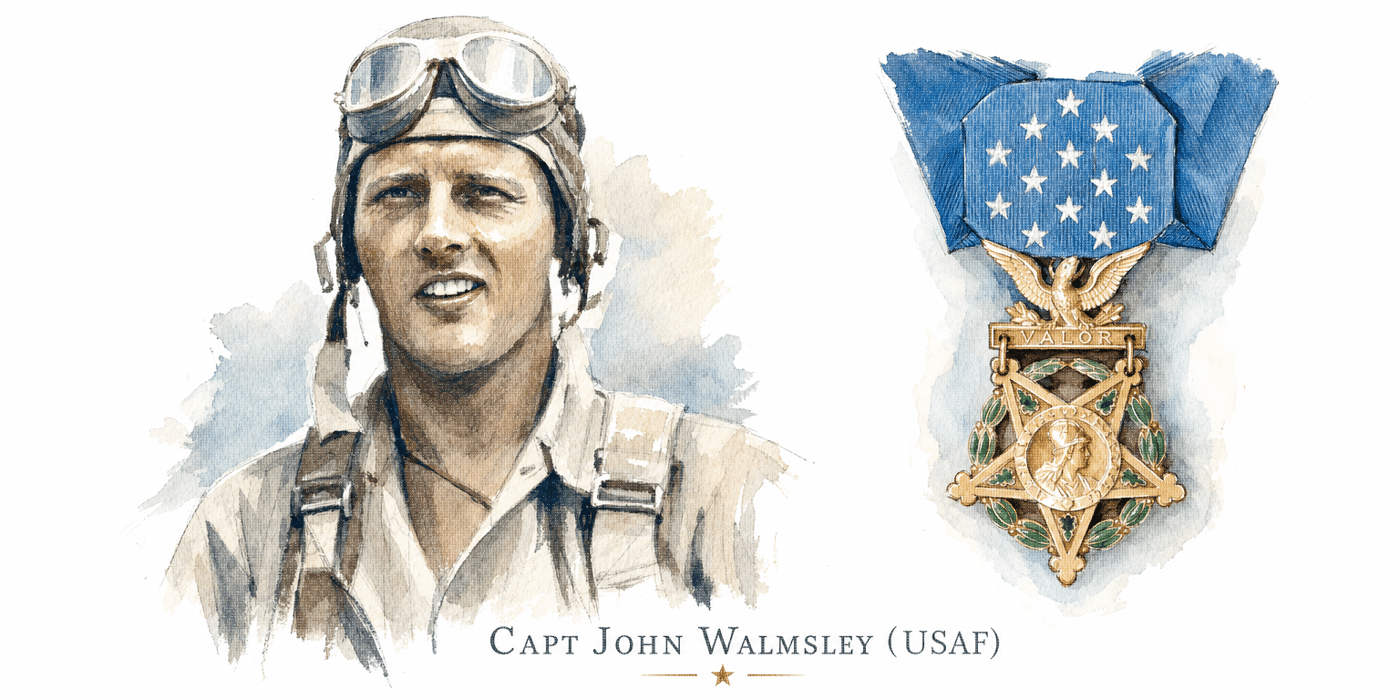

John S. Walmsley Jr. was a native of Baltimore, Maryland. After graduating from high school in Silver Springs, he attended the University of Maryland. In 1941, he married Flora Catherine O’Malia shortly before the attack on Pearl Harbor.
A year later, the 21-year-old enlisted in the Army Air Force and was assigned to pilot training first at Maxwell Field in Alabama and then at Turner Field in Georgia, where he received his wings and commission in November of 1943. He then served as an instructor pilot at Turner until 1946, when he was part of the post-war occupation of Japan.
After completing training at the Air Tactical School at Tyndall Air Force Base, Florida, in 1949, Walmsley became a specialist with air control and warning squadrons. He was then assigned to the 52nd Fighter Wing “Fighting Hawks” at McGuire AFB in New Jersey, flying the all-weather North American F-82 Twin Mustangs.
In June 1951, he deployed to Korea with the 8th Bomb Squadron Blackbirds of the 3rd Bomb Group Grim Reapers, Fifth Air Force, flying the B-26 Night Invaders, and was well liked and respected by his fellow pilots and crews. He was part of a new interdiction strategy designed to find and attack supply lines at night using arc lights mounted to the starboard wing of Invaders. These 80 million candlepower lights would illuminate enemy supply trains, but also made the Invaders marks for anti-aircraft fire. The NoKos and Chinese communists were well equipped with mobile anti-aircraft weapons, which traveled with the supply lines in order to attack the Invaders.
On 14 September 1951, then-Capt Wamsley, having already completed 20 night combat missions using the arc light, volunteered with three of his crew for a high-risk night mission over Yangdok, North Korea, part of Operation Strangle. Two days earlier, Walmsley had flown a successful mission destroying many transport trucks and forcing others off the road.
On the night of the 14th, he launched alone from Kunsan Air Base in South Korea in his plane “Skillful 13” to search for truck convoys. Over his search area, Walmsley spotted an enemy supply train moving on a major supply route, a high-value target. Without using his arc light, he immediately attacked, disabling the engine and rail cars but not destroying them. He called for another B-26 in his flight to finish the job, and once it reached his location, Walmsley turned on his arc light to guide the second bomber to the target.
Flying low over the train and lighting it up three times, on his third pass with his light ablaze, Skillful 13 suffered heavy ground fire, and the crew of four crashed into the nearby mountains, killing Wamsley, his navigator/bombardier, 2d Lt William Mulkins, and his target photomapper, Capt Philip Browning. His gunner, MSgt George Moror, was the sole survivor, taken prisoner and released after the war.
Though at a high cost, the supply train locomotive and its deadly cargo were destroyed.
The 3rd Bomb Wing flew both the first and last bombing missions over North Korea, the latter only minutes before the ceasefire of 27 July 1953.
For his actions, Walmsley became the first bomber pilot to earn the Medal of Honor for actions in Korea, and one of only four USAF personnel to receive the award in that conflict — the others were also pilots. They received the Army version of the MoH because the USAF version had yet to be created and was not awarded until Vietnam. Each of Walmsley’s crew received the Distinguished Flying Cross for extraordinary heroism.
His Medal of Honor citation concludes:
In his determination to inflict maximum damage on the enemy, he refused to employ evasive tactics and valiantly pressed forward straight through an intense barrage, thus insuring complete destruction of the enemy’s vitally needed war cargo ... His heroic initiative and daring aggressiveness in completing this important mission in the face of overwhelming opposition and at the risk of his life, reflects the highest credit upon himself and the U.S. Air Force.
His widow, Flora Katherine, and their two daughters — nine-year-old Amy and three-year-old June — received his Medal of Honor at a ceremony in June of 1954 at Bolling AFB in Washington, DC.
John Walmsley is memorialized at Arlington National Cemetery, in addition to the Korean War Veterans Memorial in Washington, DC, and on the Courts of the Missing at the National Memorial Cemetery of the Pacific.
Capt John Walmsley: An ordinary man faced with extraordinary circumstances, he summoned the greatest measure of courage to place his life and those of his crew in imminent peril to complete a critical mission. Their example of valor — humble American Patriots defending Liberty for all above and beyond the call of duty — is eternal. Live your life worthy of their sacrifice.
“Greater love has no one than this, to lay down one’s life for his friends” (John 15:13).
Join us in daily prayer for our Patriots in uniform — Soldiers, Sailors, Airmen, Marines, and Coast Guardsmen — standing in harm’s way in defense of American Liberty, and for our nation’s Veterans, First Responders, and their families.
(Read more Profiles of Valor here.)
Semper Vigilans Fortis Paratus et Fidelis
Pro Deo et Libertate — 1776
Please consider a designated gift to support the National Medal of Honor Sustaining Fund’s character education initiatives through Patriot Foundation Trust’s online donor page, or by check payable to “NMoH Sustaining Fund” and mail it to:
Generosity Trust
National MOH Sustaining Fund
345 Frazier Avenue, Unit 205
Chattanooga TN 37405
Thank you for supporting The Patriot Post, our nation’s premier journal of American Liberty.
The Patriot Post and Patriot Foundation Trust — Liberty Fund, in keeping with our Military Mission of Service to American Patriots in uniformed service and veterans, are proud to support and promote the National Medal of Honor Heritage Center, the Congressional Medal of Honor Society, both Honoring Their Sacrifice Foundation and Warrior Freedom Service Dogs aiding wounded veterans, Tunnel to Towers Foundation, the National Veterans Entrepreneurship Program, Folds of Honor, Officer Christian Fellowship outreach, the Air University Foundation and Naval War College Foundation, and the Naval Aviation Museum Foundation.