
Two hundred and fifty years ago, men in powdered hair and knee breeches did what no colony had ever done successfully. They broke away from the most powerful empire on earth. They were not bloodthirsty radicals. They had petitioned again and again to remain loyal subjects of the Crown. They fought for what was already theirs.
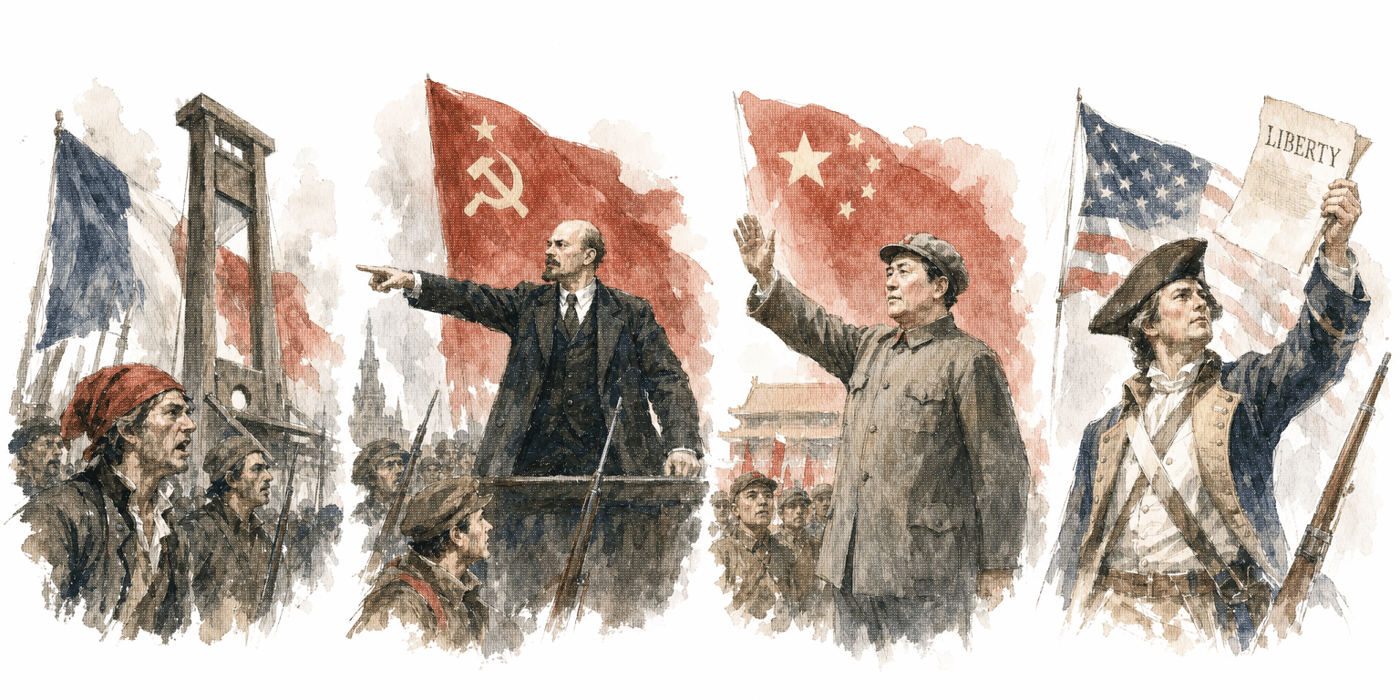
Now look at the revolutions. Ours in 1776. France in 1789. Russia in 1917. China in 1949. Four attempts to tear down an old order and build something new. Only one ended in liberty. Only one.
The French stormed the Bastille shouting about the rights of man, and within five years they had the Terror, the guillotine running like a factory, Robespierre feeding his friends to the blade until the blade came for him. They meant to remake mankind, and when mankind would not cooperate, they started shortening people by a head. The Russians promised bread, peace, and land and delivered famine, the Gulag, and a man who murdered more of his own people than Hitler murdered of anyone. The Chinese promised the workers a paradise and gave them a Great Leap Forward that starved 40 million people and a Cultural Revolution that turned children into informants against their parents. Terror. Mass murder. Dictatorship. Every single time.
And ours? King George said that if Washington gave the power back, he would be the greatest man in the world. He gave it back and went home to Mount Vernon. Every other revolution produced a strongman. Ours produced a farmer who wanted to go home.
Why the difference? We did not set out to remake man. The French, the Russians, and the Chinese believed they could perfect human nature by breaking enough eggs. Our founders believed the opposite: that man is sinful, that power corrupts, that no one can be trusted with unchecked authority. So they built a system that assumes the worst about us and dedicated the nation not to a perfect man but to a proposition — that all men are created equal, endowed by their Creator. Not by the state, not by the party, not by the revolution, which means no revolution can take those rights away.
And our sins? Slavery was the original sin, and I will not sand it down. Jefferson knew it, and he owned slaves. The hypocrisy stared right at them, and they kept kicking the can down the road. But here is what a poisoned telling of our history leaves out: the New England colonies began rejecting slavery before England did. And when the reckoning came, hundreds of thousands of men died on battlefields to make other men free. “As He died to make men holy, let us die to make men free,” read the original lyrics of the “Battle Hymn of the Republic.” That is propitiation. One man suffers so another goes free. A nation that will bleed that much to right its own wrong is not an evil nation. It is a great one, straining toward a more perfect one.
It is also why people are willing to die to get here. And I mean die. They pile into boats with no business on open water. Nobody is dying to break into Russia. Nobody is stacking themselves into a shipping container to reach the People’s Republic of China. The traffic has run in one direction for 250 years. A refugee understands what a tenured professor cannot: he has seen the alternatives up close, and the professor has only read about them in a book he misunderstood.
John Winthrop’s city on a hill was not a boast. It was a warning. The eyes of all people are upon us. Being the shining city is not a participation trophy. It is a job. A city on a hill cannot decide to stop being on the hill. It can only decide whether to shine or to go dark.
We did not earn the right to quit. We earned the obligation to lead — the moment we wrote down that all men are created equal and then, imperfectly and at horrific cost, actually tried to live up to it. No other nation ever staked its existence on a sentence like that.
COPYRIGHT 2026 CREATORS.COM