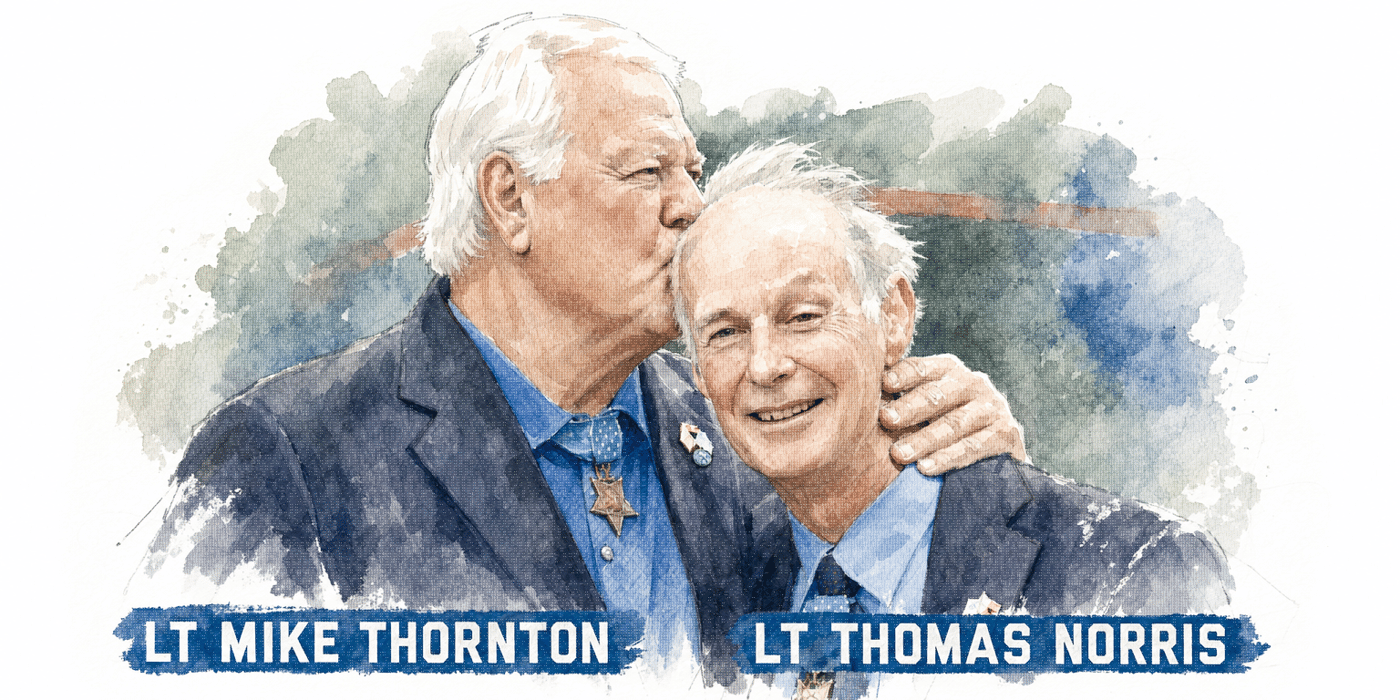

Thomas Norris is a native of Jacksonville, Florida, but he grew up in Wisconsin and Washington, DC.
As a young man, he excelled in civics, academics, and sports. He attained the rank of Eagle Scout in the BSA. After graduating from Montgomery Blair High School in Silver Spring, Maryland, in 1963, he enrolled at the University of Maryland, where he was an Atlantic Coast Conference college wrestling champion in 1965 and 1966. He earned a Bachelor of Science degree in sociology with a specialty in criminology in 1967, aspiring to become an FBI agent.
When at U of M, he enlisted in the Navy after his student draft deferment was not extended. He wanted to become a Naval Aviator but his vision kept him out of an aviation track, so he set another lofty goal for himself — to become a Navy SEAL. And he did just that.
After graduating from BUD/S class 45 in July 1969, he completed his first tour in Vietnam with Fifth Platoon, SEAL Team TWO. Early in that deployment, he earned a Bronze Star (Valor).
In 1972, during his second deployment with MACVSOG Danang Naval Advisory Detachment, he was one of the few SEALs remaining in Vietnam. In April, after an Air Force LTC was shot down behind enemy lines, initial aerial combat search and rescue operations were unable to get to the pilot. That resulted in the largest rescue mission in Air Force history — and the bloodiest of such operations during Vietnam, with five more aircraft being shot down and 11 airmen killed. That failed operation also left two additional Americans needing rescue.
Norris was tasked with mounting the ground operation to get the Americans to safety. Working with three other SEALs and five SVA Navy commandos, he and Republic of Vietnam Navy Petty Officer Nguyen Van Kiet led their team deep behind enemy lines and were able to rescue two of the Americans. The third airman was killed by NVA forces.
Though Norton first rejected being nominated for a Medal of Honor, he eventually accepted the award on behalf of his fellow warriors.
According to his MoH citation:
On the night of 10 April, he led a five-man patrol through 2,000 meters of heavily controlled territory, located one of the downed pilots at daybreak, and returned to the Forward Operating Base (FOB). On 11 April, after a devastating mortar and rocket attack on the small FOB, Lt. Norris led a three-man team on two unsuccessful rescue attempts for the second pilot. On the afternoon of the 12th, a forward air controller located the pilot and notified Lt. Norris. Dressed in fishermen disguises and using a sampan, Lt. Norris and one Vietnamese traveled throughout the night and found the injured pilot at dawn. Covering the pilot with bamboo and vegetation, they began the return journey, successfully evading a North Vietnamese patrol. Approaching the FOB, they came under heavy machine-gun fire. Lt. Norris called in an air strike which provided suppression fire and a smoke screen, allowing the rescue party to reach the FOB.
His citation concludes: “By his outstanding display of decisive leadership, undaunted courage, and selfless dedication in the face of extreme danger, Lt. Norris enhanced the finest traditions of the U.S. Naval service.”
Notably, six months later, in October of ’72, Norris and fellow SEAL LT Michael Thornton, also a Medal of Honor recipient whom I previously profiled here, conducted intelligence gathering with three South Vietnamese special forces soldiers. They initially approached the DMZ area at night by sea, then transferred to a local junk, swam the final mile to shore, and worked their way inland. The next day they realized they were five clicks north of the DMZ in North Vietnam.
As they tried to move back south toward the DMZ, NVA soldiers spotted the five-man team and alerted others; over the next four hours, Norris, Thornton, and their team held ground against an estimated 200 enemy soldiers. They survived with help from naval bombardments Norris called in. In their effort to exfil the area, Norris covered their retreat from the rear until suffering a severe head wound. When Thornton realized Norton was down, he boldly ran through enemy fire to retrieve his unconscious SEAL brother, killing enemy soldiers as he returned to the shoreline with Norris slung over his shoulder.
Thornton, who is a giant of a man, took Norris and one of the injured South Vietnamese commandos into the surf, where he supported both men for almost two hours before they were picked up by the same junk that had dropped them off 24 hours earlier.
This was the first recorded case of one Medal of Honor recipient being rescued by another. Needless to say, Mike and Tommy have remained friends ever since. (Their story is featured in the book By Honor Bound by former SEAL Dick Couch.)
Norris was medically discharged after losing an eye and suffering a severe skull fracture. His recovery took almost three years, and he endured multiple surgeries.
In 1979, Norris applied for a job as a Special Agent with the FBI, his original goal a decade earlier. Seeking a waiver for his injuries, then-FBI Director William Webster declared, “If you can pass the same test as anybody else applying for this organization, I will waive your disabilities.” Norris did just that and spent the next 20 years with the Bureau, including being one of the original members of the FBI’s Hostage Rescue Team as an assault leader.
In typical humility, Norris says: “I’m just a custodian of this medal. I wear it for the members of my teams and the people that served as valiantly and will never have the chance to wear an award like that. There are those out there who deserved it but were never recognized, and the folks that gave their lives for the missions they were sent on who will never be back again. It’s an honor for me to wear it, but I don’t consider it mine.”
In his honor, at Joint Expeditionary Base Little Creek, Fort Story in Virginia, the home of Naval Special Warfare Group Two, which includes multiple SEAL Teams, is housed in the LT Thomas R. Norris Building.
LT Thomas R. Norris: An ordinary man faced with extraordinary circumstances, he summoned the greatest measure of courage, placing his life in imminent peril to save others. His example of valor — a humble American Patriot defending Liberty for all above and beyond the call of duty — is eternal. Live your life worthy of his sacrifice.
“Greater love has no one than this, to lay down one’s life for his friends.” (John 15:13)
Join us in daily prayer for our Patriots in uniform — Soldiers, Sailors, Airmen, Marines, and Coast Guardsmen — standing in harm’s way in defense of American Liberty, and for our nation’s Veterans, First Responders, and their families.
(Read more Profiles of Valor here.)
Semper Vigilans Fortis Paratus et Fidelis
Pro Deo et Libertate — 1776
Please consider a designated gift to support the National Medal of Honor Sustaining Fund’s character education initiatives through Patriot Foundation Trust’s online donor page, or by check payable to “NMoH Sustaining Fund” and mail it to:
Generosity Trust
National MOH Sustaining Fund
345 Frazier Avenue, Unit 205
Chattanooga TN 37405
Thank you for supporting The Patriot Post, our nation’s premier journal of American Liberty.
The Patriot Post and Patriot Foundation Trust — Liberty Fund, in keeping with our our Military Mission of Service to American Patriots in uniformed service and veterans, are proud to support and promote the National Medal of Honor Heritage Center, the Congressional Medal of Honor Society, both Honoring Their Sacrifice Foundation and Warrior Freedom Service Dogs aiding wounded veterans, Tunnel to Towers Foundation, the National Veterans Entrepreneurship Program, Folds of Honor, Officer Christian Fellowship outreach, the Air University Foundation and Naval War College Foundation, and the Naval Aviation Museum Foundation.