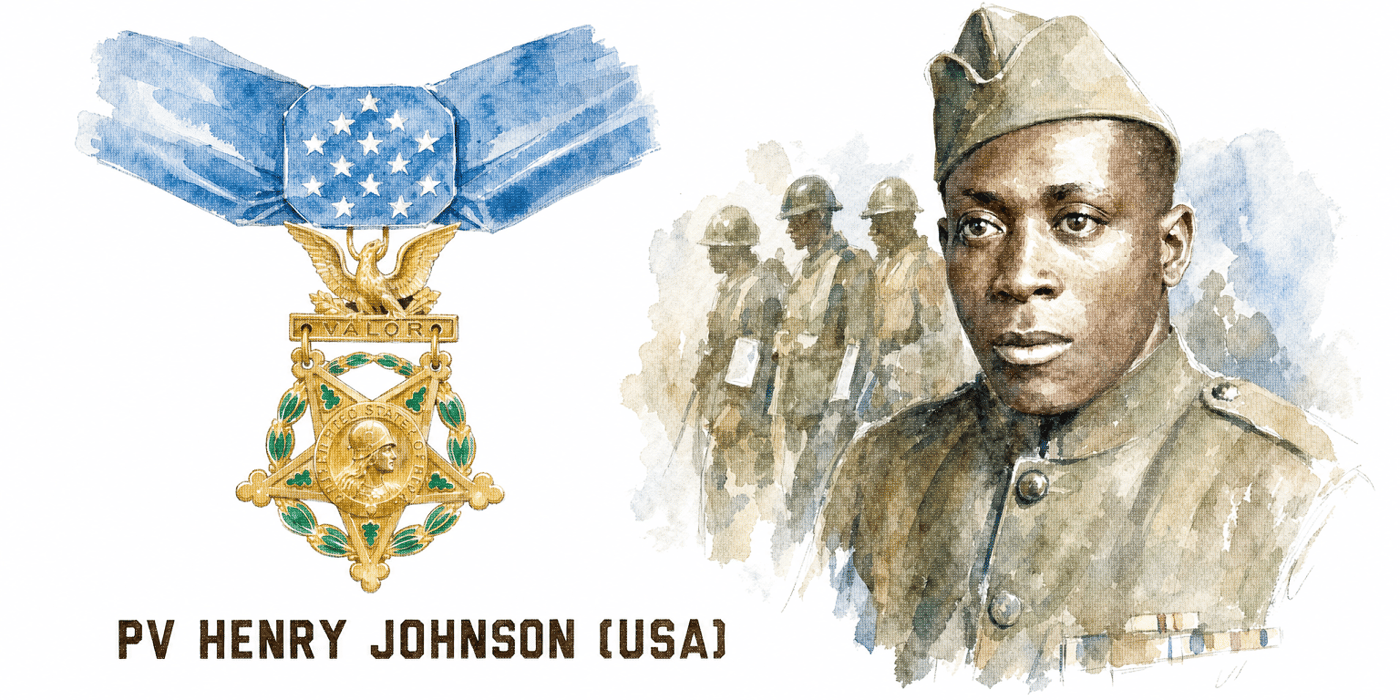

Henry Johnson was a native of Winston-Salem, North Carolina, the son of tobacco farmers. His family moved to Albany, New York, when he was 14, and in the years leading up to World War I, he held a variety of jobs, including soda mixer and redcap porter at the Albany Union Station.
In 1917, the U.S. passed the Selective Service Act, which required all men ages 21 to 30 to register for the draft. Henry enlisted in the Army in June 1917 at age 25, two months after the U.S. entered World War I. He was initially assigned to the all-black New York National Guard’s 15th Infantry Regiment base in Harlem, which was designated the 369th Infantry Regiment once federalized as part of the segregated 93d Infantry Division. The 15th Regiment was formed in 1864, notably to quell rebellions in New York by those rioting against the Civil War draft.
On arrival in France, the 369th joined the 185th Infantry Brigade and would soon gain fame as the Harlem Hellfighters. Despite Henry’s small stature, the 5-foot-4-inch, 130-pound soldier became the most famous among the Hellfighters and earned the nickname “Black Death” for his fearless defense of Allied lines.
By March 1918, the 369th was in combat under the command of MG John J. Pershing, who himself had served with the all-black 10th Cavalry — the origin of his nickname, “Black Jack.” Pershing assigned the 369th to serve with French forces, which struggled to find replacements because of high casualty rates. Despite the segregation and discrimination that the unit experienced in New York, the 369th was accepted as an equally qualified regiment by the French, whose forces included many non-white colonial units. They were equipped with French helmets and rifles before deploying to the Argonne Forest with the French 161st Division.
Henry would not see combat until the night of May 15th, when his heroic actions, despite his 21 injuries, would save the lives of many others.
Accounts of his actions and those of his friend Needham Roberts made headlines in New York in days that followed: “Two New York Negro Soldiers Foil German Assault” declared the New York World on May 20th, and likewise, the New York Sun posted, “Pershing Praises Brave Negroes.”
However, Henry would not be fully recognized for his actions for almost a century.
The 369th served 191 days in trench warfare combat — the longest combat deployment of any American unit. They suffered heavy losses in the American drive in the Meuse-Argonne in September 1918, six weeks before the 11-11-11 Armistice.
On February 17, 1919, the 2,900 men of the 369th Infantry Regiment were the first New York soldiers to return home, and they did so to a roaring welcome. They marched from Washington Square Park Arch up Fifth Avenue to their Harlem armory.
News accounts in The New York Times noted: “New York City residents, both white and black, packed the streets as they paraded up Fifth Avenue. ... Thousands and thousands of rattlesnakes, the emblem of the 369th, each snake coiled, ready to strike, appeared everywhere, in buttonholes, in shop windows and on banners carried by the crowd.”
The Times estimated that 10,000 people waited outside the Harlem armory and “all the spaces about the Armory were packed with negro women and girls.”
The New York Sun noted: “By the time the men reached 135th Street they were decorated with flowers like brides, husky black doughboys plunking along with bouquets under their arms and grins on their faces that one could see to read by. The fathers and mothers and wives and sweethearts of the men would no longer be denied and they swooped through police lines like water through a sieve. The Soldiers were too well trained to break ranks but when a mother spied her son and threw her arms around his neck with joy at getting him back again, he just hugged her off her feet.”
The men of the 369th anticipated that their service would alleviate some of the discrimination they had previously suffered in New York, and it did. Moreover, it certainly demonstrated that these men were as capable of valiant service as any men in uniform.
Once home, however, Henry was unable to return to his pre-war porter job because of his injuries. Of his service, he shunned any suggestion that he was a hero, saying: “There wasn’t anything so fine about it. Just fought for my life. A rabbit would have done that.”
He was rated disabled and was later granted a “permanent and total disability” rating after contracting tuberculosis. He received monthly compensation and medical attention from Veterans Affairs medical personnel until his death on July 1, 1929. He was buried at Arlington National Cemetery on July 6, 1929.
Thanks to advocates dedicated to correcting the record and ensuring black soldiers were appropriately recognized for their service, Henry was posthumously awarded two Purple Hearts in 1996 and a Distinguished Service Cross in 2002. But his final recognition came in 2015, when his DSC was upgraded to a Medal of Honor, which was received on his behalf by New York National Guard Command Sergeant Major Louis Wilson.
According to his Medal of Honor citation:
Private Henry Johnson distinguished himself by extraordinary acts of heroism at the risk of his life above and beyond the call of duty while serving as a member of Company C, 369th Infantry Regiment, 93d Infantry Division, American Expeditionary Forces on May 15, 1918, during combat operations against the enemy on the front lines of the Western Front in France. In the early morning hours, Private Johnson and another soldier were on sentry duty at a forward outpost when they received a surprise attack from a German raiding party consisting of at least 12 soldiers. While under intense enemy fire and despite receiving significant wounds, Private Johnson mounted a brave retaliation, resulting in several enemy casualties.
His citation continues:
When his fellow soldier was badly wounded and being carried away by the enemy, Private Johnson exposed himself to grave danger by advancing from his position to engage the two enemy captors in hand-to-hand combat. Wielding only a knife and gravely wounded himself, Private Johnson continued fighting, defeating the two captors and rescuing the wounded soldier. Displaying great courage, he continued to hold back the larger enemy force until the defeated enemy retreated leaving behind a large cache of weapons and equipment and providing valuable intelligence. Without Private Johnson’s quick actions and continued fighting, even in the face of almost certain death, the enemy might have succeeded in capturing prisoners and the outpost, without abandoning valuable intelligence.
His citation concludes: “Private Johnson’s extraordinary heroism and selflessness above and beyond the call of duty are in keeping with the highest traditions of the military service and reflect great credit upon himself, Company C, 369th Infantry Regiment, 93d Infantry Division and the United States Army.”
Notably, Henry was the first American to receive the French Croix de Guerre, France’s highest award for valor.
You can listen to his story here.
PV Henry Johnson: An ordinary man faced with extraordinary circumstances, he summoned the greatest measure of courage, placing his life in imminent peril to save others. His example of valor — a humble American Patriot defending Liberty for all above and beyond the call of duty — is eternal. Live your life worthy of his sacrifice.
“Greater love has no one than this, to lay down one’s life for his friends.” (John 15:13)
Join us in daily prayer for our Patriots in uniform — Soldiers, Sailors, Airmen, Marines, and Coast Guardsmen — standing in harm’s way in defense of American Liberty, and for our nation’s Veterans, First Responders, and their families.
(Read more Profiles of Valor here.)
Semper Vigilans Fortis Paratus et Fidelis
Pro Deo et Libertate — 1776
Please consider a designated gift to support the National Medal of Honor Sustaining Fund’s character education initiatives through Patriot Foundation Trust’s online donor page, or by check payable to “NMoH Sustaining Fund” and mail it to:
Generosity Trust
National MOH Sustaining Fund
345 Frazier Avenue, Unit 205
Chattanooga TN 37405
Thank you for supporting The Patriot Post, our nation’s premier journal of American Liberty.
The Patriot Post and Patriot Foundation Trust — Liberty Fund, in keeping with our our Military Mission of Service to American Patriots in uniformed service and veterans, are proud to support and promote the National Medal of Honor Heritage Center, the Congressional Medal of Honor Society, both Honoring Their Sacrifice Foundation and Warrior Freedom Service Dogs aiding wounded veterans, Tunnel to Towers Foundation, the National Veterans Entrepreneurship Program, Folds of Honor, Officer Christian Fellowship outreach, the Air University Foundation and Naval War College Foundation, and the Naval Aviation Museum Foundation.