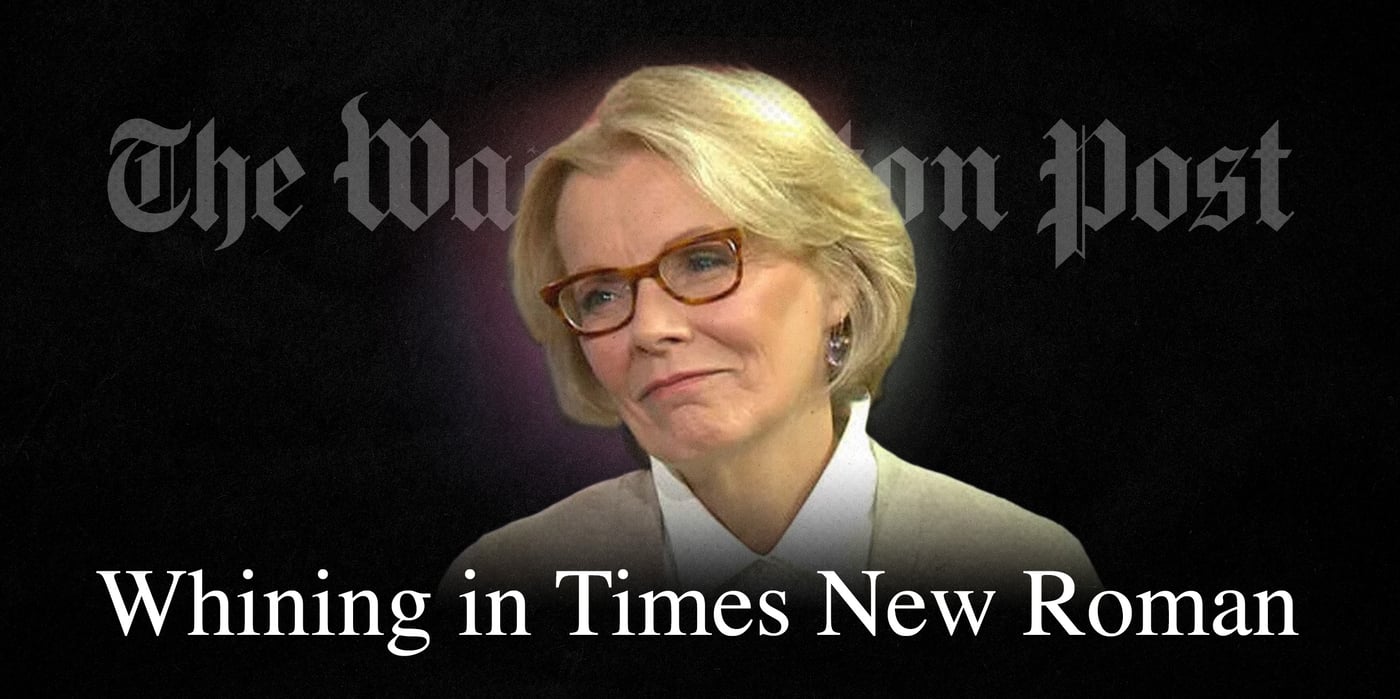

Not only has Peggy Noonan lost the plot in her latest article, but she has also lost the people who care about truthful journalism. Her “Lament for the Washington Post” as a “pillar” in journalism is laughable and lame, as those of us with eyes could clearly see the leftist propaganda the Post has been pushing for decades — even harder and angrier since Donald Trump launched his first presidential bid.
Noonan is talking about the recent layoffs at the Post, and she worries that the paper will die (in darkness).
Peggy Noonan is a Pulitzer Prize-winning columnist, and we carried her columns with her permission for many years. She was a talented speechwriter for Ronald Reagan. But what Noonan views as a loss and a “demoralizing thing in our national life” we call a win for real journalism that seeks to tell the truth and not tell you what to think. She labels the Leftmedia the “grown-ups,” “professional,” and “reputable,” calling what they do “vital” to the functioning of a free nation. I agree that a press free from lies and partiality is crucial for any nation that claims to be free, but the Post was far from that.
Aside from all the fawning over the “greatness and expertise” of a failing newspaper, what Noonan doesn’t seem to realize is that she said the quiet part out loud. She writes, “Reaction shouldn’t break down along ideological lines, in which the left feels journalism is its precinct and is sad, and the right feels journalism is its hulking enemy and isn’t sad.” Yet the mainstream media has been the Left’s territory, which means that it’s not just about “getting information” as she claims but about carrying water for the Democrat Party. It’s no wonder the Right “feels journalism is its hulking enemy” — because it is.
Noonan then hails a time that hasn’t existed in most media companies for quite some time. “It takes years to make good reporters,” she explains, “people who are trained, who love getting the story so much, who love the news so much, that they will wade into the fire, run to the sound of the guns. They are grown only in newsrooms, not at home with laptops. They are taught by older craftsmen and professionals, through stories and lore.”
When was the last time we saw any of these intrepid reporters actually on the ground doing any sort of real journalism instead of painting a picture of what they want you to see? And no, reporters haven’t been “grown in newsrooms” or “taught by older craftsmen” probably since color television was invented. Rather, they get “journalism” degrees from the indoctrination factories called universities.
National Review’s Charles C.W. Cooke tells it like it is: “As is true of academia and labor unions, journalism these days is mostly a front for progressivism, and its preferred political vehicle, the Democratic Party, and most journalists are impressionable, excitable, venal, partisan types who are susceptible to the worst forms of groupthink and conformity.”
Noonan mentions the Post’s owner, Jeff Bezos, but only to criticize his restructuring of the paper, bemoaning that it “can’t be replaced.” She says, “You can’t snap your fingers, wash away a whole world, erect a new one, and have it work well and quickly.” I think Bezos, who built a business empire, would beg to differ. It might behoove Noonan to look at the facts and information, as good reporters should, such as the $177 million the paper was hemorrhaging in 2023-2024. If the editors had instead made better business decisions about how to make the paper profitable, as The New York Times did, they might not be in this predicament. The Times added value and appeal to its organization by acquiring assets such as The Athletic, Wire Cutter, and Wordle. It also smartly expanded the cooking section to increase engagement and subscriptions. As many have pointed out, The Washington Post is not a nonprofit, and Bezos is not obligated to run the business like a charity.
But of course, Noonan goes right to the pearl-clutching and fearmongering about how this will “have an impact on our democracy,” and that, without the Post’s monitoring, “the capital of the most powerful nation in the world ... is a danger and a threat.” Hate to burst her bubble, but our Republic will survive without the Post and will actually be better off without its self-righteous censorship, cover-ups, and coloring.
Cooke cuts to the chase of the whining in Times New Roman: “What was lost ... was not America’s soul but yet another division of the mediocre worker bees who staff the sprawling progressive blob that we mistake for our national institutions.”
Contrary to Noonan’s fear that “few people really care about journalism,” people who want the truth actually do care, which is why they stopped listening to the Left’s version on everything. It’s why podcasts exploded. It’s why what we have been doing here at The Patriot Post for the past 30 years is so crucial and valuable, and why continuing in our path of journalistic truth remains essential.
As David Strom at Hot Air observes, “The media is not dying because Donald Trump and MAGA killed it or that the economic model changed, but because it killed itself. Lamenting the imminent death of The Washington Post, should it actually die, is as rational as lamenting the death of the old Soviet version of Pravda.” The lies that live in darkness can only survive so long until they are exposed by the light of the truth.
It seems what she is really lamenting is the death of the Left’s jurisdiction in journalism and absolute power over the narrative. She is right on one thing, though: “If citizens are informed, they can self-govern from a rough baseline of realism.” But the crux of the matter is whether they are fallaciously informed or truthfully informed. She referenced Thomas Jefferson as saying that “the good sense of the people ... is the best army,” allowing that they can be “led astray,” but their mistakes will be limited and can be corrected through information that can “penetrate the whole mass of the people.”
Well, Jefferson also called newspapers “chimnies to carry off noxious vapors and smoke.”
We’ll take the layoffs at The Washington Post as a sign that the truth has penetrated “the whole mass of the people” and that this is just part of the correction to being led astray.