
During the years from 1607 — when Jamestown became the first permanent colony — until the French and Indian War (1756-1763), Great Britain had functioned as an absentee landlord in dealing with the 13 colonies. While some colonies had royal governors, others had proprietary leaders, and each generally functioned individually with little direct interference from the crown or Parliament. That it until the cost of the French and Indian War drove the English treasury into debt and Parliament decided those debts could best be financed by taxing the English colonists for whom the funds had been spent. After all, sending the British army to the colonies had guaranteed the success of the war against France in North America.
Right?
The English colonists, from New Hampshire to Georgia, scoffed at the idea that the British had shown any expertise in frontier fighting. In reality, the colonial fighters had been able to “teach” some British units a new style of fighting that did not involve rigid line of formation for attack or sporting red coats, although no units ever broke protocol. Instead, the colonial fighters believed that the British troops had actually created losses for both crown and colonial forces. Their inability to adapt to the improvised method of fighting that the French had also learned from their native allies placed the British-colonial forces at a disadvantage, and needless lives had been sacrificed.
To then have Great Britain enact the Proclamation of 1763 and limit migration beyond the Alleghenies and the Appalachians into the territories won at a high cost — with no input from the colonists — countered centuries of English tradition.
Had the leaders in Parliament and King George III forgotten what had happened at Runnymede on June 12, 1215? Did no one in authority recall King John I signing the Magna Carta?
Well, the leaders in the English colonies had not forgotten the significance of that document!
John Adams, Thomas Jefferson, Patrick Henry, George Mason, and others referenced the Magna Carta in speeches during the months following the passage of the hated Proclamation of 1763. Like the nobles of 13th-century England, leaders in New England town hall meetings and in southern legislative bodies like Virginia’s House of Burgesses drew attention to the charter limiting the power of the monarch.
In the simplest of terms, the Magna Carta had established that the monarch was not above the law. It required the prompt administration of justice in all matters and established the principle of due process. (It also forbade the sale of justice.) It specifically prohibited the king from introducing any new form of taxation without consent of the nobles. The precepts of the Magna Carta were included in Elizabeth I’s 1578 grant to Sir Humphrey Gilbert, and later charters included a key provision: all rights of Englishmen were retained by English colonists under the concept of common law. Colonial charters also guaranteed the right to elect legislatures that would enact the laws approved by the duly elected delegates of each colony. True to those beliefs, Virginia had established its House of Burgesses in 1619, only 12 years after Jamestown.
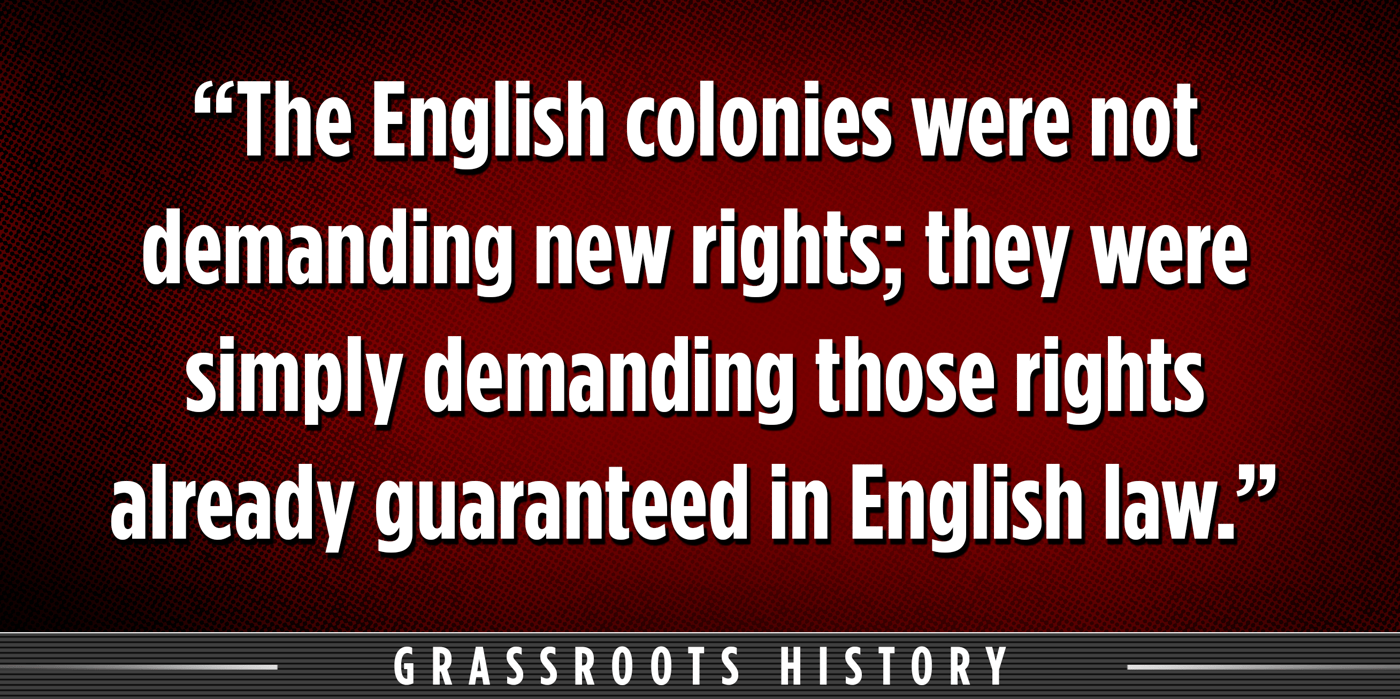
The English colonies were not demanding new rights; they were simply demanding those rights already guaranteed in English law, first enshrined in the Magna Carta.
The tradition of self-government continued the following year with the signing of the Mayflower Compact, the founding document of the Plymouth Colony in Massachusetts. The 41 adult males who signed the 200-word document agreed to establish a “civil body politic” for self-governance for the 102 Pilgrims and “stranger” passengers. The members of the colony were bound to obey “just and equal laws” that would promote the general good. The first “constitution” in the English colonies created a foundational, democratic, and voluntary social contract among equals with an elected governor, William Bradford.
But the tradition of “rights” did not end there.
Following Elizabeth I’s death in 1603, the English crown had passed to her cousin, son of Mary, Queen of Scots, who was coronated as James I. James would claim his position as a “divine rights” monarch, attempting to ignore Parliament’s authority. He would rule until his death in 1625, succeeded by his son, Charles I. Charles, like his father, attempted to rule as an autocrat, without Parliament, until 1628, when open conflict between the crown and Parliament erupted.
Parliament proved victorious — citing the Magna Carta and its control of the military — and forced Charles to sign the 1628 Petition of Rights. Charles agreed to recognize liberties, including Parliament’s authority over taxation and martial law while prohibiting his power to imprison English citizens without just cause (habeas corpus), quarter troops in private homes, and use the military against civilian population.
But the fight was not over and its outcome would establish a series of precedents for the colonists.
Exciting? Yes. Deadly? Oh, yes.
Next week.