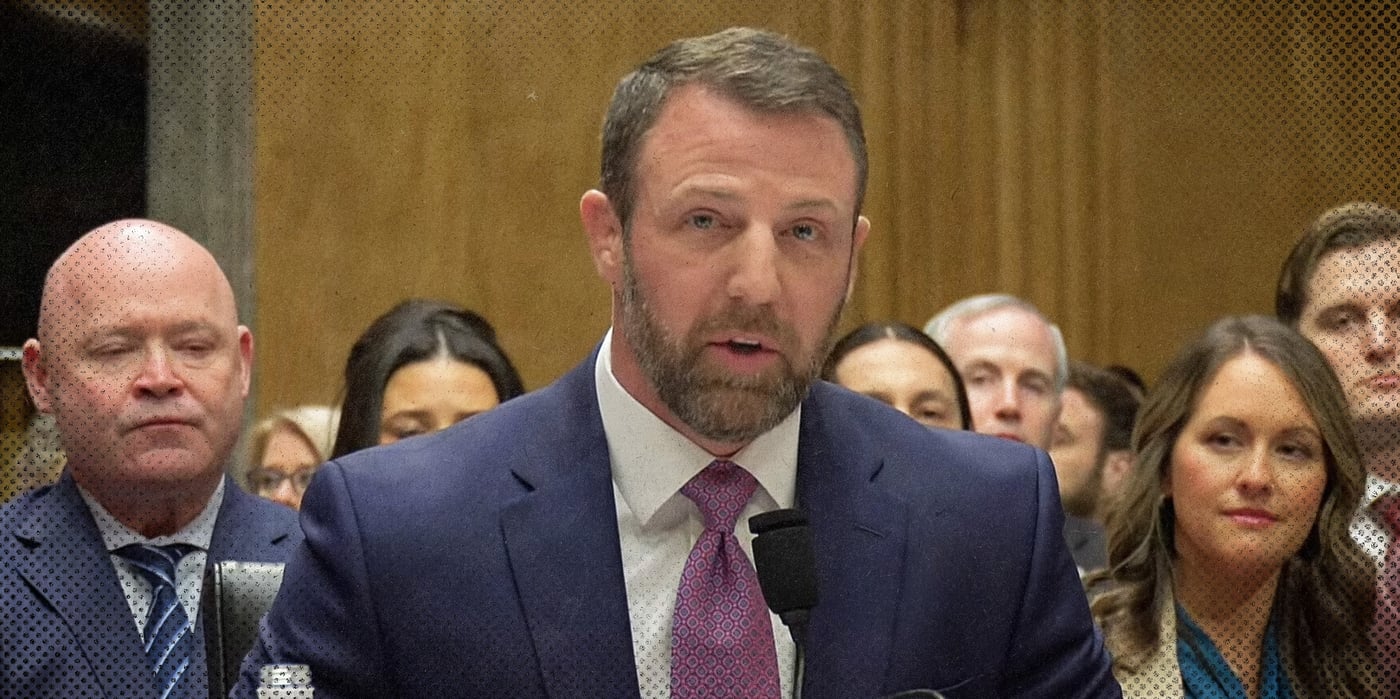

Oklahoma Republican Senator Markwayne Mullin’s confirmation hearing to lead the Department of Homeland Security signaled a potential structural shift in how the agency presents itself to the American public.
Over the past year, DHS has not faced its most significant challenges in policy execution, but in public perception. The department’s core responsibilities — border enforcement, immigration processing, and national security coordination — have remained consistent across administrations. What has changed is how those actions are communicated, interpreted, and ultimately judged.
Under President Donald Trump, agencies such as Immigration and Customs Enforcement (ICE) became politically contentious in ways that extended beyond their statutory role. Immigration enforcement did not suddenly emerge as a new function of government. ICE has operated under both Republican and Democrat administrations for decades. The difference lies in how individual enforcement actions were framed and how quickly narratives formed around isolated incidents, often before full facts were established.
DHS under Secretary Kristi Noem struggled to manage that dynamic effectively. The department frequently responded to controversies with rapid, definitive conclusions, leaving little room for clarification or adjustment as additional information emerged. Even when underlying policies were legally sound and operationally justified, the messaging surrounding them often intensified scrutiny rather than containing it. In a media environment that rewards immediacy over accuracy, that approach exacted a high cost.
Mullin’s testimony suggested a different framework — one focused not on avoiding controversy, but on managing it with consistency, discipline, and clarity. His central strength is communication. In the current information landscape, perception shapes policy outcomes as much as policy design. A federal agency that cannot clearly explain its actions risks allowing critics to define those actions on its behalf.
One of Mullin’s distinguishing advantages is his willingness to engage directly with audiences outside traditional political channels. His active presence on platforms such as TikTok reflects an understanding that public opinion is increasingly shaped by decentralized, fast-moving forms of media.
Younger Americans are not forming views on immigration or national security through press briefings or cable news. Rather, they are forming those views through short-form content that prioritizes clarity, accessibility, and perceived authenticity.
Engagement on these platforms does not guarantee agreement, but it creates the conditions for comprehension. For DHS, that distinction matters. A secretary who can present policy decisions clearly and in a structured manner reduces the likelihood that each enforcement action becomes a standalone political controversy.
The hearing also highlighted a second, equally important element: tone.
During exchanges with openly critical senators, Mullin maintained a controlled, measured approach. He framed disagreements as differences in interpretation rather than evidence of bad faith. That distinction shapes how institutional conflicts are perceived by the public and whether those conflicts escalate or remain contained.
A particularly notable moment came when Senator Rand Paul raised Mullin’s past confrontation with Teamsters President Sean O’Brien — the one in which Mullin, a former MMA fighter, challenged a combative O’Brien to a fight. The exchange with Paul could have developed into a politically damaging line of questioning. Instead, it underscored Mullin’s ability to manage conflict without allowing it to define his broader message.
O’Brien’s presence in the room reinforced the point that disagreements can be resolved without undermining credibility or authority.
Public trust in DHS does not depend solely on enforcement outcomes. It depends on whether Americans view the agency as consistent, transparent, and accountable in exercising its authority. When communication breaks down, even effective policies can appear arbitrary or excessive. The gap between action and perception becomes a source of instability.
Mullin’s approach indicates a recognition of that structural problem. If confirmed, his success will not be measured only through border statistics or enforcement metrics, but by whether DHS can reduce the disconnect between what it does and how those actions are understood.