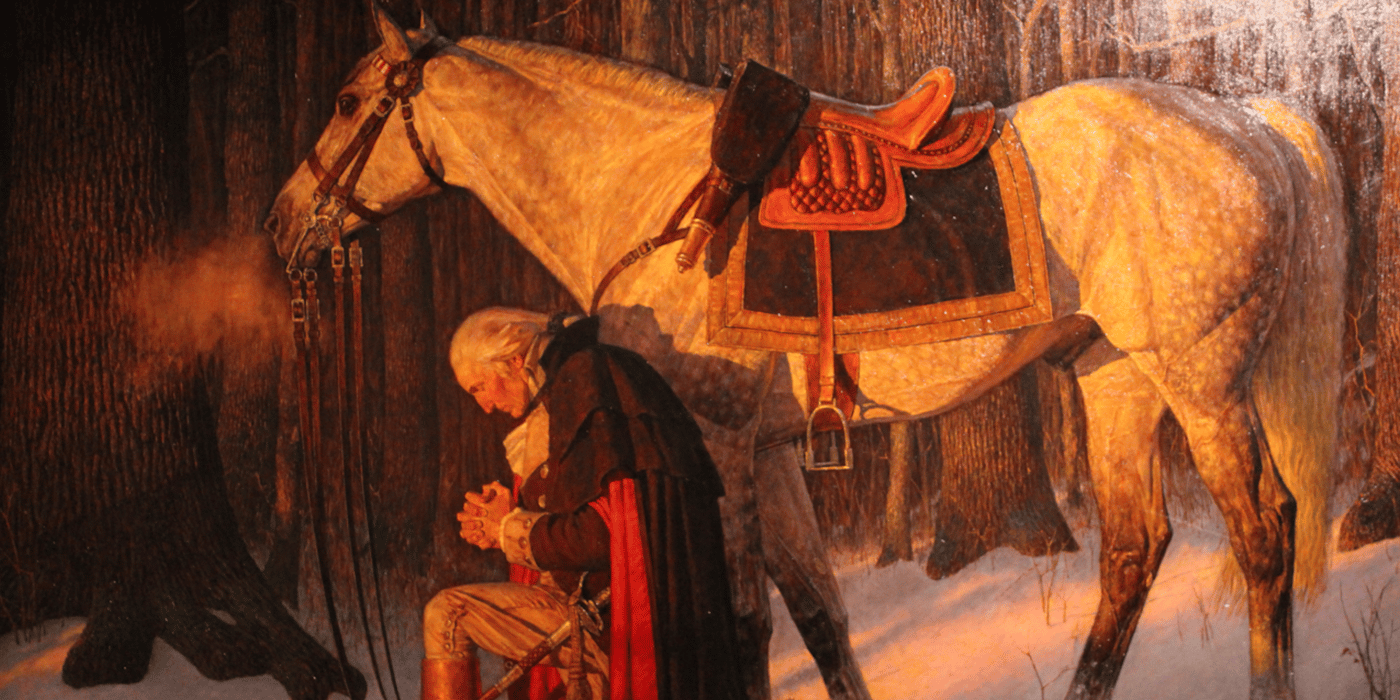

George Washington was not the most formally educated of the Founding Fathers. Unlike figures such as Thomas Jefferson or James Madison, Washington lacked extensive academic training and did not produce lengthy philosophical writings. Yet his Farewell Address remains one of the most consequential documents in American history. It is remembered for its warnings against political parties and entangling foreign alliances, as well as for reinforcing the precedent of a peaceful transfer of power.
However, modern interpretations often overlook one of its most foundational messages: the indispensable role of religion and morality in sustaining the American republic.
Washington’s argument made a direct and structured case that political prosperity depends on moral character, and that morality itself cannot be sustained without religion. He warned that those who attempt to separate morality from religious principle undermine the very foundation of republican government. This was not framed as a narrow endorsement of a single denomination, but as a broader acknowledgment that ethical behavior, civic responsibility, and national cohesion require a moral framework rooted in religious tradition.
This perspective aligns with Washington’s broader public statements. In his 1790 letter to the Touro Synagogue congregation, he made clear that the United States would not merely tolerate religious diversity, but would fully protect it. That letter affirmed that Jewish Americans, along with all religious groups, would find both security and equality under American law.
The principle was clear: religious liberty would be preserved, but religion itself would remain central to the nation’s moral structure.
Over time, however, the interpretation of the relationship between religion and government has shifted significantly. The modern concept of “separation of church and state,” often traced to a letter by Thomas Jefferson, has evolved far beyond its original intent. The Founders sought to prevent the establishment of a state-controlled religion, not to eliminate religious influence from public life altogether. Today, that distinction has blurred, particularly within public education.
In public school systems, any reference to religion is often treated as inherently inappropriate, even when discussed in a historical or ethical context. As a result, the moral frameworks that Washington viewed as essential are frequently excluded from the educational process. This shift has produced a system that prioritizes technical knowledge while neglecting the development of civic virtue and ethical responsibility.
Education, in its fullest sense, was never intended to function as a purely secular transfer of information. Rather, it was designed to cultivate individuals capable of contributing meaningfully to society, guided by a shared understanding of right and wrong.
The consequences of this shift are increasingly visible. Public discourse has become more fragmented, civic trust has declined, and institutions face growing skepticism from the very populations they serve. While these developments have multiple causes, the erosion of a shared moral foundation remains a significant contributing factor.
Washington’s warning was not that political systems would fail immediately without religion, but that, over time, the absence of moral grounding would weaken the stability of the republic itself.
Importantly, this argument does not require uniform religious belief. George Washington himself supported a pluralistic society in which individuals could practice different faiths or none at all. The core principle is not theological conformity, but the recognition that the United States was built on religious values, and that those same values remain essential to maintaining a functioning democracy.
A republic cannot endure on structure alone. It requires virtue, and virtue cannot be separated from the religious foundations that shaped it.