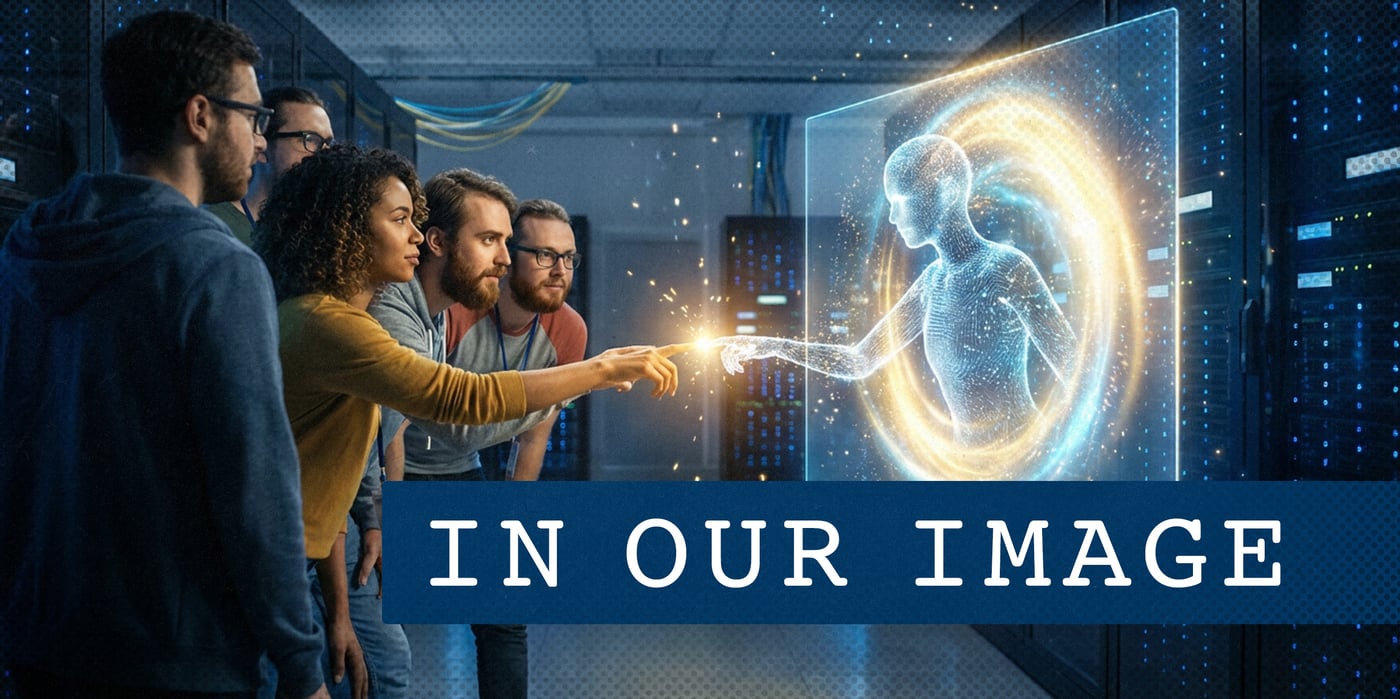

The question artificial intelligence raises is not primarily about machines. At its core, it is a question about humanity itself: what it means to bear God’s image and steward the world He has made — and even how we direct our most impressive technologies toward love of God and neighbor. For that reason, thoughtful engagement with AI is not a minor ethical issue. It is part of what faithfulness looks like now.
Many people today assume that technology is morally neutral, a set of instruments that simply carry out the intentions of their users. But this misses something important. Technologies do not merely serve human purposes. Over time, they shape our habits and attention, and, eventually, even our communities. Technology critic Neil Postman once observed that every tool carries a built-in bias. Each one encourages us to see the world, and act in it, in particular ways. It describes something Scripture itself already prepares us to expect: the things we make inevitably shape us in return.
The opening chapters of Genesis explain why this matters so much. God created human beings in His image and appointed them as His representatives on the earth. They were called to care for the world He made and develop it for His glory and the good of others. Being made in God’s image is not simply a description of human abilities. It is a calling: to reflect God’s character and act responsibly within His creation. Technology, on this view, can be a legitimate expression of this cultural mandate. Every significant invention, from the printing press to the microprocessor, can be received as part of humanity’s vocation to cultivate creation under God’s authority. When rightly ordered, these tools can serve as instruments of common grace, reflecting God’s providential care. When misused — or adopted carelessly — they represent a failure of that same responsibility.
The smartphone offers a concrete example. By emphasizing speed and constant, algorithm-driven stimulation, it quietly erodes the habits of attention and reflection that life requires. Ideas that once demanded sustained thought are now compressed into a headline or an image, delivered before we’ve finished the previous one. Recognizing this is not technophobia. Instead, it invites Christians to practice discernment. The real question isn’t just whether a tool is useful. It’s what kind of life it encourages — and whether that life is consistent with the love of God and neighbor that Christ taught to be the heart of the law.
Viewed within this theological framework, artificial intelligence shares a fundamental continuity with earlier technologies: it is a man-made tool, developed by people who live and work within God’s creation. AI has no soul and no moral standing before God. It does not blur the line between Creator and creature. Claims that advanced AI might one day surpass or replace humanity, therefore, get human dignity wrong. Human worth does not rest on intelligence or productive capacity — it rests on the image of God, which belongs to human beings alone. A machine may one day outperform humans across many tasks, but such achievements would not alter the theological truth that human dignity comes from God’s image, not from computational power.
Still, AI differs from earlier technologies in one important respect. Previous technologies mainly extended human physical power or accelerated communication. AI, by contrast, imitates forms of thinking that people often associate with human intelligence, such as language, pattern recognition, and decision-making — even something that resembles creativity. Large language models generate fluent text, and generative systems can produce images and music at remarkable speed and scale. This creates a new kind of danger. The risk is not that AI will become human. It is that people will begin treating it as though it were, attributing to it a kind of personality, moral authority, or trustworthiness it does not possess. Studies of human interaction with AI show that people readily attribute human qualities to these machines. They form emotional attachments and trust AI-generated answers too easily. Some even begin to prefer AI conversation partners to real human relationships. Christians should recognize this tendency and respond with discernment. When people begin to treat machines as moral authorities or relational partners, genuine human accountability is weakened, and responsibility for decisions becomes blurred.
AI systems are extraordinarily good at quantification, pattern-matching, and repetitive processing at scale. These are genuine and useful capabilities. But computers do not create meaning. They do not exercise wisdom, form relationships, or bear responsibility for the consequences of their outputs. These belong to human beings, who alone bear God’s image. No increase in computing power changes that fundamental distinction.
This points toward what is perhaps the most useful way to frame the difference between AI’s proper use and its misuse: the distinction between delegation and abdication.
Delegation means wisely assigning to AI what falls within its strengths: processing large datasets, running calculations, producing drafts for human review. Abdication means handing over to a machine the kinds of decisions that belong to image-bearers: moral judgment, spiritual care, the pursuit of justice, and the formation of character. Christians may use these tools where they genuinely assist human work. They must not surrender to them where genuine human presence and accountability are essential.
Faithful engagement with AI will not come naturally. The pace of development outruns reflection almost by design, and human beings are not disinterested evaluators of tools that promise efficiency and ease. This is precisely why grounding our thinking now — before urgency overtakes wisdom — matters so much. Christians, whether in families, schools, and institutions, therefore share responsibility for evaluating new technologies not only by what they allow us to do, but by the kind of character they shape and the attention and desires they form. A few convictions are worth holding onto.
The first is the simplest: every human being is made in the image of God, possessing a dignity that no created system can reproduce. This has practical consequences. It means resisting casual talk about AI “personhood” or “consciousness” as that language drifts into everyday use. What makes a human being irreplaceable is not intelligence or output, but something that cannot be coded — the image of God.
The second is that discipleship sometimes requires declining what technology makes possible. Sustained attention and embodied relationships are not accidents of pre-digital life — they are genuine goods, and they are fragile. There may be times when wisdom means using less than what is available, or setting aside AI-generated material precisely because the struggle of working something out yourself is part of the good.
The third is to hold both gratitude and skepticism at once. AI can be received as a gift — one expression of common grace, offering tools that serve human life and work. But not every new capability represents genuine progress. The question is not only what technology makes possible. It is what it makes of us. And in the end, every new tool should pass a simple test: does it lead us to better love God and care for others?
The question artificial intelligence poses is, in the end, a question about us. Tools do not bear responsibility for how they are used. Image-bearers do. We are not called to fear what we’ve made. But neither should we surrender to it. Instead, we are called to govern it with wisdom and humility — for in the end, it is not our machines that define us, but the God whose image we bear.