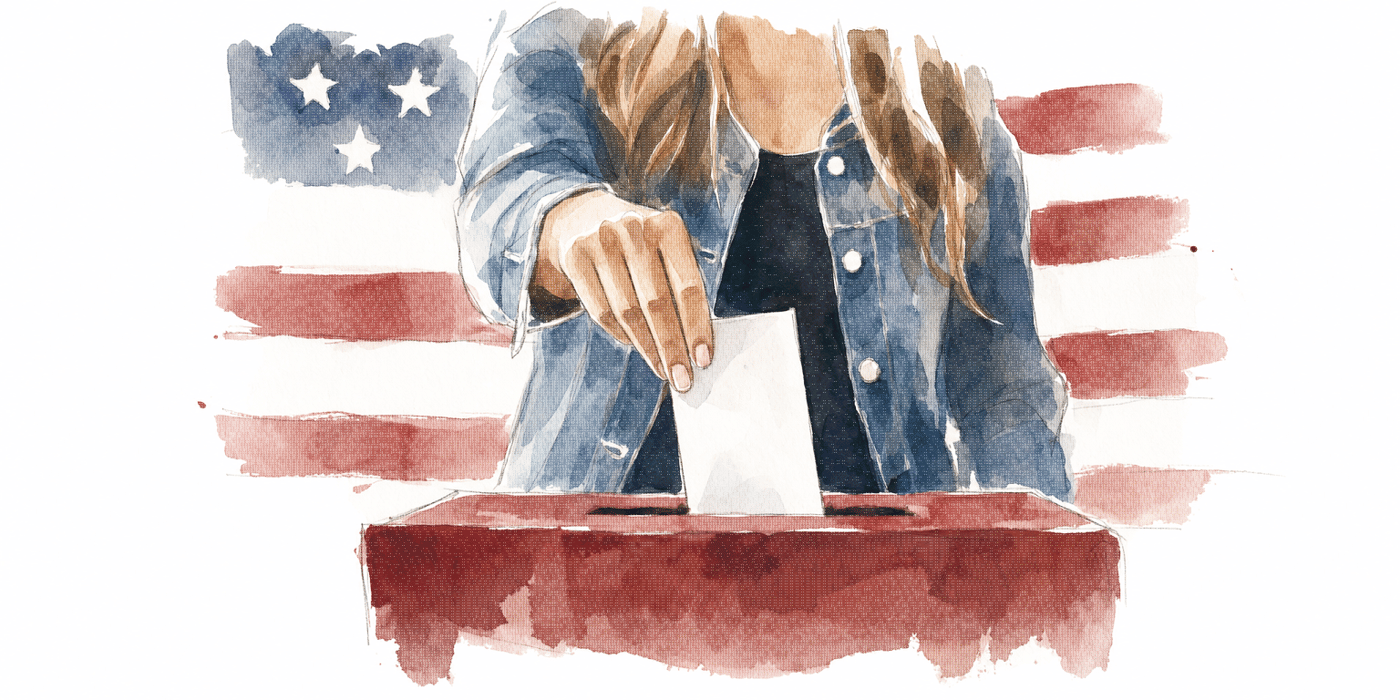


As with most issues, Left and Right views on the subject of election fraud are as far apart as they could possibly be. Republicans assert that election fraud is rampant and is worsening with every cycle. Democrats assert that election fraud is almost nonexistent, as proven over and over by investigations into Republican complaints.
It’s a vitally important issue. Nothing is as central to the survival and continued success of our constitutional federal republic — a carefully constructed form of representative democracy — than free and fair elections.
But in this case, the stark difference between Left and Right views is attributable, at least in part, to semantics. The term “election fraud” implies illegality; I’d argue that the larger problem lies in our election practices (generally left to the discretion of individual states by our Constitution) that increasingly create room for political interference at the expense of fairness.
As specific examples, let’s examine two familiar — and controversial — elections:
First, consider the 2020 Donald Trump vs. Joe Biden presidential election — yes, the one that Trump still insists he actually won, despite it being “rigged” to produce a Biden victory, while Democrats doggedly maintain that it was “fair and transparent.”
From the start, there were more than enough reasons for Republicans to be wary about the 2020 election, such as overt censorship of public information about the infamous Hunter Biden laptop, flagrant misinformation about it peddled by former high level intelligence officials, major relaxation of mail-in voting rules (attributed to COVID challenges), and the substantial involvement (with financial contribution exceeding $300 million) by the Mark Zuckerberg family to facilitate get-out-the-vote efforts in Democrat-leaning areas coast-to-coast.
Concerns about election integrity mounted on Election Day as we watched strong Trump leads in multiple swing states that evening evaporate suddenly during pre-dawn hours of the following morning, evidently due to the arrival of a tsunami of mail-in ballots. Finally, on November 7 — four days after the election — Joe Biden was declared the winner.
A Biden win had always been in the cards — the Trump presidency had been controversial, and COVID had taken its toll. But the real shocker was the apparent strength of Biden’s victory. The reported vote tallies showed that the uninspiring Biden, who’d failed miserably in previous presidential runs and whose tepid COVID-era 2020 campaign had been operated largely from his Delaware basement, had somehow amassed eight million more votes than Democrat superstar Barack Obama at the peak of his popularity.
Trump’s frantic efforts to convince various courts to set aside the election results failed at every turn. But it was that single data point — Biden’s wholly unbelievable vote tally — that tells the tale. Whether “rigged” (Trump’s word), or fraudulent, or simply purchased at an exorbitant price, Biden’s victory in 2020 was surely not “fair and transparent.”
And for a second example, there’s the Los Angeles mayoral primary just two weeks ago, in which the reported outcome was so absurd that no one actually believed it — rather, they just chalked it up to “well, that’s California.”
To recap, the Election Day vote count showed that, as expected in Democrat-rich LA, incumbent Karen Bass was the leading vote-getter, while the independent rookie candidate Spencer Pratt had captured the all-important second-place position. In California, only the two top primary finishers compete in the upcoming mayoral election, so Pratt’s second-place win teed up an unusual (for California) two-party contest.
In a distant third place came Democrat Socialist Nithya Raman, who tearfully apologized to her supporters on election night for her weak showing in the day’s primary.
But wait! Mail-in votes kept pouring in for days — and as I write this column two weeks later, the vote counters are still counting. And lo and behold, those mail-in votes — from the same voting pool, in the same election, and at the same time — flipped the script completely. A week after the election, they bumped Pratt from his #2 slot, resurrected the candidacy of the hitherto-ignored Raman, and, most importantly, scuttled once and for all the possibility of a non-Democrat LA mayor. Whew! That was close!
OK, you might argue, stranger things have happened. But actually not. According to The Washington Times, even AI was unable to find a single U.S. election in which mail-in ballots produced such a profound reversal, with ballots ostensibly submitted on or before election day reflecting a totally different voter sentiment than those indicated by in-person voting that day.
Takeaways from these two sorry episodes — and many more, with less visibility: both produced election outcomes that are highly unlikely (arguably, impossible), that quite possibly do not reflect the collective electorate’s intent, and that were made possible by watered-down election processes.
The reality of our election system is as clear as it can be — and I believe both sides know it, even if admitting so is impolitic: amidst all of the angst we hear from the Left about threats to our democracy, the most severe threat by far is the steady erosion of fairness and transparency in our election processes.
As our deeply divided nation careens toward the midterms — an election that will dictate the course of the final two years of Donald Trump’s presidency — the perennial issue of election fairness is as daunting as ever.
There are many gaps to fill. At the top of the list, of course, is the need for legally mandated voter IDs in U.S. elections, as recognized and supported by a strong majority of Americans. Voter ID is the centerpiece of the SAVE America Act, legislation that Democrats oppose for all the wrong reasons, and that is currently stalled in the Senate.
Next in line, in my view, is a major rethink of our mail-in election policy. Mail-in or absentee voting is now permitted, to some degree, in all states and is the principal voting method in eight states. The voters love it, for obvious reasons — It’s simple, fast, and convenient.
But critics maintain that mail-in voting is an open invitation to voter fraud, and it’s hard to disagree. Think about what guardrails have been bypassed by the switch from in-person to mail-in voting. In the good old days of in-place voting on Election Day, we each went to the polls, confirmed our identity, verified our registration status, cast our votes individually and privately, and deposited them, either in physical or electronic form, directly into the vote tabulation system.
By comparison, a ballot delivered to the voting precinct via U.S. Mail or another delivery method could have been prepared by anyone. There’s no way of knowing for sure if it is, in fact, the vote of the registered voter whose signature is scrawled on the form, no idea of the circumstances of the ballot’s preparation, what “help” might have been provided and by whom, or where the ballot has been and in whose custody since preparation. And there’s no way to be sure that other ballots, possibly votes for the “wrong” candidates, may have been discarded along the way.
Why are we so willing to give away, so easily, the measures that have protected the integrity of our elections for over two centuries?
At this point, I doubt that we’ll ever disallow mail-in voting; nor will it be possible to effect substantial, nationwide improvements in those systems prior to the midterm elections. But if, as a nation, we wish to provide sufficient long-term confidence in mail-in voting, we must steel ourselves to the necessity for establishing strict controls and protections, adopted by Congress and mandated by law.
And as life teaches us again and again, step one in any fix is admitting and owning the problem. U.S. elections must be fixed, and they won’t fix themselves. Our Republic demands it.