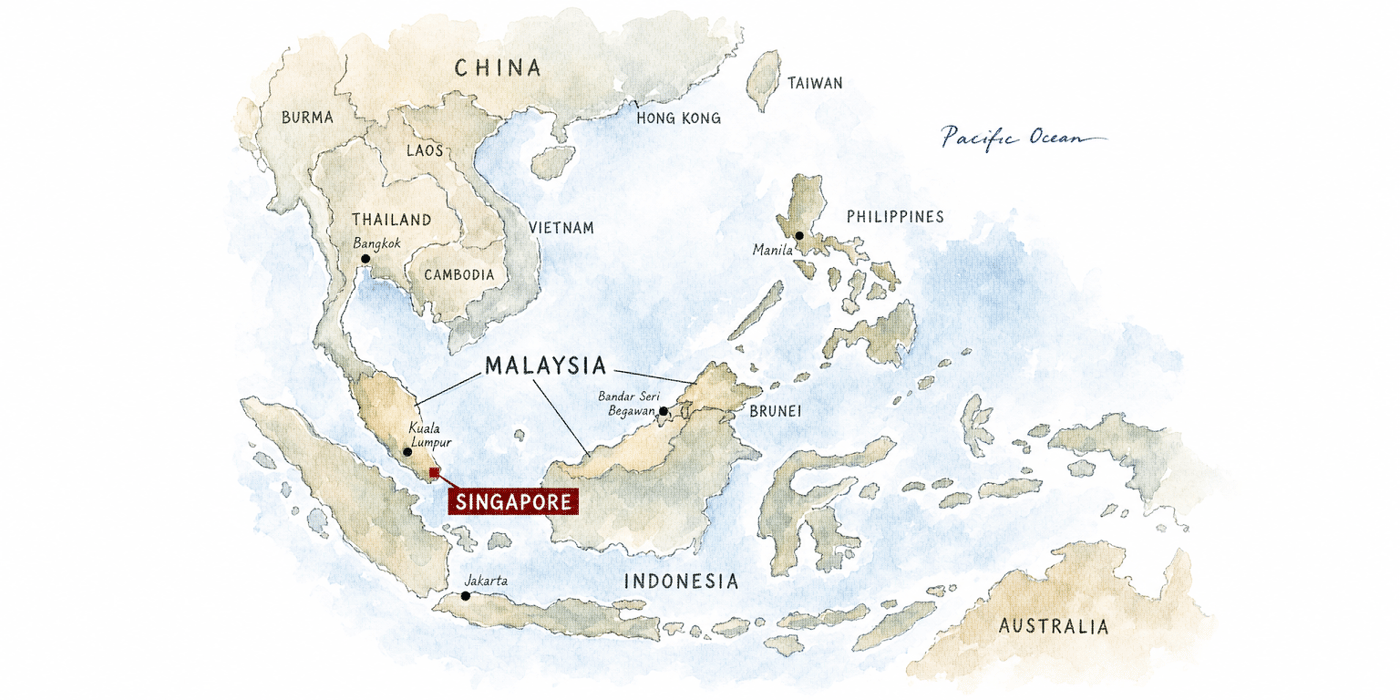


Singapore might seem like a strange subject for an article related to the defense of Taiwan. After all, Singapore is a tiny island with a small population, almost half of which are foreigners, either students or in the labor force. With just over six million people and an area of only 284 square miles, it punches way over its weight in terms of its impact on the region and the potential defense of Taiwan by the U.S. and others.
It is a sovereign city-state founded in 1965. Its history as an important feature of world trade dates back at least to the 14th century. As the map shows, it is found at the southern tip of the Malay peninsula, just north of the equator. Malaysia lies to the north and Indonesia to the south, so it sits astride the Singapore Strait and near the strategically vital Strait of Malacca, a prime passage for global trade between the Indian Ocean and the South China Sea. According to the Institute for Supply Management, a staggering $3.5 trillion in world trade goes through the Strait, including two-thirds of China’s trade, 40% of Japan’s trade, and a third of the world’s trade. Over 82,000 vessels transit the strait each year. Brittanica describes Singapore as “Southeast Asia’s largest port and one of the busiest in the world, a position built on its command of the Malacca-Singapore sea lane between the Indian Ocean and South China Sea.” Singapore is the world’s leading bunkering and transshipment hub. It has become strategic and important due to its good governance, emphasis on education, the creation of valuable infrastructure supporting maritime trade and finance, and extensive use of advanced technology.
The key to Singapore is its status as a global port and international trade node. It is also a growing finance and supply hub. It has developed a small but potent military despite its tiny geographic size and, most importantly, is cultivating relations with major world players, notably the United States and other key states in the region.
Singapore has a strong emphasis on its defense. It devotes 3% of its GDP to defense, a larger percentage than most nations. It emphasizes a strong Singapore Armed Forces, including mandatory national service for its citizens, the development and use of advanced technology, and leveraging overseas training for its Armed Forces from allies and partners, including the U.S. As evidence of its seriousness about its military, it is buying both the F-35A and the F-35B (short-takeoff/vertical-landing aircraft) and is modernizing its Navy with the Invincible-class submarines. Singapore already has two of the subs now and will add four more by 2028. Germany’s shipbuilder Thyssenkrupp Marine Systems builds the Invincible submarine for Singapore.
U.S.-Singapore defense cooperation is extensive. While not a treaty ally, it is one of our most important partners in the region, and the relationship includes access to Singapore’s modern port, supply support, training support, technology exchange, maritime security cooperation, and air operations support. It grants the U.S. a regional presence in the form of multiple military sites in Singapore, including the Naval Support Activity, Singapore. Navy Littoral Combat Ships often visit and refresh at Singapore, as do P-8 Poseidon maritime patrol planes. In May 2024, the U.S. Department of Defense signed a Defense Innovation Cooperation Memorandum of Understanding with Singapore focused on maritime security and unmanned systems. In the event of any military threat in the Indo-Pacific, Singapore’s support will be critical for access to the region, the maintenance of U.S. forces, supply and maintenance support, and maritime surveillance.
Singapore recognizes the People’s Republic of China and officially supports China’s “One-China” policy. Despite this policy, Singapore maintains long-standing relations with Taiwan dating back to the 1970s. Singapore’s lack of land prompted it to reach out to Taiwan to use Taiwan for large military exercises. The program continues to this day with China’s full knowledge, but it is carried out quietly to avoid friction. If a conflict between China and Taiwan were to arise, Singapore would not be a front-line participant. However, it is expected that Singapore would continue to support U.S. forces’ regional presence in any contingency. Singapore’s value to the U.S. in any Taiwan threat would be its importance as a key chokepoint state, its extraordinary port facilities, intel sharing, supply support, and maritime surveillance.
The Five Power Defense Arrangements consists of the UK, Australia, New Zealand, Malaysia, and Singapore. This connection with three key U.S. allies in the region is especially important to us and valuable to Singapore, as it provides Singapore with greater access to training opportunities for its military with those partners.
For the U.S. and its allies, what importance does Singapore have to our defense of Taiwan in the event of a Chinese military incursion?
- It serves as the Western gateway to the South China Sea. This is important for U.S. forces moving from the Indian Ocean, Australia, the Middle East, Diego Garcia, and the Western Pacific.
- It is a supply and refueling hub.
- The U.S. has operational access to Singapore for both naval and air forces.
- It is a Maritime domain awareness location for tracking forces in the South China Sea and the Indo-Pacific.
- Singapore is a respected, highly competent country with a strong influence on the regional commerce landscape and on those transiting the region. What Singapore does if Taiwan is attacked by China will speak volumes to ASEAN nations and the world as they consider coming to Taiwan’s aid.
- Singapore’s independence from China enables it to follow its own path. It can resist China’s efforts to undermine Taiwan’s defense. It is free to aid those nations that will come to Taiwan’s aid.
In conclusion, Singapore’s strategic location and economic influence provide a vital foundation of support for the U.S. and our allies, who also support Taiwan’s independence from China, in the event of any attack on Taiwan, whether military or economic.