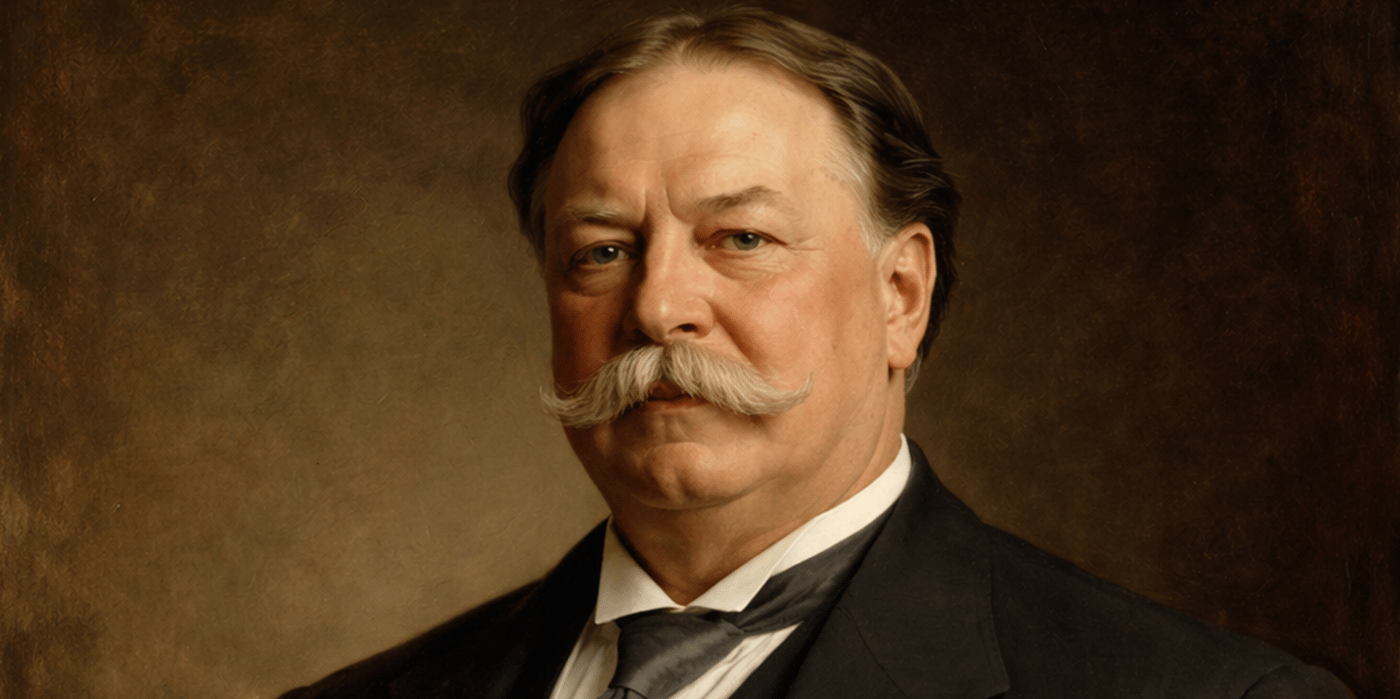

The president’s speech had been a triumph.
It was April 25, 1912, five days before the Republican primary in Massachusetts. A massive crowd packed the Boston Arena to see William Howard Taft, who was seeking his party’s nomination for a second term, finally strike back at former president Theodore Roosevelt. For months, Taft had remained silent as Roosevelt traveled the country to mock and belittle him, dismissing his presidency as timid and accusing him of being a tool of special interests. Now, for the first time, Taft answered the charges. To cheers from the audience, he rebutted the accusations point by point. Then Taft — a former US Solicitor General and federal appellate court judge — denounced his predecessor’s demand that voters be allowed to overturn court decisions they disliked. That would end judicial independence, he warned, and “destroy the keystone of our liberties.”
The speech removed any doubt that the nation’s 26th and 27th presidents were now bitter political enemies. But Taft felt no exhilaration at the crowd’s thunderous applause. He returned to his railroad car shortly after midnight, drained and miserable. “Roosevelt was my closest friend,” he told a reporter, his voice breaking. Then he began to weep.
Only a few years earlier, such a scene would have seemed unimaginable.
When Roosevelt first met Taft in Washington in the early 1890s, their friendship was instantaneous. “One loves him at first sight,” Roosevelt said. Taft, genial and self-effacing, possessed what Roosevelt later called “the most lovable personality I have ever come in contact with.” The admiration was mutual. Taft described his alliance with Roosevelt as “one of close and sweet intimacy.”
The two shared a privileged background, a call to public service, and a passion for reform. Yet they could hardly have been more different. Roosevelt was volcanic — restless, exuberant, theatrical. Taft moved, as one contemporary observed, “in straight lines and by long, logical habit.” Roosevelt craved public attention. Taft was happiest in the quiet discipline of the law.
In September 1901, the assassination of William McKinley propelled Roosevelt into the White House. The new president turned instinctively to Taft — the steady jurist whose judgment he trusted above almost anyone’s. He tried more than once to elevate his friend to the Supreme Court; eventually he brought him into his Cabinet as secretary of war and confidant. “Remember too the aid and comfort you would be to me,” he urged Taft, “as my counsellor and adviser in all the great questions that come up.”
By 1908, Roosevelt’s determination to see Taft succeed him in the White House far exceeded the candidate’s own ambition. Indeed, Taft’s announcement of his candidacy was so half-hearted — “I do not expect to be the Republican candidate,” he insisted — that it seemed at first as if he were refusing to run. But Roosevelt campaigned for his old friend with fervor and rejoiced in Taft’s victory as if it were his own. On Inauguration Day in 1909, the two men clasped shoulders and grinned broadly at one another before parting ways — Roosevelt to private life, Taft to the White House.
“No other friendship in our modern politics has meant more to the American people,” journalist William Allen White wrote in a profile of Taft in 1908, “for it has made two most important and devoted public servants wiser, kindlier, more useful men.”
But that friendship would not survive the test of power.
The break didn’t come overnight. Taft sought to extend Roosevelt’s legacy— filing antitrust suits, strengthening federal regulation, protecting federal lands, and pressing for tariff reform. He saw himself as consolidating the Progressive gains of the previous seven years.
Beneath the surface, however, lay a deeper divide — not of policy, but of principle.
Roosevelt insisted the president was the steward of the people, empowered to do anything the Constitution did not expressly forbid. Taft believed presidents could do only what the Constitution explicitly authorized. Where Roosevelt disdained unfavorable judicial decisions as obstacles to democratic justice, Taft revered judicial independence as a vital check on populist demagoguery.
Temperament sharpened philosophy into conflict. As Roosevelt returned from a year abroad, he grew restless with his successor’s restraint. He barnstormed the country, delivering radical speeches on what he called a “New Nationalism” — speeches that, as Taft told his brother, went “quite beyond anything that he advocated when he was in the White House.” Roosevelt convinced himself that his legacy was being betrayed — and that only his return could save it.
By the spring of 1912, the disagreement had toxified into open contempt. Roosevelt ridiculed Taft as a “fathead” and “a dead cock in the pit,” and unleashed repeated denunciations of his former friend. Taft lamented “the monumental egotism, and almost the insanity of the megalomania that possess Theodore Roosevelt.” In a letter to his wife, he confessed that he could hardly “realize that we are talking about the same man as that man whom we knew in the Presidency.”
The Republican National Convention that June unfolded under extraordinary tension. More than 1,000 police officers were stationed at the Chicago Coliseum amid fears of violence. When the delegates nominated Taft, Roosevelt accused him of having rigged the results. Then he bolted the GOP and ran as the candidate of his own Bull Moose Party. With the Republican vote split, Woodrow Wilson captured the White House. A presidency was destroyed, the party of Lincoln was fractured, and the country would soon learn that Wilson’s lofty rhetoric masked a presidency marred by racial regression and assaults on civil liberties.
What happened in 1912 is a pattern that has repeated itself in American politics. A disagreement over policy hardened into moral indictment. What might have been settled through private persuasion was prosecuted in public denunciation. Roosevelt convinced himself that Taft’s restraint was not merely mistaken but illegitimate — that only his own return to power could redeem the cause.
Taft, for all his political missteps, had been defending something larger than his own career. He believed the presidency was bounded by law, that courts should not bend to popular passions, and that reform must operate within constitutional limits. He was the better guardian of the office — and the country paid a price for his defeat.
The two men reconciled in 1918, briefly and sincerely. Within months, Roosevelt was dead. At the funeral, after the other mourners had moved away from the graveside, Taft remained — the last to leave, weeping for the friend whose loss he had mourned long before death made it final. In 1921, he achieved his true lifelong ambition, becoming chief justice of the United States — the role for which he was always best suited.
Strength is not measured only in audacity. At times, it lies in refusing to be audacious. Taft deserves to be remembered this Presidents’ Day not as a triumphant president but as a principled one. He held fast to constitutional restraint, even when it cost him the White House and the friendship he cherished most.