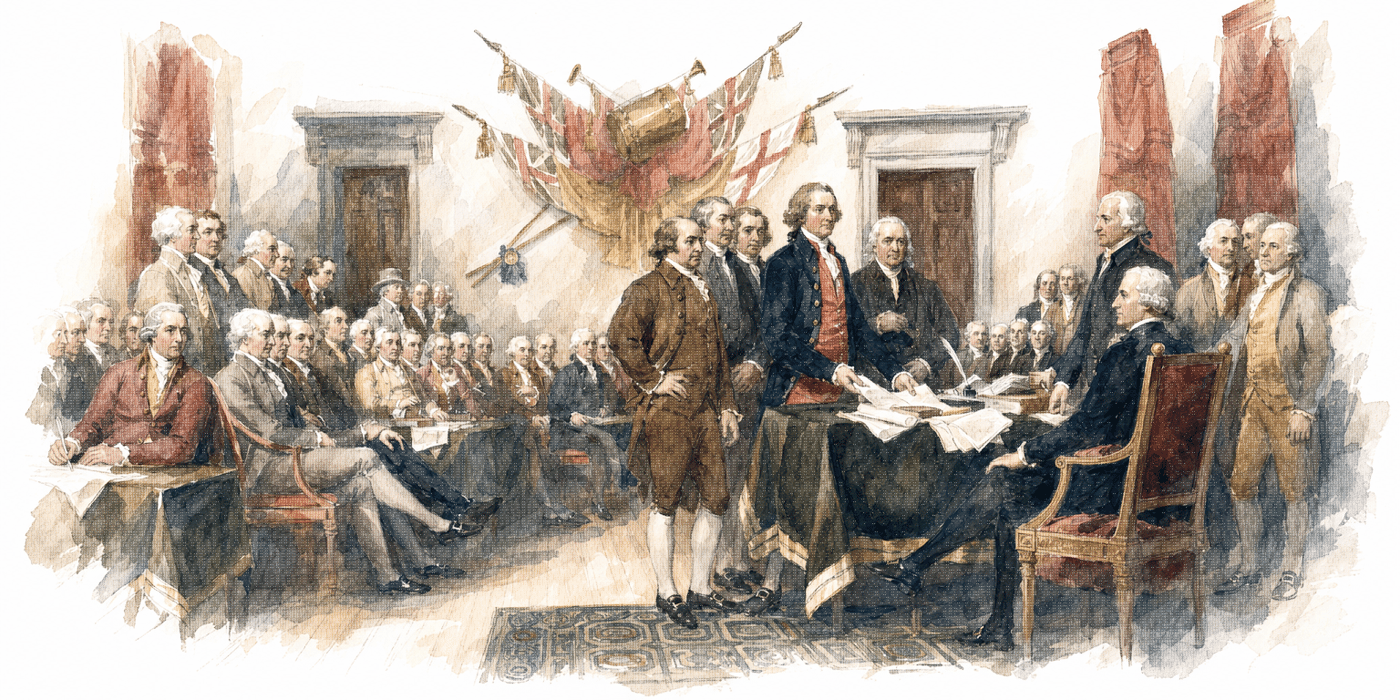

As we inch toward the 250th anniversary of the signing of the Declaration of Independence, let me share a couple of reflections on the background of how this extraordinary, unprecedented and daring event succeeded.
Two decades ago, I set out to write a book about the events known as the Glorious Revolution of 1688-89. I suspected that this revolution — the ouster of the Catholic King James II of England and the installation of his Protestant son-in-law (and nephew) William III and daughter Mary I — was helpful, perhaps a necessary precursor of the American Revolution.
“Our First Revolution” appeared in 2007 and sold in respectable numbers, with a sharp upturn after I was interviewed by Jon Stewart on Comedy Central. I was told that Stewart is interested in history and had actually read the book, and he gave it a rousing endorsement. Our paths have not crossed since, and I owe him a belated and robust thanks.
I was convinced then and am more so now that the events of the Glorious Revolution and their reverberations over the next three-quarters of a century made possible the success of the American Revolution.
First, because the ouster of one king with a clear hereditary claim, the exclusion of his male heirs, and the installation of three foreign successors left a cloud over the title of whoever held the monarchy. James and his Stuart son and grandsons were Catholics, unsuitable for Protestant England.
William was a Dutchman, stadtholder of the Dutch Republic; his English wife, Mary, was subservient and died six years into his reign; they were childless and succeeded by the very English Queen Anne. After her one surviving child died of smallpox in 1700, Parliament passed the Act of Succession barring Catholics (and anyone who married a Catholic) from the throne, and when Anne died in 1714, she was succeeded by George I, elector of Hanover, who spoke no English.
George I spoke to his ministers in French, the lingua franca of continental courts; his son George II spoke English with a German accent, and both were suspected of caring more for their German lands in Hanover than for England. Only in 1760 did England get a plainly English king, the young George III.
The clouds on the titles of both the Stuart pretenders and the Hanover incumbents left room for philosophers to concoct theories of resistance to kings. John Locke’s “Two Treatises of Government” was used to justify the Glorious Revolution, the pro-Stuart Bolingbroke’s “Patriot King” to justify resistance to the Hanoverians. American revolutionaries drew on both philosophical traditions, as the great historians Bernard Bailyn and Gordon Wood who took their writings seriously have established.
At the same time, English monarchs, aware of their arguable illegitimacy, avoided the fashion for absolutist government pursued and championed by Louis XIV in France, Charles III in Spain, Joseph II in Austria and Frederick III in Denmark.
James II’s taste for absolutism was apparent before his ouster. One of his projects, starting in New England and New York, was to abolish the colonial legislatures. William III reinstated the legislatures, leaving them to tussle with royal or proprietorial governors or lieutenant governors. Over the next 75 years, these political arenas were schools of practical politics and philosophic principle, whose star pupils included Benjamin Franklin, George Washington, John Adams and Thomas Jefferson.
Progressive historians portrayed the legislatures as devices for long-established rich people to hold on to their money. But property was widely held in the colonies, and with manpower always scarce, the older legislative leaders were always on the lookout for talented young men. Both Washington and Jefferson were given important assignments while still in their 20s.
The colonies were founded at different times, were of different heft, and the product of diverse religious traditions after a century of wars centered on religious differences. The idea that the colonies had a common interest, or so my research for my 2023 book “Mental Maps of the Founders” suggested, was a product of Benjamin Franklin in the 1750s.
Franklin, as biographies by Wood, Edmund Morgan and Walter Isaacson make clear, was a businessman, a printer who sold his “Poor Richard’s Almanack” up and down the seaboard colonies, a deist who sponsored the revivals of the evangelist George Whitefield, a scientist who refused to patent his Franklin stove but received royalties from printers renting his presses and distributing his writings. He retired a rich man at age 42.
Colonies had depended on their specific ties with patrons and places in England and hired colonial agents — lobbyists — to pursue their interests in London. Franklin was hired as a colonial agent for Pennsylvania and then for Georgia, New Jersey and Massachusetts as well. He urged colonial unity at the 1754 Albany conference when French troops were threatening to advance on the Appalachian chain with his famous “Join, or die” political cartoon.
At the same time, he was preparing his pamphlet on population, predicting, accurately, that the population of the colonies, not considered separately, but all 13 taken together, would exceed that of England in 100 years.
Franklin’s idea that the colonies, for all their particularities, shared common interests had consequences in 1774 when grievances in a few colonies prompted the summoning of a Continental Congress and its continual meetings during the Revolutionary War.
The American Revolution was a chancy event, unsure of success at every turn, and, at the same time, of enormous possibility: Franklin and Washington contemplated that the American republic could be the world’s largest and strongest nation. It was the product of extraordinary individuals, whose clustering genius at one time and in one place is reminiscent of Periclean Athens or Renaissance Italy.
But background circumstances also contributed. Without a lightly governing king-in-parliament, unwilling to press for absolutist rule; without locally elected legislatures, left largely to their own initiatives and devices; without the willingness to perceive common interests despite differences in religious belief and cultural folkways that had been so recently the stuff of violent disagreement and war — without all these advantages, it is hard to see how the Revolution whose Declaration we celebrate next week, of which we are the fortunate, if often also the querulous heirs, could have been so largely, though imperfectly, successful.
Happy Fourth!
COPYRIGHT 2026 CREATORS.COM