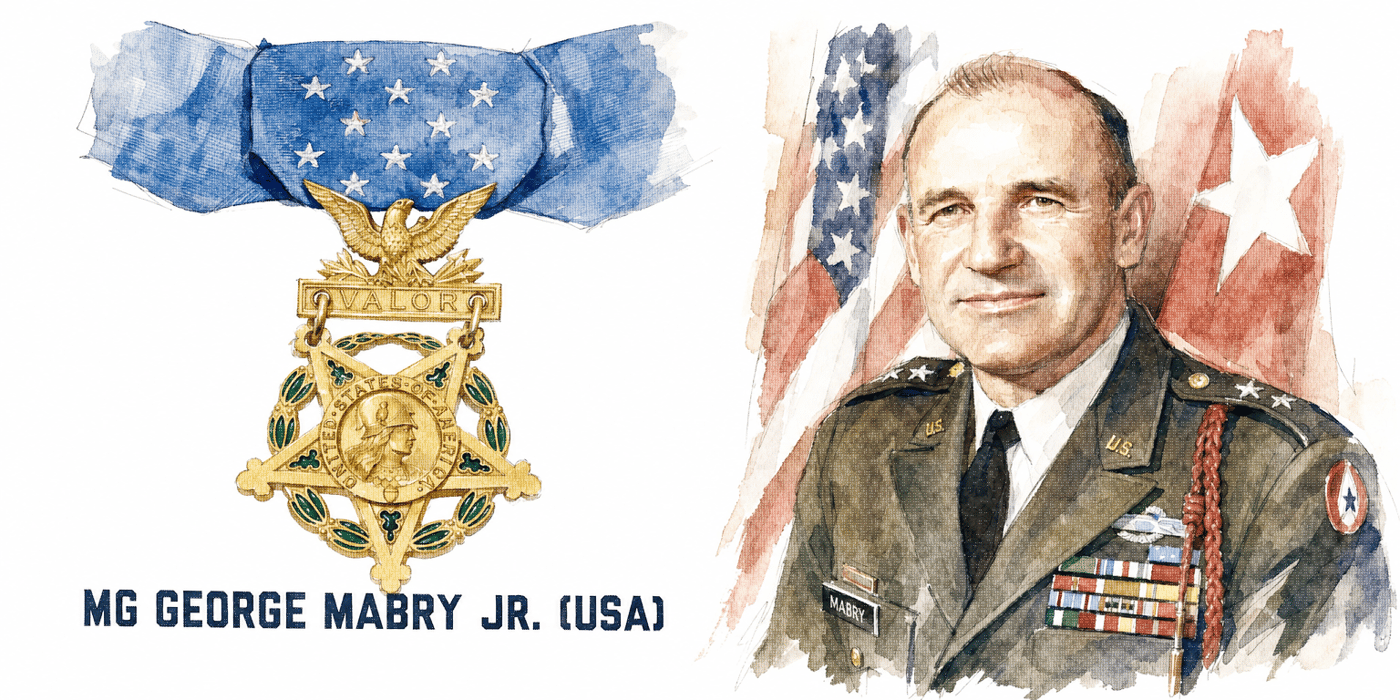

George Mabry Jr. was the son of George and Tallulah and was born on his family farm in Sumter County, South Carolina.
He graduated from Hillcrest High School and spent a year working for his father as a farm supervisor before attending Presbyterian College on a baseball scholarship. He studied English and Psychology, thinking he might eventually become a teacher; he excelled in sports and graduated in 1940 as a Captain in his college’s ROTC Corps. He was commissioned as a Second Lieutenant in the Army and began his training with the 4th Infantry Division at Fort Benning, Georgia.
He married his sweetheart Eulena Myers in 1941 — before the attack on Pearl Harbor and entry of the U.S. into World War II.
He trained stateside for three years before deploying with the 4th ID to England in January 1944. Then-Captain Mabry’s first action in combat was 6 June 1944 — D-Day at Normandy, when he led his company in the third wave onto Utah Beach. Moving toward the beach, Mabry said, “As light began to improve, the first casualty I saw was a Navy boat which apparently had hit a mine. One sailor was lying on the keel of the boat, holding onto a man who was obviously either critically wounded or dead.” Just ahead of beaching, he recalled: “The bombers began to bomb the beaches. Smoke and dust obliterated the area. We couldn’t see the shore or any distinguishing features which we had memorized. As the bombers went away, naval gunfire opened up. They began to pulverize the beaches and behind them.”
On the beach: “I moved forward. Ahead of me was a man carrying [something] like a cloverleaf of 81mm mortar ammunition. ... A mortar round came in and hit this soldier right on top of his head. That caused the 81mm mortar rounds to detonate also, and this man’s body completely disappeared. ... I followed a squad of about six men from G Company. ... The sergeant started through the barbed wire. A tremendous explosion occurred. Obviously, he had stepped on a mine. All six men fell to the ground, some killed, some wounded, some screaming.”
That brutal day, he cleared a path through the minefield using his bayonet as a sand probe, killing and capturing 10 German soldiers, and then organizing tank assaults on enemy machine-gun batteries. His company was the first to join up with 101st Airborne Division troops who parachuted behind the Normandy lines earlier that day. For his actions, he would later receive the Army’s second-highest award for valor, the Distinguished Service Cross.
Three weeks later, when 4th ID soldiers where taking heavy fire in the drive to seize Cherbourg, he personally led the routing of the key German position, for which he would later be awarded a Silver Cross.
Mabry would serve with the 4th Division through the end of the war, but he is best remembered for his actions in the bloody battle to force the NAZI retreat from the Huertgen Forest in Germany.
Fighting his way across France, the 27-year-old Mabry was promoted to Major and commander of his battalion ahead of his division’s role in the Huertgen Forest campaign near Schevenhutte, Germany. The 4th had suffered more than 6,000 casualties in its effort to open a hole in the Siegfried Line in order for Allied forces to drive deep into Germany.
Mabry had already been cited twice for his heroic actions before 20 November when he took command of 2nd Battalion, 8th Infantry Regiment. On that day, when ordered to move east and flank a critical German position, his men were pinned down by machine-gun fire in a minefield. He used his trench knife to clear a path through the minefield, then led his men across 300 meters of open ground under fire to seize the high ground behind the enemy line. Mabry would surge ahead of his men to clear enemy bunkers, and in the process, he killed three Germans and captured six others. Completing his battalion’s flanking maneuver enabled the 2nd to pin down and overrun the enemy.
His Medal of Honor citation details his actions that day:
During the early phases of the assault, the leading elements of his battalion were halted by a minefield and immobilized by heavy hostile fire. Advancing alone into the mined area, Col. Mabry established a safe route of passage. He then moved ahead of the foremost scouts, personally leading the attack, until confronted by a booby-trapped double concertina obstacle. With the assistance of the scouts, he disconnected the explosives and cut a path through the wire. Upon moving through the opening, he observed three enemy in foxholes whom he captured at bayonet point. Driving steadily forward he paced the assault against three log bunkers which housed mutually supported automatic weapons. Racing up a slope ahead of his men, he found the initial bunker deserted, then pushed on to a second where he was suddenly confronted by nine onrushing enemy. Using the butt of his rifle, he felled one adversary and bayoneted a second, before his scouts came to his aid and assisted him in overcoming the others in hand-to-hand combat.
His citation continues:
Accompanied by the riflemen, he charged the third bunker under point-blank small-arms fire and led the way into the fortification from which he prodded six enemy at bayonet point. Following the consolidation of this area, he led his battalion across 300 yards of fire-swept terrain to seize elevated ground upon which he established a defensive position which menaced the enemy on both flanks, and provided his regiment a firm foothold on the approach to the Cologne Plain.
His citation concludes: “Col. Mabry’s superlative courage, daring, and leadership in an operation of major importance exemplify the finest characteristics of the military service.”
Notably, two weeks after the Huertgen Forest battle, according to Mabry, what remained of his battalion occupied a “quiet section of Luxembourg to regroup and lick our wounds.” He recalled, “My battalion had been reduced in strength to a point where my companies consisted of not more than 40 men each.”
But there would be little recovery. The German Army sprang a surprise attack on American forces near the Ardennes Forest, an attack that would become known as the Battle of the Bulge.
George was ordered to report to his division commander: “He took me to a map, put his arm around my shoulders, and made the following points. My battalion was the only reserve the division had. He was rounding up every available man at headquarters, including cooks and bakers, to constitute a division reserve after he committed my battalion. He then issued the shortest oral order I ever received, in words to the effect, ‘Proceed up this main road [pointing on the map] until you hit the enemy, then attack. Once you’ve done that, I’ll try to get these cooks and bakers up to you if possible. There will be no one to your right or left. You got that?’ ‘Yes sir,’ I replied.”
And the 4th ID was instrumental in defeating German troops during the Battle of the Bulge, Germany’s last major defensive effort of the war. For his part, George Mabry was promoted to Lieutenant Colonel.
After World War II, Mabry chose to remain in the Army and build a career. He completed the Command and General Staff College and then had command assignments in the Panama Canal Zone and Korea before taking command of the 1st Armored Division in 1965. He did several tours in Vietnam, steadily earning promotions before retiring in 1975 as a Major General.
He and Eulena settled in Columbia, South Carolina, where he was active in youth and veterans’ groups. They lived there until his death in 1990 at age 72. He was survived by his wife, their two sons, and a daughter.
In his honor, the Major General George L. Mabry Jr. Veterans Memorial Park was dedicated in Stateburg, South Carolina.
MG George Mabry: An ordinary man faced with extraordinary circumstances, he summoned the greatest measure of courage, placing his life in imminent peril to save others. His example of valor — a humble American Patriot defending Liberty for all above and beyond the call of duty — is eternal. Live your life worthy of his sacrifice.
“Greater love has no one than this, to lay down one’s life for his friends.” (John 15:13)
Join us in daily prayer for our Patriots in uniform — Soldiers, Sailors, Airmen, Marines, and Coast Guardsmen — standing in harm’s way in defense of American Liberty, and for our nation’s Veterans, First Responders, and their families.
(Read more Profiles of Valor here.)
Semper Vigilans Fortis Paratus et Fidelis
Pro Deo et Libertate — 1776
Please consider a designated gift to support the National Medal of Honor Sustaining Fund’s character education initiatives through Patriot Foundation Trust’s online donor page, or by check payable to “NMoH Sustaining Fund” and mail it to:
Generosity Trust
National MOH Sustaining Fund
345 Frazier Avenue, Unit 205
Chattanooga TN 37405
Thank you for supporting The Patriot Post, our nation’s premier journal of American Liberty.
The Patriot Post and Patriot Foundation Trust — Liberty Fund, in keeping with our our Military Mission of Service to American Patriots in uniformed service and veterans, are proud to support and promote the National Medal of Honor Heritage Center, the Congressional Medal of Honor Society, both Honoring Their Sacrifice Foundation and Warrior Freedom Service Dogs aiding wounded veterans, Tunnel to Towers Foundation, the National Veterans Entrepreneurship Program, Folds of Honor, Officer Christian Fellowship outreach, the Air University Foundation and Naval War College Foundation, and the Naval Aviation Museum Foundation.