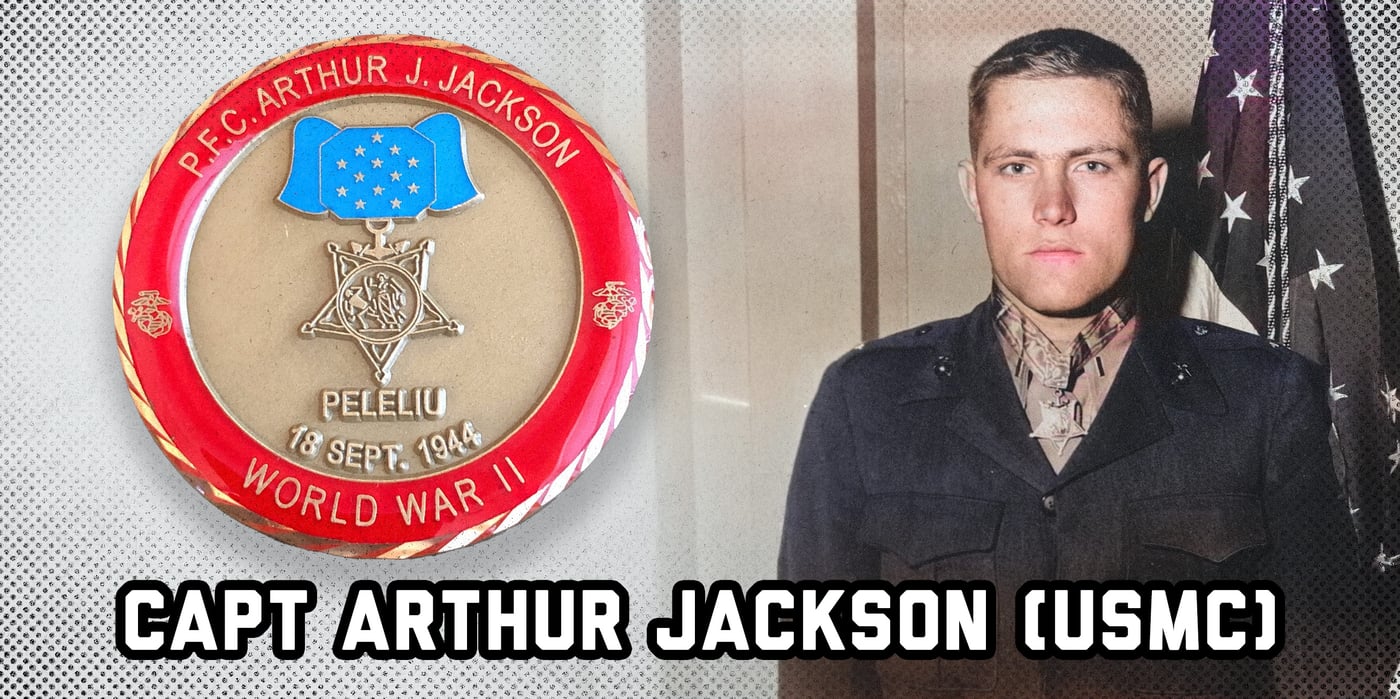

Arthur Jackson was a native of Canton, Ohio, the son of Arthur Sr. and Zara. His father was a watchmaker who struggled to make ends meet, so they moved to Portland, Oregon, before World War II for better prospects. Young Arthur was always working odd jobs to help. He graduated from Grant High School, having lettered in baseball, football, and track. He then moved to Alaska and was employed for the construction of new naval air station runways near Sitka. It was there that he met Marines, sparking his interest in the Marine Corps.
In November 1942, he returned to Portland and applied for Navy flight training but did not make the cut, so early in 1943 he enlisted in the Marine Corps.
After his initial training, he shipped out to the Pacific theater as an automatic rifleman with 3rd Battalion, 7th Marines Regiment, 1st Marine Division. In September 1944, his Battalion was on the front lines of the Battle of Peleliu, an important strategic island stepping stone to retake the Philippines. It was a brutal battle, much more difficult than anticipated.
As Jackson recalls: “When we hit the beach, we landed in about seven feet of water. Once I started getting about knee deep in the water, I looked down that beach in both directions, and it was on fire.” Once on the beach, he ran for cover, ending up with another Marine unit until reuniting with his own platoon near the island’s airstrip.
Tasked with securing the south end of the island, on 18 September, his unit was pinned down under a hail of enemy fire. His commanding officer asked if he could get through that field of fire to neutralize the Japanese machine-gun bunkers. He grabbed all the ammo and grenades he could carry and charged toward the bunkers — those who were with him were wounded, but he made it through, saying later, “I was just unbelievably lucky that day.”
Reaching the first bunker, he tossed in a phosphorous grenade and recalled: “The smoke just poured out of that bunker entrance. That gave me lots of cover.” At the next pillbox with about 35 enemy fighters inside, he unloaded automatic fire into the opening, and then, with his squad leader, stuffed about 40 pounds of plastic explosives through the entrance.
He recalls: “I had about a 30-second time fuse — just a small piece of time fuse — and a striker. I just set that thing on fire, and then I took off running. And just about the time I dove into a [bomb crater] and covered myself up in the fetal position, logs, stones, earth — honest to God, it was an unbelievable amount of stuff that went up 40, 50, 60 foot. I thought, ‘Boy, I’m going to be done in by my own stupidity. But when the dust all settled, there was no more bunker.”
Surviving the rain of heavy debris, having taken out all of the enemy in that bunker, he said, “I still had ammo left, and I just figured I’d better get to as many of these [bunkers] as I can.”
And that he did, earning a Medal of Honor before the day was over.
According to his Medal of Honor citation:
Advancing alone under the continuous fire from other hostile emplacements, he employed similar means to smash two smaller positions in the immediate vicinity. Determined to crush the entire pocket of resistance although harassed on all sides by the shattering blasts of Japanese weapons and covered only by small rifle parties, he stormed one gun position after another, dealing death and destruction to the savagely fighting enemy in his inexorable drive against the remaining defenses, and succeeded in wiping out a total of 12 pillboxes and 50 Japanese soldiers. Stouthearted and indomitable despite the terrific odds, Pfc. Jackson resolutely maintained control of the platoon’s left flank movement throughout his valiant one-man assault and, by his cool decision and relentless fighting spirit during a critical situation, contributed essentially to the complete annihilation of the enemy in the southern sector of the island.
His citation concludes: “His gallant initiative and heroic conduct in the face of extreme peril reflect the highest credit upon Pfc. Jackson and the U.S. Naval Service.”
You can watch Jackson tell his service story in this living history video.
In retrospect, Arthur says: “To this day, I don’t understand why they didn’t vacate some of those positions and come after me. They must have thought I was more than one person doing this.”
In the continuing battle that day, Arthur was wounded, and the bullet was lodged a millimeter from his jugular vein — what would have been a quick death. His doctor told him, “If you had rolled over or turned your head in the wrong way, you’d be a dead man.”
Before VJ Day, Jackson received a field commission as a second lieutenant. A month later, he was notified that he was being sent to Washington to receive the Medal of Honor from President Harry Truman. There was also a ticker tape parade in New York, where he and his family were joined by other recipients, including fellow Marine LtCol Gregory “Pappy” Boyington. He recalls: “We had one hell of a time. That was the highlight of my dad’s life.”
After World War II, he gave up his Marine commission to enlist in the Army as a Master Sergeant so he could serve during the occupation of China. He then served through the Korean War, attaining the rank of Captain. In 1959, he returned to the Marine Corps until again going back to the Army, where he retired as a reservist in 1984. (That must be some kind of record for switching service branches.)
Arthur and his family moved to Idaho, where he died in 2017. He was interred in the Idaho Veterans State Cemetery.
Capt Arthur Jackson: An ordinary man faced with extraordinary circumstances, you summoned the greatest measure of courage to place your life in imminent peril to save others. Your example of valor — a humble American Patriot defending Liberty for all above and beyond the call of duty — is eternal.
“Greater love has no one than this, to lay down one’s life for his friends.” (John 15:13)
Live your life worthy of his sacrifice.
(Read more Profiles of Valor here.)
Semper Vigilans Fortis Paratus et Fidelis
Pro Deo et Libertate — 1776
[Follow Mark Alexander on X/Twitter.](https://twitter.com/MAlexander1776)
Join us in daily prayer for our Patriots in uniform standing in harm’s way in defense of American Liberty, and for the families awaiting their safe return. Pray also for our Veterans, First Responders, and their families.
Please consider a designated gift to support the National Medal of Honor Sustaining Fund’s character education initiatives through Patriot Foundation Trust, or make a check payable to “NMoH Sustaining Fund” and mail it to:
Generosity Trust
National MOH Sustaining Fund
345 Frazier Avenue, Unit 205
Chattanooga TN 37405
Thank you for supporting our nation’s premier journal of American Liberty.