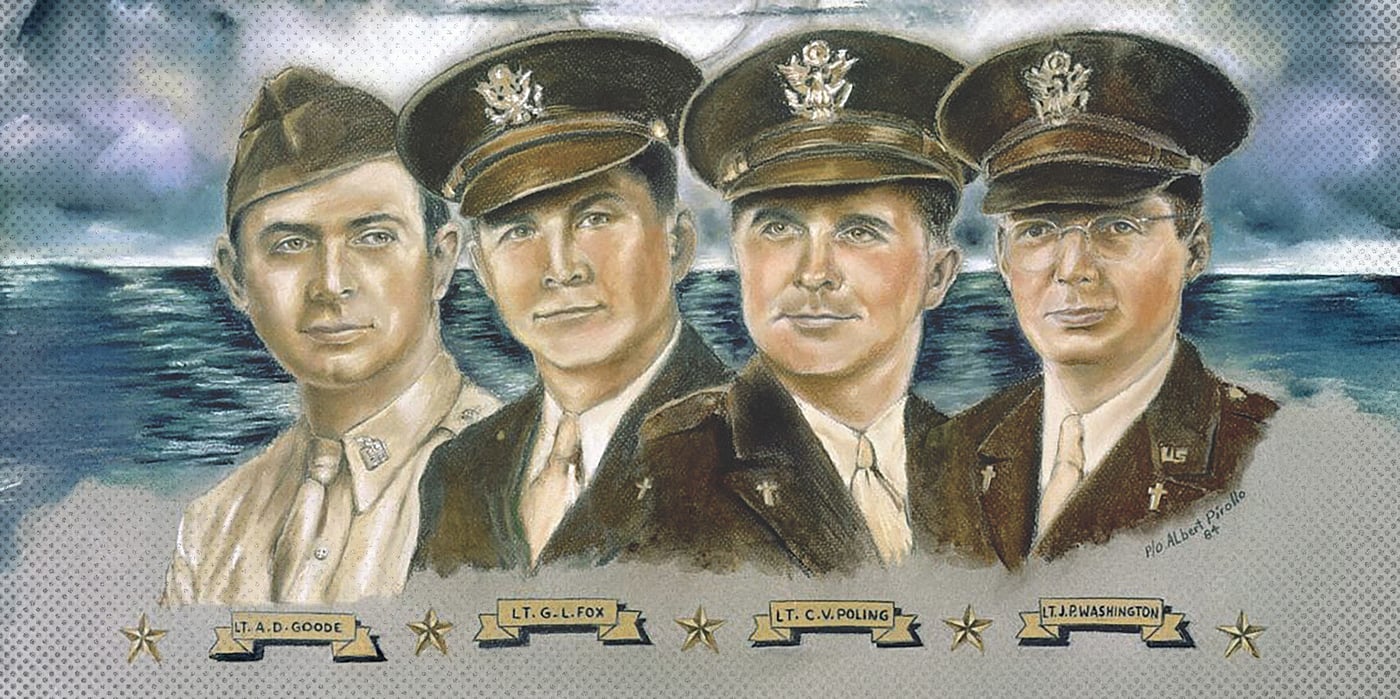

This week, we observe the faithful devotion, sacrifice, and fate of four Chaplains who were aboard the USAT Dorchester, a 5,649-ton civilian luxury liner that, during World War II, was converted for military service as a troop transport.
In January 1943, Dorchester left the port of New York with 902 souls on board — 597 service members, 171 civilian workers, 130 merchant seamen, and four Chaplains: LT George Fox (a Methodist minister from Pennsylvania), LT Alexander Goode (a Reform rabbi from New York), LT Clark Poling (a Reformed Church in America minister from Ohio), and LT John Washington (a Roman Catholic priest from New Jersey). The Chaplains met at Harvard’s Army Chaplains School, where they were trained for assignments in the European theater, for which they were en route.
The Dorchester was part of the SG-19 convoy being escorted by the Coast Guard Cutters Tampa, Escanaba, and Comanche through “Torpedo Junction.”
Late in the evening of 2 February, the ship’s Merchant Marine Captain, Hans Danielsen, was alerted by the Coast Guard that they had sonar detection of a submarine. The convoy was 150 miles from their Army base destination in Greenland, and as the day grew dark, he issued this order: “Now hear this: This concerns every soldier. Now hear this: Every soldier is ordered to sleep in his clothes and life jacket. Repeat, this is an order! We have a submarine following us. ... If we make it through the night, in the morning, we will have air protection from Blue West One, which is the code name for the air base in Greenland, and of course, we will have protection until we reach port.”
At 00:50 on 3 February, a periscope broke the frigid waters of the North Atlantic as the German sub U-223 approached the convoy off the coast of Newfoundland. The commander of U-223 ordered torpedoes fired, and at 00:55, one hit the Dorchester starboard dead center. In less than 20 minutes, she would sink.
Danielsen ordered a rapid evacuation as the Chaplains helped with the wounded. As the remaining lifejackets were distributed, the supply ran out, and in the minutes that followed, the Chaplains removed their own jackets and gave them to others.
PFC Walter Miller recalled the terror-filled voice of a soldier screaming, “I can’t find my life jacket.” As he turned toward that voice, he heard Chaplain Fox say, “Here’s one, soldier,” as the Chaplain removed his vest and put it on the soldier.
Petty Officer John Mahoney attempted to return to his quarters to get gloves as protection. He was confronted by Chaplain Goode, who told Mahoney, “Don’t bother, I have another pair. You can have these.” But Goode did not have two pairs, and Mahoney says that at that moment he realized Goode was not leaving the Dorchester.
The Chaplains continued helping with the evacuation, getting men into a few lifeboats until they were filled, some of which capsized due to overcapacity. Almost 700 others dove into the freezing water with faint hope of being rescued by the Coast Guard vessels. The Chaplains prayed and sang hymns as the ship sank below the seas.
Survivor Grady Clark recalls as he swam away from the sinking ship: “I looked back. The flares had lighted everything. The bow came up high, and she slid under. The last thing I saw the four chaplains were up there praying for the safety of the men. They had done everything they could. I did not see them again. They themselves did not have a chance without their lifejackets.”
PFC William Bednar, floating in the heavy oiled surface water and surrounded by the dead and dying, said: “I could hear men crying, pleading, praying. I could also hear the chaplains preaching courage. Their voices were the only thing that kept me going.”
John Ladd, who witnessed the Chaplains’ actions, said, “It was the finest thing I have seen or hope to see this side of heaven.”
From the dark night waters, the CGC Comanche was able to rescue 97 survivors, and the CGC Escanaba rescued an additional 132 survivors. The third cutter, CGC Tampa, continued escorting the remaining two ships in the convoy to safety.
By daybreak, only 230 of the 902 men had been rescued — 668 of those remaining succumbed to hypothermia in the 36-degree water and Arctic air, and four Chaplains perished on deck.
For their actions, Chaplains Fox, Goode, Poling, and Washington were posthumously awarded Distinguished Service Crosses, the Army’s second-highest military decoration below the Medal of Honor. They were also awarded Purple Hearts. Additionally, in 1960, Congress authorized the “Four Chaplains’ Medal,” which was awarded to the families of each of the Chaplains. Those medals were awarded once and, according to the Four Chaplains Memorial Foundation, then retired.
Since 1943, military and civilian groups have held ceremonies honoring the Chaplains, and in 1998, by Senate Resolution, 3 February was officially recognized as Four Chaplains Day.
At the Army’s recent FCD observance, MG Bill Green Jr., the Chief of Chaplains, noted: “Despite their differences, the four chaplains were united in their desire to provide comfort, care, and calm to their shipmates as everyone abandoned the ship. They made the ultimate sacrifice. ... Chaplains have been a strong, steady, and courageous presence in every major conflict beginning with the Revolutionary War, and today we continue building spiritual readiness so that our soldiers can endure in any future fight.”
The Four Chaplains’ example of valor — humble American Patriots placing the lives of others above their own — is eternal.
Footnote: U-233 escaped after firing the fatal torpedo that sank the USAT Dorchester. But the following year, it was sunk by a British destroyer, with the loss of almost its entire crew. In 2000, the Four Chaplains Memorial Foundation brought two U-233 survivors, Kurt Rosser and first officer Gerhard Buske, to Washington, where they attended memorial ceremonies, toured the Holocaust Museum, and met with Dorchester family members. Buske observed, “We ought to love when others hate. ... We can bring faith where doubt threatens; we can awaken hope where despair exists; we can light up a light where darkness reigns; we can bring joy where sorrow dominates.”
(There are nine Chaplains who are recipients of the Medal of Honor. I invite you to read about one of them, CPT Father Emil Kapaun (USA).)
“Greater love has no one than this, to lay down one’s life for his friends.” (John 15:13)
Live your life worthy of their sacrifice.
(Read more Profiles of Valor here.)
Semper Vigilans Fortis Paratus et Fidelis
Pro Deo et Libertate — 1776
[Follow Mark Alexander on X/Twitter.](https://twitter.com/MAlexander1776)
Join us in daily prayer for our Patriots in uniform standing in harm’s way in defense of American Liberty, and for the families awaiting their safe return. Pray also for our Veterans, First Responders, and their families.
Thank you for supporting our nation’s premier journal of American Liberty.
The Patriot Post and Patriot Foundation Trust, in keeping with our our Military Mission of Service to our uniformed service members and veterans, are proud to support and promote the National Medal of Honor Heritage Center, the Congressional Medal of Honor Society, both Honoring Their Sacrifice Foundation and Warrior Freedom Service Dogs aiding wounded veterans, Tunnel to Towers Foundation, the National Veterans Entrepreneurship Program, the Folds of Honor outreach and Officer Christian Fellowship, the Air University Foundation and Naval War College Foundation, and the Naval Aviation Museum Foundation.