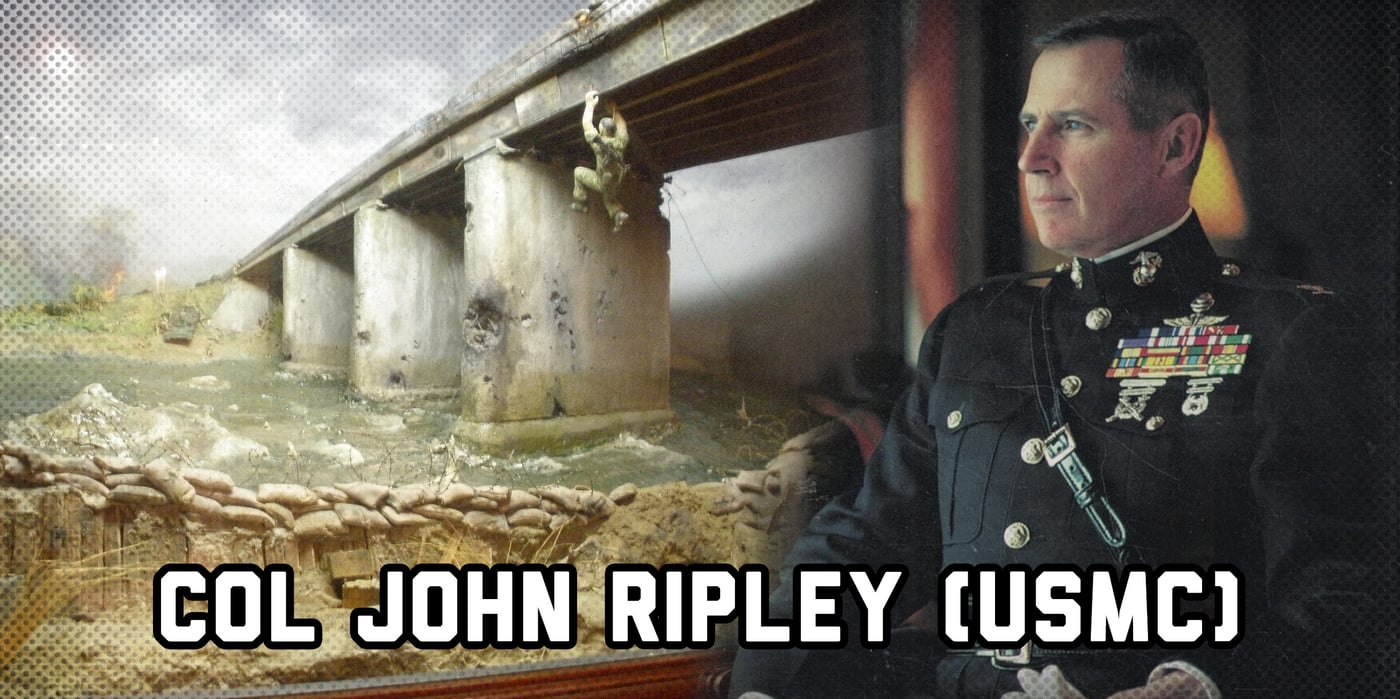

Being the week we celebrate Easter this year, it is appropriate to recognize John Ripley, who, on Easter Sunday in April 1972 in Vietnam, earned his irrevocable status as a Marine legend.
John was born in Radford, Virginia. After graduating from high school, he enlisted in the Marine Corps at age 17. A year later, he received an appointment to the U.S. Naval Academy.
He graduated from USNA in 1962 with a BA degree in electrical engineering and was commissioned as a second lieutenant with the Marine Corps. After completing The Basic School, he deployed with the Marine detachment on the USS Independence, and after completing his sea duty, he joined 2nd Battalion, 2nd Marines. In 1965, then-1stLt Ripley was transferred to 2nd Force Reconnaissance Company and deployed to South Vietnam.
In 1966, he transferred to 3rd Battalion, 3rd Marines and was promoted to Captain, serving as company commander of Lima Company, which became revered as “Ripley’s Raiders.” He was wounded in action but returned to complete his tour.
John returned stateside to complete the Amphibious Warfare School and served at Marine Headquarters until 1969, when he became an exchange officer with the British Royal Marines and Special Boat Service. He completed their Marine Commando Course in Lympstone, England, and served in Singapore with the 3rd Commando Brigade, including several months of service with the famous Gurkha Rifles.
In 1971, he returned for a second tour in Vietnam as the Senior Advisor to the 3rd Vietnamese Marine Battalion operating along the Demilitarized Zone. Over the course of his two tours, he participated in 26 major operations in the famous “Leatherneck Square” area of Dong Ha, Con Tien, and Khe Sanh.
On Easter morning in April 1972, the North Vietnamese launched their Easter Offensive, a three-pronged invasion of South Vietnam by 120,000 NVA troops and 600 heavy tanks. On that day, Capt Ripley’s heroic actions earned him a Navy Cross, the USN’s second-highest award under the Medal of Honor.
According to his citation:
Upon receipt of a report that a rapidly moving, mechanized, North Vietnamese army force, estimated at reinforced divisional strength, was attacking south along Route #1, the Third Vietnamese Marine Infantry Battalion was positioned to defend a key village and the surrounding area. It became imperative that a vital river bridge be destroyed if the overall security of the northern provinces of Military Region One was to be maintained.
His citation continues:
Advancing to the bridge to personally supervise this most dangerous but vitally important assignment, Captain Ripley located a large amount of explosives which had been pre-positioned there earlier, access to which was blocked by a chain-link fence. In order to reposition the approximately 500 pounds of explosives, Captain Ripley was obliged to reach up and hand-walk along the beams while his body dangled beneath the bridge. On five separate occasions, in the face of constant enemy fire, he moved to points along the bridge and, with the aid of another advisor who pushed the explosives to him, securely emplaced them. He then detonated the charges and destroyed the bridge, thereby stopping the enemy assault.
His citation concludes: “By his heroic actions and extraordinary courage, Captain Ripley undoubtedly was instrumental in saving an untold number of lives. His inspiring efforts reflected great credit upon himself, the Marine Corps, and the United States Naval Service.”
Do you get the picture here?
Ripley repeatedly, over three hours, moved hand over hand, grabbing the bridge girders overhead to place more than 500 pounds of explosives at critical points under Dong Ha Bridge. He hung from the bottom of the bridge while being shot at by enemy soldiers in order to stop the advance of 20,000 North Vietnamese and 200 tanks preparing to cross the Cua Viet River.
In an interview with the U.S. Naval Institute, Ripley said: “I’m dangling under the bridge and hanging by my arms with a full load of explosives. I would drop down out of the steel, grabbing the flanges of the I-beam; swing sideways, and leap over to hand walk all the way out over the river.”
Receiving small-arms sniper fire was bad enough, but eventually a tank fired at his position under the bridge, and the round ricocheted near him, exploding on the bank below his position. He recalls, “Boy, when that 100mm round went off with me in the steel of the bridge, what a racket.”
He said he never thought he would survive the ordeal: “The idea that I would be able even finish the job before the enemy got me was ludicrous. When you know you’re not going to make it, a wonderful thing happens: You stop being cluttered by the feeling that you’re going to save your butt.”
He constantly repeated a simple prayer for courage and clarity: “Jesus, Mary, get me there; get me there.”
That reminds me of another heroic American from an earlier war: Desmond Doss, who, through a night of terror rescuing wounded Americans from the top of Hacksaw Ridge, repeatedly prayed, “Lord, please help me get one more man.”
After placing the final time-fused blasting caps, Ripley managed to get off the bridge just moments before the detonation, which threw him into the air: “I’m lying on my back, looking skyward, and I can see enormous chunks of this bridge going through the air. It was a tremendous feeling.”
The resulting logjam of NVA tanks and personnel became easy pickings for U.S. attack aircraft and our warships off the coast. In no small measure because of Ripley’s heroic actions, the Easter Offensive failed.
In a conversation this week, my friend MG Bill Raines (USA), whom I previously mentioned in a profile when he returned to Vietnam to find the crash site of our friend LtCol Bill Gauntt (USAF), discussed Ripley’s actions. Bill also served at a firebase near the Cua Viet River in the DMZ. He says the Dong Ha Bridge was 500 feet long, to put in perspective what Ripley did. He revisited the area on his return with Gauntt because the site of his F-4 crash was just north of the bridge.
John Ripley also returned to Vietnam with some of his buddies from L/3/3 Marines in 1997 to visit the Dong Ha Bridge. In 2002, he became the first Marine officer to receive the “Distinguished Graduate Award” from the U.S. Naval Academy, its highest and most prestigious award. In October 2006, John again returned to Vietnam to help film a documentary of his actions at the Dong Ha Bridge.
On 11 June 2008, Ripley became the first Marine to be inducted into the U.S. Army Ranger Hall of Fame.
He died four months later on 28 October 2008, but his heroic actions were further immortalized in the 2009 biography [An American Knight](https://amzn.asia/d/0gWKtXMf) by Norman Fulkerson.
Moreover, on 3 March 2026, Congress passed a bill authorizing Ripley’s Navy Cross to be upgraded to the Medal of Honor.
His son Tom said his father would want proper credit given to those who supported him, trained him, and served alongside him, especially the 300 men of the 3rd Vietnamese Marine Battalion who fought to hold off the NVA while Ripley placed the explosives on the Dong Ha Bridge. Only 60 of those South Vietnamese Marines survived the battle.
Tom says of his dad, “He knew nothing great is ever accomplished by the individual,” and his actions reflected his personal mantra: “Mission first, Marines always.” He added, “My father resigned himself to, ‘I’m probably not making it out of here. I have a job to do. I’m a United States Marine. That’s what we do.’”
He said his father embraced this Winston Churchill quote: “To each, there comes in their lifetime a special moment when they are figuratively tapped on the shoulder and offered the chance to do a very special thing, unique to them and fitted to their talents. What a tragedy if that moment finds them unprepared or unqualified for that which could have been their finest hour.”
Col John Ripley: An ordinary man faced with extraordinary circumstances, he summoned the greatest measure of courage to place his life in imminent peril to save others. Your example of valor — a humble American Patriot defending Liberty for all above and beyond the call of duty — is eternal. Live your life worthy of his sacrifice.
“Greater love has no one than this, to lay down one’s life for his friends.” (John 15:13)
(Read more Profiles of Valor here.)
Semper Vigilans Fortis Paratus et Fidelis
Pro Deo et Libertate — 1776
[Follow Mark Alexander on X/Twitter.](https://twitter.com/MAlexander1776)
Join us in daily prayer for our Patriots in uniform standing in harm’s way in defense of American Liberty, and for the families awaiting their safe return. Pray also for our Veterans, First Responders, and their families.
Please consider a designated gift to support the National Medal of Honor Sustaining Fund’s character education initiatives through Patriot Foundation Trust, or make a check payable to “NMoH Sustaining Fund” and mail it to:
Generosity Trust
National MOH Sustaining Fund
345 Frazier Avenue, Unit 205
Chattanooga TN 37405
Thank you for supporting our nation’s premier journal of American Liberty.