
My morning walks with Murph and Ellie — my 75-pound Lab-Pit Bull terrier mix and my daughter’s irrepressible Labradoodle — tend to provoke a certain kind of reflective irritation, especially when who is on which end of the leash is in debate.
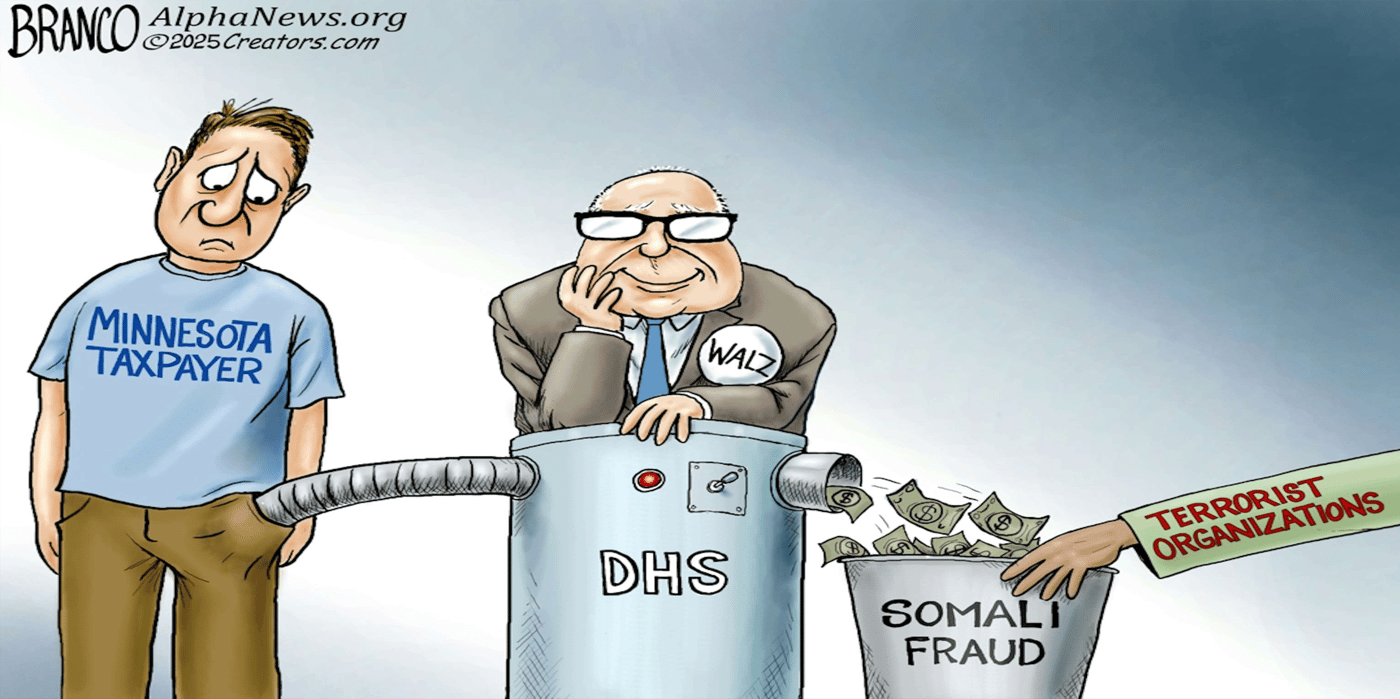
One morning’s musings circled back to Minnesota, where an expanding fraud scandal, a paralyzed political establishment, and a governing class allergic to accountability have converged into something perilously close to a civic unraveling. What’s unfolding there is not simply a local embarrassment but a revealing glimpse into how the modern Democrat political machine now operates.
The state’s leadership, from Attorney General Keith Ellison to Representative Ilhan Omar to Governor Tim Walz — recently elevated as the party’s 2024 vice presidential nominee — treats the widening scandal over massive misappropriation of federal funds as little more than a minor cultural misunderstanding. Estimated losses run into the billions. Federal dollars evaporated into an ecosystem of shell organizations, sham nonprofits, and opportunistic intermediaries while state officials looked the other way. If the Biden-era FBI was not so preoccupied with monitoring PTA parents and catechism-going Catholics, perhaps someone might have noticed sooner.
What struck me during the aforementioned morning walk was that Minnesota’s crisis is not merely a story of incompetence or negligence. It has the shape of something more coherent — a functioning model. The Minnesota Mogadishu dynamic, as it’s beginning to look, is less an aberration than a microcosm of the Democrat Party’s national strategy.
To see this clearly, consider the state’s political branding: the Democrat-Farmer-Labor (DFL) Party. The name implies a coalition of practical citizens: farmers rooted in the rhythms of nature and laborers whose livelihoods are inseparable from sweat, skill, and time. I grew up on a Mississippi farm and later worked in factories and construction yards; these communities earn their living the old-fashioned way. Their work is honest because reality doesn’t negotiate — machines either run or break, crops either yield or fail, and the weather can humiliate even the best-laid plans.
These voters once formed the backbone of Democrat support. But in Minnesota, as nationally, they have been displaced — culturally, politically, and economically — by a new favored constituency: migrants (legal or otherwise) who attract vast streams of federal assistance and whose presence materially alters the political arithmetic.
Why the shift? Four reasons stand out.
First, migrant populations draw extraordinary amounts of federal and state funding. A farmer whose crop drowned in a flood or a factory worker laid off after another plant moved to Guangdong does not generate the same emotional or political leverage as a newly arrived refugee family whose hardship can be endlessly invoked in press conferences and grant proposals.
Second, most migrant populations cannot vote immediately. At first glance, this seems like a drawback. But it actually spares Democrats from political accountability. A citizen who loses his job or farm may punish his representatives; a noncitizen dependent on state services cannot.
Third, census apportionment counts heads, not citizens. More bodies mean more congressional seats, more Electoral College votes, and more opportunities to redraw districts to entrench Democrat power. Republicans, only lately awakening to this reality, remain years behind.
Fourth, and most consequential, the flow of aid money creates enormous opportunities for political patronage. When billions move quickly through opaque channels, a portion always finds its way into friendly hands, political networks, and party infrastructure. It is no coincidence that the Democratic National Committee’s recent financial struggles align with the federal government tightening oversight over certain aid programs. When the spigot narrows, the machine sputters.
Minnesota’s farmers and laborers — the original DFL foundation — are discovering that the party bearing their name now operates on an entirely different incentive structure. Their interests have become secondary, their loyalty assumed, their contributions taken for granted.
Minnesota’s unfolding catastrophe is an early warning. It is the pilot project for a national strategy built on demographic reshuffling, fiscal exploitation, and political insulation.
Whether Minnesotans choose to recognize this — and whether voters elsewhere recognize the model being tested — will determine whether the state becomes a cautionary tale or a template for reform.