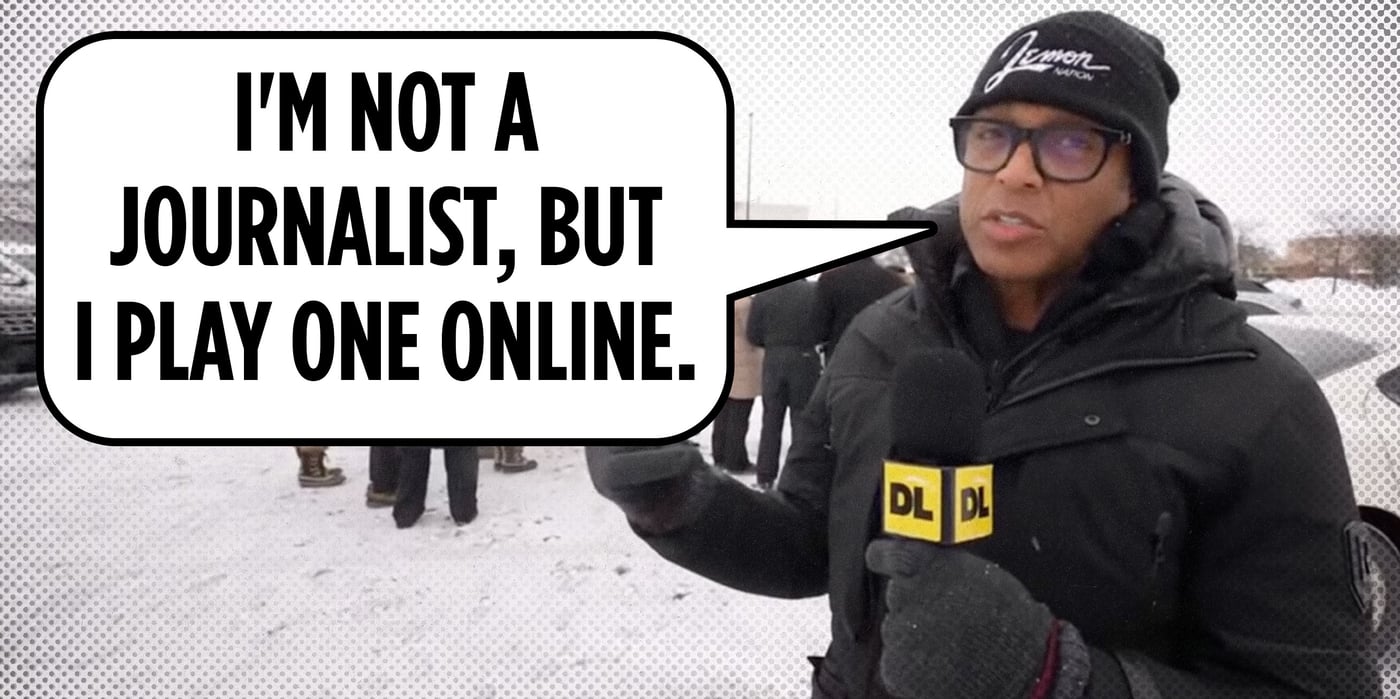

It was certainly feel-good news on Friday when disgraced former CNN host Don Lemon was arrested by federal agents just after midnight, at a Los Angeles hotel, where he was in town to cover the woke Grammys, for his livestreaming role in the outrageous and terroristic storming of a church earlier in the month, ostensibly to protest the ongoing lawful actions of U.S. Immigration and Customs Enforcement agents in nearby Minneapolis, apparently because one of the church’s pastors is also an ICE official.
As Fox News’s Bill Melugin reported, the arrests didn’t come easy, as federal authorities shopped for an arrest warrant before three successive judges, and they all refused to sign off on an arrest warrant.
As Attorney General Pam Bondi posted, “At my direction, early this morning federal agents arrested Don Lemon, Trahern Jeen Crews, Georgia Fort, and Jamael Lydell Lundy, in connection with the coordinated attack on Cities Church in St. Paul, Minnesota.”
Said lead church rioter Nekima Levy Armstrong, who clearly has no idea what slavery was like: “We had handcuffs on. As an African American Studies expert, it was the closest I was to sIavery!”
The good news is that Don Lemon could face up to a year in prison if convicted. The bad news is that the word “if” in the above sentence should be in 72-point bold font.
Lemon has lawyered up, and Abbe Lowell doesn’t tend to take cases that can’t be won. “The First Amendment exists to protect journalists whose role it is to shine light on the truth and hold those in power accountable,” Lowell said in a statement. “There is no more important time for people like Don to be doing this work.”
The First Amendment grants wide protections to those exercising their right to worship. This case, though, pits another widely protected First Amendment right — the right of a free press — against the right to worship.
Lemon, of course, will claim that he was just there within the church to cover a story. But that’s only part of the story, right? This was a premeditated attack on a church, which Lemon knew about and, it seems, conspired with the attackers prior to its execution. Furthermore, Lemon seemed to actually encourage the terrorism of the churchgoers by putting his camera in their faces and confronting the pastor.
Two things are clear, though: Lemon not only left terrified children in tears and in fear for their safety, but he also left his profession in the gutter. Which is no small feat, given the trial-lawyer-moonlighting-as-a-used-car-salesman reputation that our mainstream media currently enjoys.
Put another way: It’s impossible to fall off the floor, but Lemon actually found a trapdoor. His fellow journalists should sue him for reputational harm.
Journalists can’t break the law while covering the news. For example, a journalist can’t conspire with the bank robbers beforehand and then waltz in with the masked men and cover the robbery if he knows about it beforehand. And he absolutely did know about it beforehand, despite his denials.
If you watch his video, you’ll see that he’s in on the conspiracy. At one point, before the storming of the church, as his would-be terrorists are assembling, he steps away from the group to set the stage, telling his viewers that the group looks “MAGA coded, heh heh,” which means “white,” and then he adds this: “But there’s a reason they have so many white people here, I’m just gonna be honest, it’s because of the, the, what they’re, the operation that they’re doing today, it’s important to have allies, as I said, white allies here, um, so, that is, uh, what I can say. I turned our camera off of them because they’re giving some critical information here.”
So he’s selectively reporting, right? He’s protecting the leftist assailants by not reporting certain “critical information,” right? Does that make him a journalist or a fellow traveler? A journalist or an advocate? I think the answer is pretty clear.
As if there were any doubt, Lemon then says, “There we go. Everybody’s ready to go. Let’s go.” He then walks back to the group and says, “Thank you, guys, for being, thanks for allowing me to be here. Thank you, guys.” He then walks up to someone he knows well: Nekima Levy Armstrong, the leader of the “operation,” whom he then hugs and kisses on the cheek.
“How are you?” asks the genuflecting journalist. “Good to see you. We’re on. We’re not saying what it is, what’s going on, but thank you.”
Again, Lemon is selectively reporting. So he’s not engaged in journalism. He’s engaged in rioting against a church and its parishioners.
Does the First Amendment protect this sort of pseudo-journalism, even if it tramples on the constitutional rights of its victims? We’re about to find out. I’m guessing in a year or two.