
In a major blow to President Donald Trump and his entire economic and foreign policy agenda, the U.S. Supreme Court ruled this morning in Learning Resources v. Trump that Trump’s broad unilateral use of tariffs went well beyond his executive authority. To say this is a monumental ruling is to underestimate the situation.
The 6-3 ruling, in which conservative Justices Samual Alito, Clarence Thomas, and Brett Kavanaugh dissented, deals primarily with Trump’s use of the 1977 International Emergency Economic Powers Act to impose tariffs to avoid having to gain congressional approval. As I wrote after oral arguments in November, the justices appeared skeptical of the administration’s legal argument.
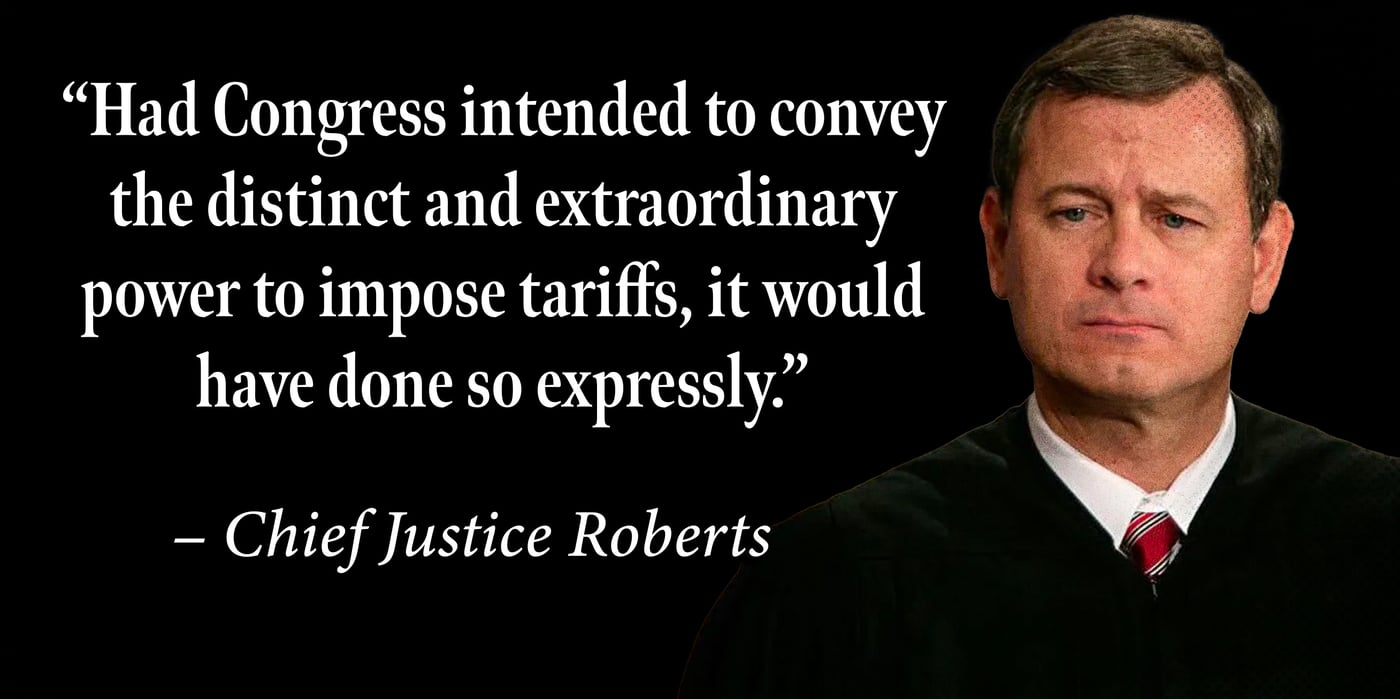
Indeed, writing for the majority, Chief Justice John Roberts stated, “Had Congress intended to convey the distinct and extraordinary power to impose tariffs, it would have done so expressly.”
“Based on two words separated by 16 others in Section 1702(a)(1)(B) of IEEPA — ‘regulate’ and ‘importation’ — the President asserts the independent power to impose tariffs on imports from any country, of any product, at any rate, for any amount of time,” Roberts wrote. “Those words cannot bear such weight.”
He added, “Recognizing the taxing power’s unique importance, and having just fought a revolution motivated in large part by ‘taxation without representation,’ the Framers gave Congress ‘alone ... access to the pockets of the people.’”
Furthermore, he wrote, it’s “telling that in IEEPA’s ‘half century of existence,’ no President has invoked the statute to impose any tariffs — let alone tariffs of this magnitude and scope.”
There were two categories of tariffs struck down by the ruling: one on Mexico, Canada, and China in retribution for the spread of fentanyl into the U.S., and another on virtually every other country in the world to balance trade deficits.
The president has previously claimed that the Court striking down his tariffs would be “the biggest threat in history” to U.S. national security and “would literally destroy the United States of America.” This morning, he called the ruling “a disgrace.”
He also said he had a backup plan, which almost certainly means reimplementing tariffs using another means because, again, his economic and foreign policy agendas largely hinge on tariffs as a tool.
In his 63-page dissent, Kavanaugh declared, “Although I firmly disagree with the Court’s holding today, the decision might not substantially constrain a President’s ability to order tariffs going forward, because numerous other federal statutes authorize the President to impose tariffs and might justify most (if not all) of the tariffs at issue in this case — albeit perhaps with a few additional procedural steps that IEEPA, as an emergency statute, does not require.”
He argued, “The tariffs at issue here may or may not be wise policy. But as a matter of text, history, and precedent, they are clearly lawful.”
Kavanaugh also noted a major looming problem: “The Court says nothing today about whether, and if so how, the Government should go about returning the billions of dollars that it has collected from importers. But that process is likely to be a ‘mess,’ as was acknowledged at oral argument.” What to do with $133 billion, he warned, will have “significant consequences for the U.S. Treasury.”
That mess may occupy lower courts for the foreseeable future. Do other nations get a refund? Or do the American consumers who actually pay tariffs?
Justice Thomas was equally pointed in his concurring dissent: “Neither the statutory text nor the Constitution provide a basis for ruling against the President. Congress authorized the President to ‘regulate ... importation.’ ... Throughout American history, the authority to ‘regulate importation’ has been understood to include the authority to impose duties on imports. ... Since the 1790s, Congress has consistently delegated to the President power over foreign commerce, including the power to impose duties on imports. ... This Court has consistently upheld Congress’s delegation of power [to the president] over foreign commerce, including the power to impose duties on imports.”
“Because the Constitution assigns Congress many powers that do not implicate the nondelegation doctrine, Congress may delegate the exercise of many powers to the President,” he added. “Congress has done so repeatedly since the founding, with this Court’s blessing.”
The ruling is an unfortunate one for the president, but Trump was making a high-stakes gamble.
“Until Trump,” reports The Wall Street Journal, “no president had invoked the emergency-powers law as a basis to impose tariffs. Three different lower courts ruled the tariffs unlawful, including a specialized federal appeals court of national jurisdiction that said the emergency-powers law didn’t authorize tariffs of the magnitude Trump imposed. Across the three decisions, 15 judges weighed in on Trump’s actions, with 11 concluding the president exceeded his authority.”
Responding to the decision, President Trump protested, “I am absolutely ashamed of certain members of the court for not having the courage to do what is right for our country. ... They’re just being fools and lapdogs for the RINOs and the radical left Democrats. They’re very unpatriotic and disloyal to our Constitution. The good news is that there are [other] methods, practices, statutes, and authorities, as recognized by the entire Court in this terrible decision. Therefore, effective immediately, all national security tariffs ... remain in place and in full force. Today, I will sign an order to impose a 10% global tariff under Section 122 over and above our normal tariffs already being charged. And we’re also initiating several Section 301 and other investigations to protect our country from unfair trading practices of other countries and companies.”
Notably, though Section 122 and 301 tariffs are subject to some limitations, those provisions are clear about the president’s authority to impose tariffs.
Finally, what I find particularly galling is John Roberts’s vote. This is the man who saved ObamaCare, a glaringly obvious constitutional abomination, by effectively rewriting the law’s language about tax versus penalty because he didn’t want to allow judges to determine political policy. Here he is effectively making the exact opposite argument to gut Trump’s political agenda.
He promised to be an “umpire” during his confirmation hearings, but we didn’t expect him to be Angel Hernandez.
[Follow Nate Jackson on X/Twitter](https://twitter.com/NatriotJackson).
(Updated)