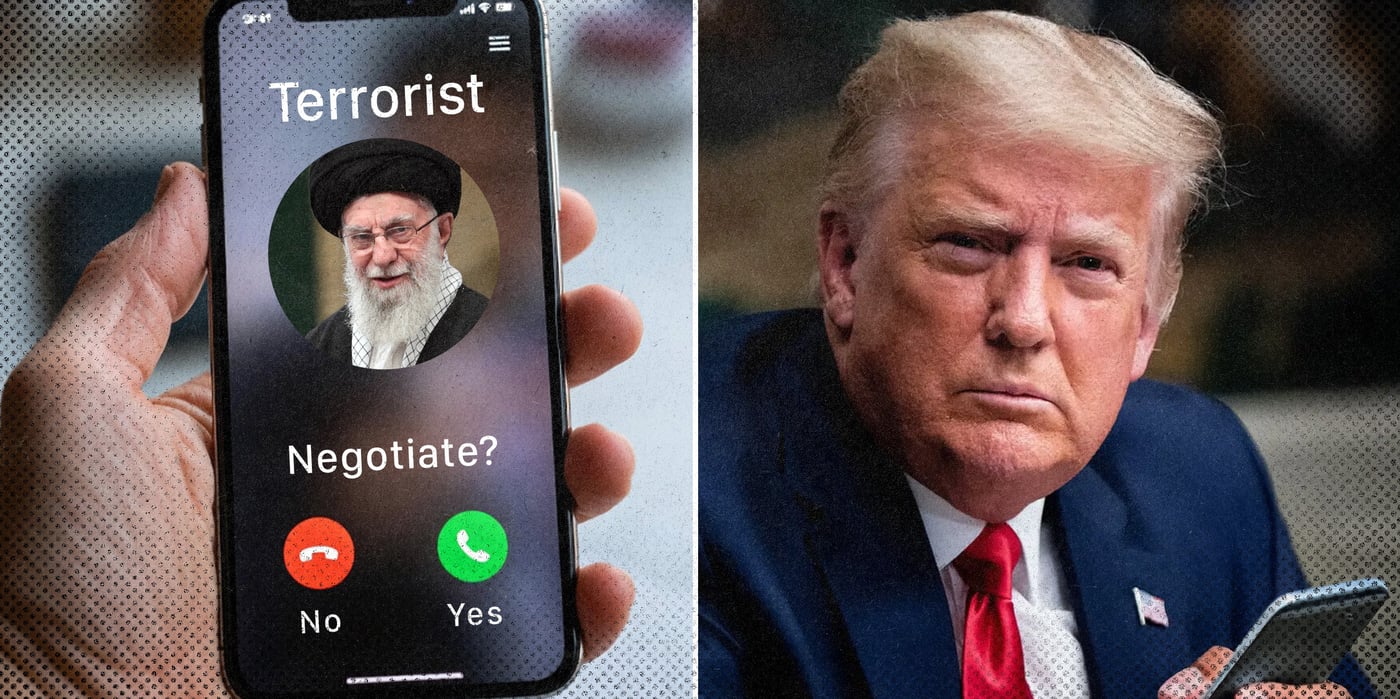

With all the speculation and scenarios swirling around what, if anything, the Trump administration will do in Iran, one thing remains clear: President Donald Trump hasn’t made a decision yet. That is both intentional, not wanting to show his hand, and strategic, allowing for negotiations to be possible.
Trump stated at the Board of Peace meeting in Washington, “We may have to take it a step further, or we may not. Maybe we’re going to make a deal. You are going to be finding out over the next, probably, 10 days.”
We all know that “negotiating” with Iran has proven fruitful only for one country — Iran. It is never possible to negotiate with terrorists who want you dead and your country annihilated. Any “deals” that have been made have only emboldened and allowed Iran to continue its nuclear program and terrorist support around the world. Attempting to “reason” with them only gives the mullahs the advantage of more time. It’s understandable that, from a diplomatic perspective, Trump and the Pentagon are making it appear they are doing what they can peacefully, but anyone with common sense and historical knowledge can see that trying to “negotiate” with Tehran has always been and will always be useless.
“Now is the time for Iran to join us on a path that will complete what we’re doing. And if they join us, that’ll be great. If they don’t join us, that’ll be great too, and it’ll be a very different path,” Trump added. “They cannot continue to threaten the stability of the entire region. And they must make a deal, or if that doesn’t happen ... bad things will happen.” We heard the president give similar warnings to the Venezuelan regime, and then they found out.
Some are fearmongering that the U.S. is going to go to war with Iran, citing the massive military buildup in the Middle East. They also say that the U.S. has constantly been involved in forever wars in the Middle East and that we can’t seem to get out of them. A full-blown war seems highly unlikely given Trump’s track record of avoiding war. The other reason not to believe the hype is that we have evidence from what Trump did in Venezuela. If anything, it’s going to be a similar operation, probably jointly with Israel, where we take out the people unwilling to work with us and ensure the people who replace them are more amenable to dealing with the U.S. However, if this operation occurs, it will surely prove vastly more complex, taking weeks rather than days. Trump again warned Iran that it faced a “traumatic” moment if it doesn’t make a “deal.”
The usual suspects are also making the argument that Trump is doing all this to advance Israel’s interests and claiming that Iran needs “conventional” weapons such as mid-range ballistic missiles to be a deterrent for adversaries, such as Israel, “from attacking it on a whim.” Israel doesn’t attack anyone, let alone Iran, “on a whim.” The Israelis have attacked in self-defense against attacks on them.
Moreover, you cannot extricate Israel’s interests from ours in regard to Iran because the mullahs have made it abundantly clear they want to annihilate both Israel and the U.S. Regardless of whether it advances Israel’s interests, getting rid of a radical theocratic regime with nukes that funds terrorist proxies will almost certainly create more stability for the entire Middle East.
It will be a bad look for Trump and his administration if they don’t follow through on their threats, which would not only embolden Iran but also China and Russia. It will be an egregious error if he promised the Iranian people that “help is on the way” and then, after 40,000 people are massacred, no help comes.
If there’s one thing we know for certain about Trump, it’s that he doesn’t like to look bad. As we’ve witnessed many times over, he is willing to follow through on his threats when forced. With the buildup over recent weeks, Trump is poised to keep his promises. “Over the past few days,” The Wall Street Journal reports, “the U.S. has continued to move cutting-edge F-35 and F-22 jet fighters toward the Middle East, according to flight-tracking data and a U.S. official. A second aircraft carrier loaded with attack and electronic-warfare planes is on the way. Command-and-control aircraft, which are vital for orchestrating large air campaigns, are inbound. And critical air defenses have been deployed to the region in recent weeks.”
Iran is not completely defenseless, though, and could become dangerous if backed into a corner. It has a sizable missile arsenal that could be used to fire at U.S. bases and allies in the region. Although the U.S. and Israel have the capability to take most of those down and destroy launch sites, some could get through and do damage. Iran could use its military to attempt to close the Strait of Hormuz and disrupt that vital sea lane, but the U.S. is hoping that the vast number of forces in the region will deter it from attacking at all.
Regarding reports of full-scale war with Iran, Trump commented on Truth Social, “Everything that has been written about a potential War with Iran has been written incorrectly, and purposefully so. I am the one that makes the decision, I would rather have a Deal than not but, if we don’t make a Deal, it will be a very bad day for that Country and, very sadly, its people, because they are great and wonderful, and something like this should never have happened to them.”
Talks between U.S. and Iranian officials are scheduled to resume this week in Geneva.
What are some of the operational options on the table if a diplomatic agreement cannot be reached? The Journal writes, “The options include a campaign to kill scores of Iranian political and military leaders, with the goal of overthrowing the government, U.S. and foreign officials said, as well as an air attack that would be limited to striking targets including nuclear and ballistic-missile facilities.”
Trump is asking for Iran’s nuclear programs to be eliminated, regional proxy forces to be disbanded, and ballistic missiles to be dismantled. It is highly doubtful the mullahs will agree to these terms. As Iranian Foreign Minister Abbas Araghchi touted on social media, “Curious to know why we do not capitulate? Because we are Iranian.”
They may agree to pause their nuclear enrichment program, but only to buy time until Trump is out of office. It would be a mistake to allow that and miss the opportunity to end the pointless and ceaseless cycle of “negotiating” with terrorists.