
Buckle up, folks. Things are happening fast.
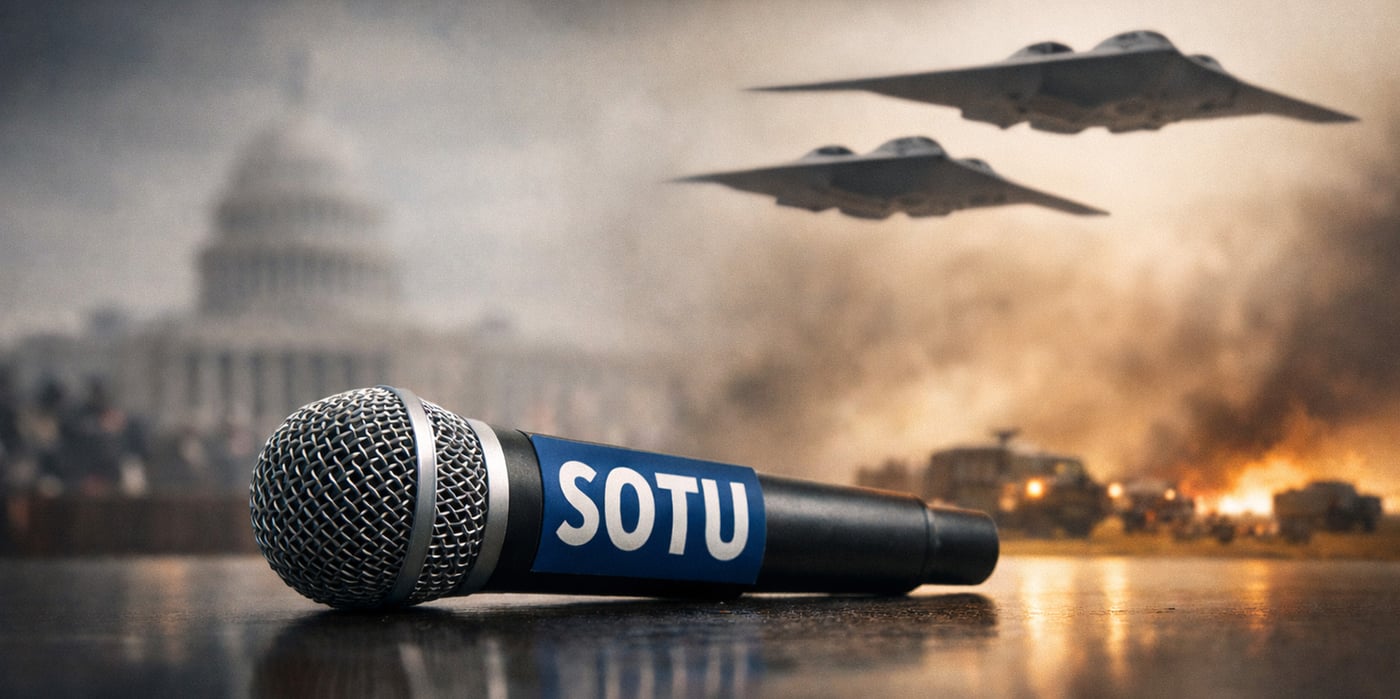
One week ago, the big news was the president’s State of the Union Address — well covered here and elsewhere. It was, in my view, most important because it demonstrated with unmistakable clarity that the current state of our union is, in a word, disunity.
On Saturday, February 28, we all awoke to the news of a massive coordinated attack against Iran by U.S. and Israeli military forces, anticipated but certainly risky. How long the hostilities will last (days, weeks, or longer) and how far they will spread (to a full-blown Middle East war?) are unknowable right now.
But we can be sure of one thing: Our nation at war, with our troops in harm’s way and with potential danger for the region and the world, is a circumstance that demands unity. Political disunity won’t work. We’ve learned firsthand how a deadly, unpopular war (e.g., Vietnam) can tear the country apart.
Much of the post-SOTU chatter last Tuesday night was about the president’s “performative” style (some liked it, others did not) and whether or not he satisfied Americans’ concerns about “affordability.” But in my view, the far more important takeaways were two stark revelations from the president’s interactions with the assembled members of Congress.
The first is the diametrically opposed differences between the Left and the Right on key issues facing the country, including but not limited to how we should deal with the consequences of mass illegal immigration during the previous administration. After the SOTU address, Democrats complained that Trump’s challenge to “stand up if you agree” that the government’s primary responsibility is to “protect our own citizens rather than illegal immigrants” was a cheap trick intended to make them look bad.
But tricky or not, his challenge was as straightforward as it could be. The angry confrontations between ICE agents trying to apprehend pre-identified criminal illegal immigrants and the protesters trying to impede them from doing so — with full-throated support from the governor and mayor — were precisely the distinction that crystallized weeks of street violence, and two unnecessary deaths, in Minneapolis earlier this year.
The other very troubling revelation exposed during last week’s SOTU — actually a confirmation of what we’ve been seeing for far too long — was the depth of personal contempt for the president held by many elected Democrat members of Congress. Seventy-three of them chose not to attend the SOTU address at all, and some expressed sentiments such as their preference for sticking needles or forks in their eyes rather than listening to our president talk about the state of the union. Nice.
Meanwhile, those who did attend sat sullenly, looking bored or, in some cases, yelling insults, heeding House Minority Leader Hakeem Jeffries’s suggestion that they convey “seated defiance” — this from the folks who regularly snipe at Trump for violating “norms” of behavior. It was not a good look.
The unmistakable conclusion here is that the reflexive rejection by Democrat members of Congress of all actions by the Trump administration is prompted not by ideological differences but by personal animosity. They detest the president and therefore oppose everything he says or does.
Four days after that controversial SOTU address, we find ourselves leading a shooting war in the Middle East.
There are legitimate reasons why many Americans strenuously object to our nation starting any war, even against an adversary as problematic as Iran. Peace is always preferable to war. War’s inevitably devastating consequences, primarily to innocent civilians, are unavoidable. The Iranian threat to America is real, but probably not imminent — we’ve managed to live with it for years.
Moreover, we’ve not yet exhausted all possible ways to prevent Iran from building or acquiring a nuclear arsenal. And history, including our own, tells us that even well-intended attempts to forcefully impose regime change on other countries rarely achieve the desired outcome.
There are political reasons (excuses, actually) as well for avoiding this particular war. It plays right into the Democrat Trump-is-Hitler fantasy — the narrative so enticing that we’re sure to hear it ad nauseam: “There he goes again! Just like we predicted, the wannabe dictator is mobilizing his armed forces to impose his will worldwide!”
On the other side of the coin, there are very sensible reasons for joining with Israel in taking the fight to Iran right now, as we just did. Arguably, both countries are already at war with Iran and have been for decades — or more precisely, Iran has been at war with us for decades, killing Americans and Israelis at will. Their “death to America” chants and vows to “eradicate Israel from the map” are quite real. Iran or its proxies have jailed and tortured American citizens. They killed 241 U.S. Marines in Lebanon in 1983. Their IEDs killed thousands of American troops in Afghanistan. They routinely fire missiles into Israeli territory. They sponsored the Hamas barbarity of October 7, 2023. It’s about time we punched back.
The current fanatic Iranian leadership is at war with its own citizens, reportedly murdering tens of thousands of protesters in the past month. Their economy has collapsed, and their military is badly depleted. Iran is the world’s leading exporter of terrorism, and so clearly we cannot allow it to acquire nuclear weapon capability — and yet it doggedly continues to try to do so. Regime change in Iran, as difficult as it may be to achieve, could stabilize the tempestuous Middle East for decades to come.
Right now, we have an opportunity, albeit a risky one, to resolve a long-standing problem that has plagued us for decades, one that allowed to fester could be our undoing. And whether you agree or disagree — either is a reasonable sentiment — our nation’s leadership has chosen a course of action, and it is time for our citizenry to stand behind it.
We’re not off to a good start on that. Most Americans (myself included) are instinctively taking their usual sides. On day one of the new war, The Wall Street Journal reported that Democrats are characterizing the U.S. attacks as “illegal” and “unconstitutional,” while most Republicans are rallying behind the president’s difficult decision. There were Iranian claims, uncorroborated so far, that the first day’s barrage destroyed a school, killing “at least 80 children.” The New Yorker dubbed it “Donald Trump’s capricious War.”
We’ve been down this road before. Half a century ago, a huge segment of the American citizenry joined forces in a powerful nationwide movement fiercely opposed to the unpopular Vietnam War. Their efforts were motivated largely by genuine disagreement with our nation’s involvement in what seemed to be a territorial conflict in a faraway nation. We know now that their antiwar concerns were legitimate — but we also know that their concerted opposition didn’t end the war; it protracted it, encouraging our enemy to remain engaged in a war of attrition that enabled them to win at the peace negotiations table what they could not win on the battlefield. The consequences were both lasting divisions at home and a war that continued for years longer than necessary, claiming an additional tens of thousands of American lives.
This is not like an Olympic hockey game that calls for enthusiastic exhortations of “USA! USA! USA!” from everyone. This one requires a responsible, mature, constructive response from all. American troops, our sons and daughters, are in harm’s way. Our country’s reputation, our stature as a world leader, and our national security are all at stake.
As American citizens in wartime, we must fully understand the situation, express our concerns and even our disagreements constructively, and at the same time support our nation unconditionally.