
Democrats are in campaign mode for this fall’s congressional elections, and they’re hoping to take back the White House in 2028. It’s no wonder the first thing they’re thinking of doing once in power is raising taxes on the rich.
Leftists like nothing more than taking money belonging to someone else. It’s how they create class division and resentment, pitting the working class against the “one percent.” And that’s why they didn’t stand during the State of the Union Address when President Donald Trump boasted about big tax cuts.
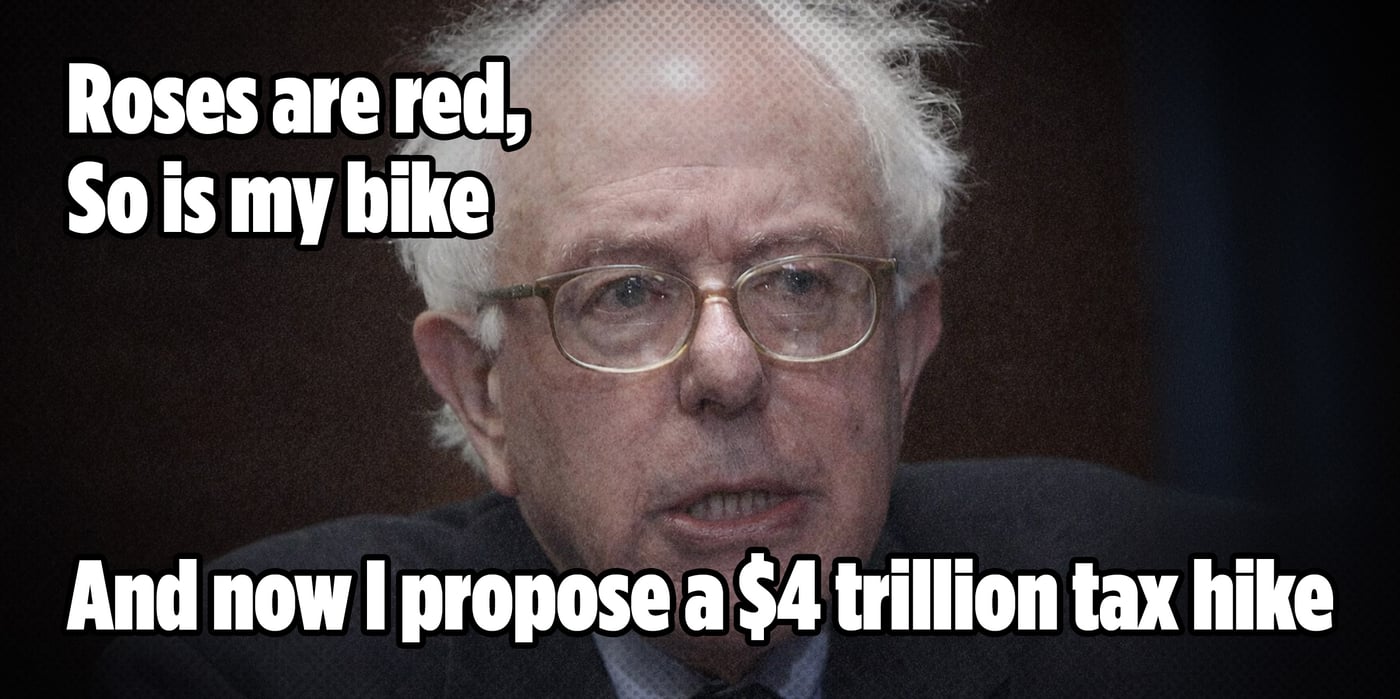
Now, Senator Bernie Sanders of Vermont and Representative Ro Khanna of California are proposing a multitrillion-dollar tax known as the Make Billionaires Pay Their Fair Share Act.
According to Fox Business, “The core of the proposal is a direct 5% annual wealth tax on assets, not just income, exceeding $1 billion. Sanders and Khanna project the bill to raise $4.4 trillion in revenue over 10 years. The measure would direct new tax revenue toward one-time $3,000 payments for individuals in households earning $150,000 or less, meaning a family of four could receive up to $12,000.”
Fox adds, “The $4.4 trillion in estimated revenue is earmarked for a massive expansion of the federal safety net and public infrastructure, including a more than $1 trillion Medicare and Medicaid expansion, building affordable homes, capping childcare costs, and establishing a minimum $60,000 salary for public school teachers.”
Sanders and Khanna are counting on the perception that billionaires are hoarding wealth and are somehow responsible for the working class struggling to pay their mortgages, car loans, and utility bills. In reality, billionaires create businesses that, in turn, expand job opportunities. They also invest in scientific and technological developments. Taking 5% of that wealth from 900 billionaires and passing out government checks might help some Americans in the short-term, but it’s political vote-buying, not a solution.
Despite the popular image, billionaires aren’t keeping stacks of dollar bills in their safes — or swimming in money bins full of gold coins. Much of their wealth isn’t even accessible as cash.
“Two-thirds of billionaire wealth is held in the form of equity,” Jack Nicastro writes at Reason Magazine, “affording private and publicly traded companies the capital required to improve their products, increase their headcount, and generate returns for their shareholders, many of whom are middle-class Americans with 401(k) plans and individual retirement accounts. (About 31 percent of billionaire wealth is held in liquid assets, such as bank deposits, much of which is also invested.) Just like the proposed 5 percent billionaire wealth tax in California, forcing large shareholders to prematurely liquidate their stocks would distort markets, decrease the amount of capital available to these companies to invest and hire workers, and lower the rate of return to shareholders.”
Sanders, a millionaire himself, is running around the country trying to convince others to get on board with tax-the-rich schemes. But even some prominent Democrats aren’t sure it’s a good idea. Just last month, Sanders tried to rally support for a similar billionaire tax in California but was met with opposition from the state’s party leaders.
NBC News expounds, “On one side, California Gov. Gavin Newsom, widely seen as a presidential hopeful, has lined up in opposition to the proposed ballot measure. So, too, have a handful of Democrats who are trying to succeed him as governor, including former Rep. Katie Porter, former Los Angeles Mayor Antonio Villaraigosa, and former U.S. Health Secretary Xavier Becerra. They’ve argued the initiative would drive wealthy investors and tech leaders from the state.”
For his part, Newsom warned the tax would be “really damaging to the state” and added, “I think it will be defeated because I think people understand what it does versus what it promotes to do.”
What it proposes to do is to make those who produce products, drive innovation, and create jobs pay the government’s obligations. Whether in California or nationally, there aren’t enough billionaires to make up for wasteful government spending or expensive, never-ending social programs.
On a good note, Sanders’s bill faces several key obstacles and isn’t likely to become law as long as Republicans maintain power in Congress and Donald Trump is in the Oval Office.
“Despite the projected revenue windfall, the legislation is unlikely to pass. Republicans control the House and Senate and generally oppose major tax increases,” explains Kelley Phillips Erb at Forbes. “Even some moderate Democrats have expressed caution, particularly after recent tax-and-spending proposals stalled. There are also constitutional concerns. A true wealth tax — one imposed on net worth rather than income — has never been enacted at the federal level. And notably, the Constitution limits direct taxes unless apportioned among the states by population.”
Bernie Sanders has railed against the rich throughout his political career while enjoying the high life most of us will never experience. He envisions himself as a modern-day Robin Hood, taking money from miserly billionaires to keep the peasants happy. The billionaire tax, though, is detrimental to innovation and job growth and won’t do anything to help the rest of us live a better life.