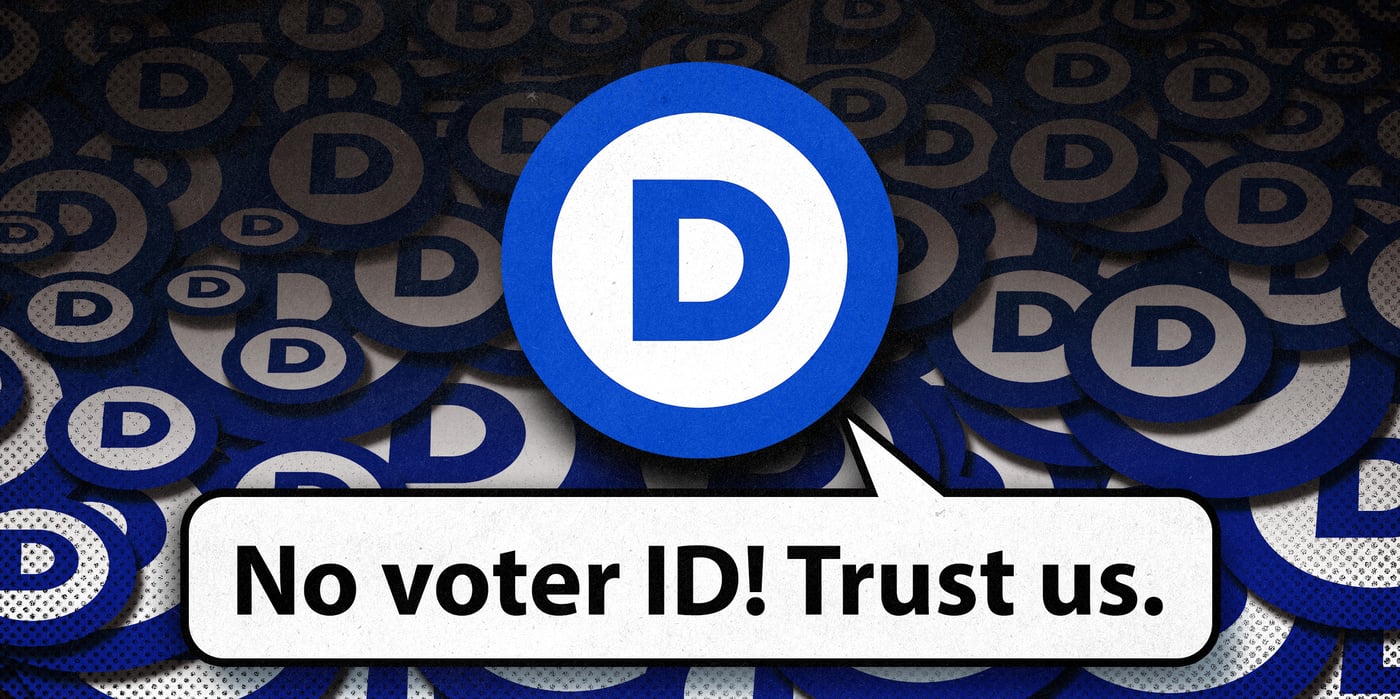

The longer the SAVE America Act remains stalled in Congress, the less likely it is to pass — not because the policy lacks merit, but because the political framing surrounding it continues to dominate the debate. Republican lawmakers have largely united behind the legislation’s core provisions, particularly the requirement for documentary proof of citizenship in federal elections. Democrats, meanwhile, have remained firmly opposed.
Without some Democrat support, even the most basic election-integrity measures face significant obstacles.
I support the SAVE America Act, and the reasoning is straightforward. Federal elections are designed to reflect the will of American citizens. A system that does not verify qualifications introduces a structural vulnerability that undermines confidence in electoral outcomes. That principle is not controversial. What is controversial is how the policy is implemented.
The most legitimate criticism of the SAVE Act — and, in my view, the only structurally valid one — relates to the 24th Amendment to the Constitution. Courts have consistently interpreted the amendment to prohibit not only direct poll taxes, but also indirect financial burdens tied to voting. If an individual must pay to obtain documents such as a birth certificate or passport in order to prove citizenship, that requirement risks being classified as unconstitutional.
That problem, however, is entirely solvable. A narrowly tailored federal provision that ensures individuals can obtain the necessary documentation free of charge, strictly for voting purposes, would eliminate the constitutional concern without weakening the bill’s integrity.
Recently, I had the opportunity to speak with Representatives Byron Donalds and Randy Fine, both of whom have been actively involved in advancing the SAVE Act. I raised this exact issue directly. Their response was clear: They would support such a provision if it meaningfully changed the political calculus, but they do not believe it would alter Democrat opposition.
That response highlights the central issue. Opposition to the SAVE Act is not driven by the 24th Amendment argument. That concern is used because it is legally recognizable and politically effective, but it does not explain the broader resistance. The deeper issue is structural. The SAVE Act changes how voting operates at a fundamental level.
Requiring proof of citizenship introduces a process into voting. It does not restrict access for eligible voters, but it does ensure that participation is intentional. A system with minimal verification enables low-engagement voting — voting without a strong personal investment, sometimes at others’ encouragement or simply as a favor to someone.
A system with basic safeguards shifts voting toward deliberate participation.
That shift has political consequences. The SAVE Act does not prevent lawful voting, but it may reduce participation among individuals who are not voting out of their own goodwill. That reality explains why opposition remains firm even when legitimate concerns can be addressed through straightforward policy adjustments.
At the same time, the debate surrounding the SAVE Act exposes a broader weakness within the Republican Party: ineffective communication. Policy design alone does not determine political outcomes. Public perception does.
Republicans have repeatedly advanced policies with strong structural arguments, only to lose control of the narrative. Immigration enforcement has been reframed as extremism. The One Big Beautiful Bill was reduced to simplistic claims that it benefits the wealthy. In each case, the policy itself became secondary to how it was presented.
The SAVE Act risks following the same trajectory. If the constitutional concern is addressed through a clear, enforceable provision guaranteeing free access to required documentation, Republicans eliminate the strongest legal argument against the bill. More importantly, they create an opportunity to reframe the debate around election integrity rather than access.
Legislative success requires more than sound policy. It requires alignment between substance and messaging. The SAVE America Act presents an opportunity to achieve both. Whether that opportunity is realized will depend not only on how the bill is written, but on how effectively it is communicated to the American public.