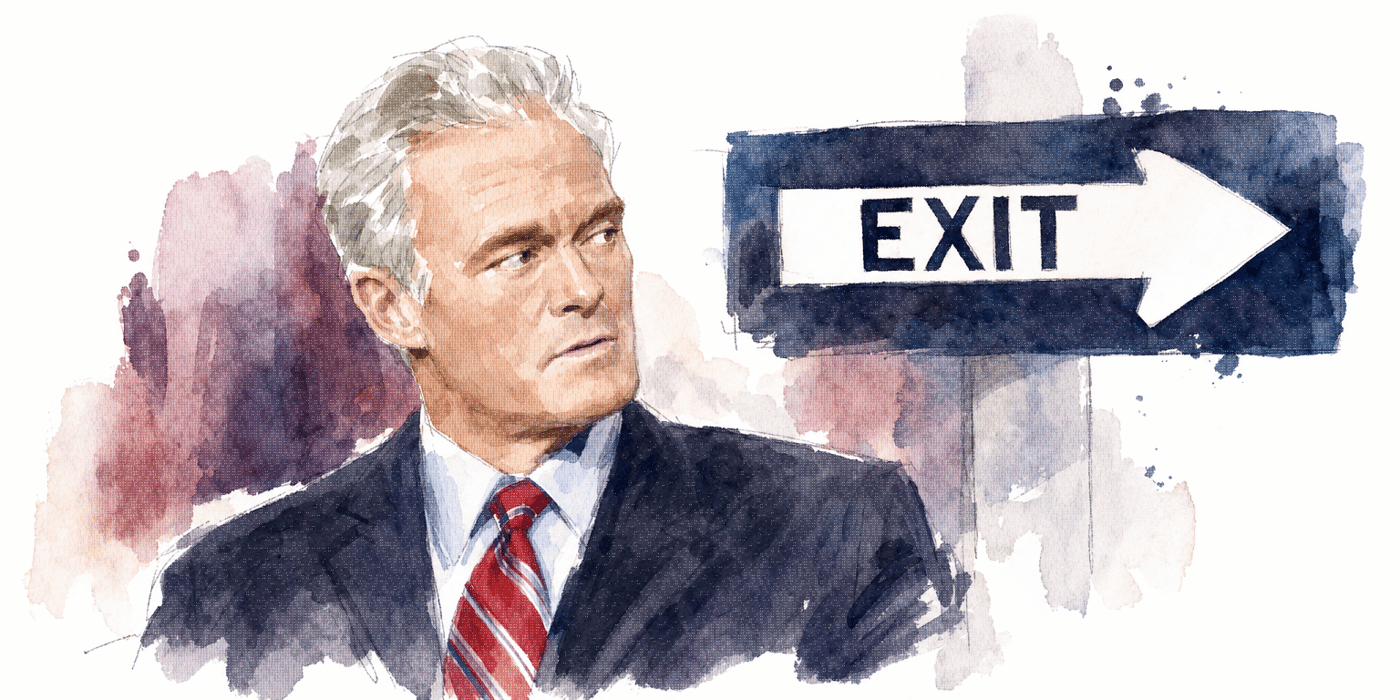

The shake-up drama at CBS News continued this week with the firing of veteran “60 Minutes” correspondent Scott Pelley.
Pelley, who had been at CBS News since 1989 (he joined “60 Minutes” in 2004 and anchored “CBS Evening News” from 2011 to 2017), loudly expressed his displeasure over a number of recent firings at the news network.
Ever since CBS hired Bari Weiss as editor-in-chief, Pelley has been among those expressing criticism and discontent regarding the changes Weiss was bringing.
Following last year’s resignation of longtime “60 Minutes” executive producer Bill Owens, who had complained of losing editorial independence in the wake of Donald Trump’s lawsuit against Paramount, CBS’s parent company, Pelley told viewers, “Our parent company, Paramount, is trying to complete a merger. The Trump administration must approve it. Paramount began to supervise our content in new ways. None of our stories have been blocked, but Bill felt he lost the independence that honest journalism required.”
He added, “No one here is happy about it, but in resigning, Bill proved one thing. He was the right person to lead ’60 Minutes’ all along.”
Recall that Trump sued CBS over the “60 Minutes” interview with Kamala Harris in which the program deceptively edited her answers to make them appear more cogent and concise, when in reality Harris had effectively given word-salad nonanswers.
Following Paramount’s merger with SkyDance, it settled the lawsuit with Trump, to which Pelley responded: “Our previous owners at CBS faced political pressure and crumbled.”
Then this week, after Weiss and new “60 Minutes” executive producer Nick Bilton fired a number of CBS staff, including veteran journalist and program correspondent Sharyn Alfonsi, Pelley apparently lost his sauce.
During a Monday meeting, he blasted Weiss, claiming that she was “murdering ’60 Minutes’” and that she “was brought in to kill it and is doing exactly that.” Pelley added, “She has no qualifications for her job. The changes that she’s made at the ‘Evening News’ have been catastrophic, so why should we expect that any of this is going to be any better?”
Pelley further demanded that Bilton and Weiss’s deputy, Charles Forelle, give him an explanation for the recent firings. He also laid into Bilton, suggesting that he lacked appropriate qualifications for the job and that he “will never be welcome here.”
It would appear that Pelley decided to go full prima donna and, in the process, destroyed any possible working relationship with CBS’s new brass. Following Pelley’s firing, Weiss explained that she had hoped to work with him, but “the foundation [of trust and mutual respect] was broken.” She continued, “Despite our attempts to engage with Scott Pelley and to find a way back, unfortunately we weren’t able to do so, and so we had to part ways,” adding, “We did not want that to happen, but that’s the path that he chose.”
For his part, Pelley called Weiss’s characterization of the meeting “disingenuous,” claiming he was never offered “a way back.”
Despite Pelley’s negative depiction, Weiss graciously responded, “That unfortunate outcome does not discount from the amazing contributions and work that Scott Pelley has done for CBS and for ’60 Minutes’ over the course of his career.”
At the very least, the drama at CBS appears to be a classic case of journalists thinking too highly of themselves and failing to appreciate that viewership had been dropping for years — and that change was necessary for the network’s survival.
But it also reveals the deep-rooted problem with much of mainstream journalism today: Too many of these journalists are activists, believing their job is not merely to report the news but to shape how the public understands it.
Pelley and his ilk express frustration over journalistic “independence” not because they are concerned with accurately reporting the facts but because they want the freedom to put their own biased interpretive spin upon those facts.
Weiss, to her credit, has recognized that this attitude is precisely why much of the mainstream media, which primarily leans left, finds itself in the current predicament of diminishing viewership and lost trust.
CBS News President Tom Cibrowski, who was in on the meeting, acknowledged that change can be frustrating, stating, “We know that these events, developments, changes are a lot to process for every single person in this room and on this call.” He further noted, “And they are happening frequently.”
It appears that under Bari Weiss’s leadership, CBS News is removing the rot that must be extricated for real and lasting change. Hopefully, this results in an outlet that the vast majority of Americans can trust to provide the most balanced news among the big three networks.
That does not mean the rot is going away. It may be that Pelley’s high-profile firing was intentionally self inflicted. His CBS exit may have been completely scripted theater. The leftist “news” platform MSNOW’s head hater, Rachel Maddow, has offered him a job.