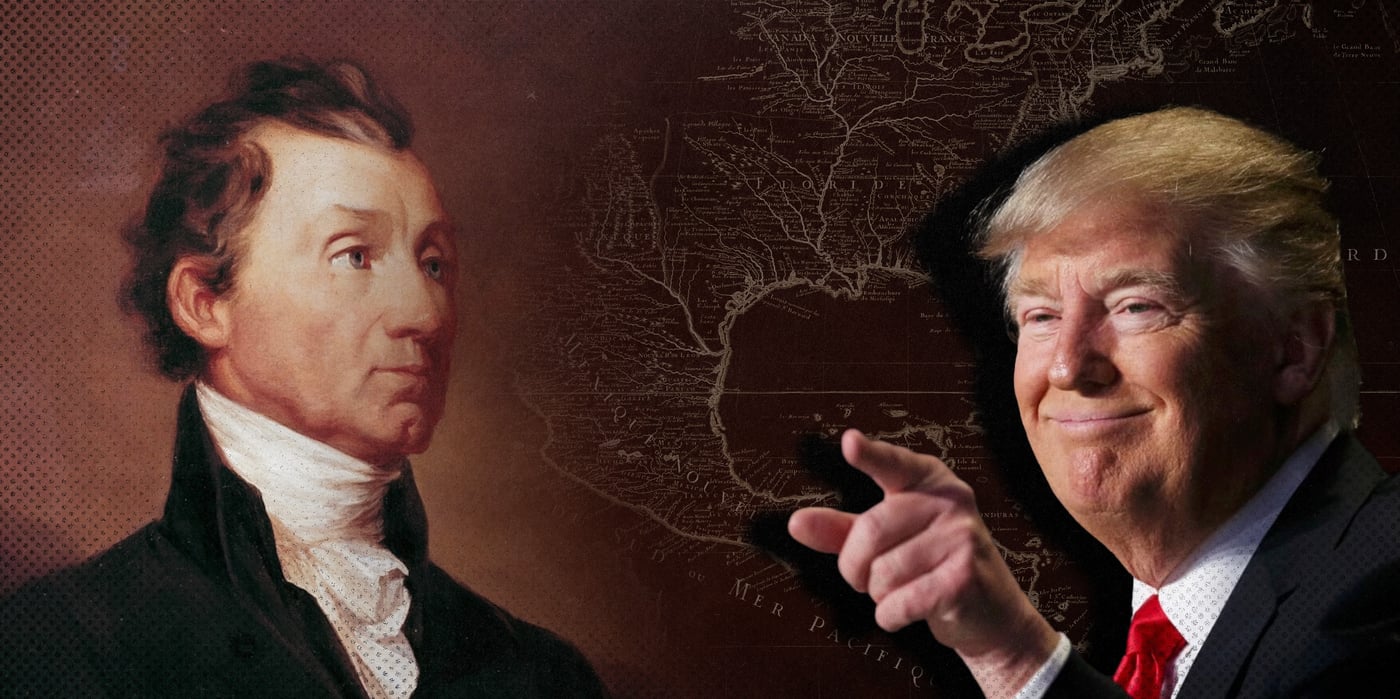

President Trump likes putting his name on things, so maybe it was inevitable he’d get his own corollary to the Monroe Doctrine.
Truth be told, what the president’s just-released national security strategy sets out as a new proposition is really a restatement of the Lodge Corollary, named after Senator Henry Cabot Lodge in 1912. That proviso prohibited any foreign power or interest — not just European governments — from gaining “practical power of control” in the Western Hemisphere.
Naming rights aside, the treatment of our hemisphere is a strong element of the strategy. The so-called Trump corollary aims to assert U.S. preeminence in the hemisphere and keep non-hemispheric actors from creating threats or controlling strategically vital assets here. It is, in the words of the strategy, “a common-sense and potent restoration of American power and priorities, consistent with American security interests.”
We should, by all means, breathe new life into a Monroe Doctrine that in recent decades has become a museum curiosity.
The precipitating crisis for the making of the doctrine was an 1821 declaration by the Russians that they’d prohibit foreign shipping within 115 miles of their holdings on the Pacific coast. Secretary of State John Quincy Adams rebuffed the edict in terms anticipating the doctrine.
The bigger issue was that the Spanish empire was disintegrating. The end of its grip in the Western Hemisphere catalyzed the birth of Latin American republics and presented the risk of interventions by ambitious, illiberal continental Europeans states.
What to do? The British, who didn’t want to get locked out of Latin American markets by other European countries and viewed the U.S. as a potential partner, suggested a joint declaration that continental powers should steer clear.
We played the Brits along, and then President Monroe, in an annual message to Congress in 1823, issued on his own what would become his eponymous doctrine.
He asserted that “the American continents, by the free and independent condition which they have assumed and maintain, are henceforth not to be considered as subjects for future colonization by any European powers.”
New European footholds in the Western Hemisphere were thought to represent not just security but territorial, demographic, and ideological threats.
Metternich, the Austrian statesman, took great umbrage. He called it an “act of revolt,” and pronounced it “fully as audacious” and “no less dangerous” than the American Revolution.
Tsar Alexander said that “it merits only the most profound contempt.” But Russia backed off its 1821 power play.
Initially, we weren’t close to being militarily capable of contesting European encroachments, and we relied on the British, in effect, to enforce our declaration.
Still, the Monroe Doctrine became a predicate of American geopolitical power by avoiding major challenges to our hegemony in our own hemisphere. When we had the means, we enforced it ourselves. Once we were no longer distracted by the Civil War, we pressured France to end its intervention in Mexico in the 1860s. We got Germany to stand down during the Venezuela crisis of 1902 (this event led to the Roosevelt corollary, named after President Teddy Roosevelt, stipulating that the U.S. could deploy “an international police power” when Latin American countries were failing).
Since the 1990s, though, we’ve let down our guard. China is now Latin America’s second-largest trading partner, after the United States, and has expanded its influence in the region on all fronts. Russia has relationships with Venezuela, Nicaragua, and Cuba and has increased its covert operations in Mexico. Hezbollah has a notable presence in Latin America.
Trump’s focus on countering these malign actors could be seen in his successful effort earlier this year to get Panama to pull out of China’s Belt and Road Initiative, and is evident now in his pressure campaign against a Maduro regime in Venezuela that is aligned with China, Russia, and Iran.
Trump often feels new and different, but here, his strategic departure is returning to a traditional American approach to our side of the Atlantic.
© 2025 by King Features Syndicate