Four years and 25 days. Twenty days. There’s a huge difference between those two numbers. The first number — 1,486 days altogether — is the length of time since Russian troops crossed the Ukraine border on Feb. 22, 2022, and headed for Kyiv. The second number — just 20 days — is the number of days since U.S. and Israeli forces on Feb. 28 began bombing strategic targets in Iran.
The two attacks have this in common: Their initial responses were far different from what many experts, in the United States and beyond, expected and predicted.
Back in 2022, the conventional wisdom in many quarters was that Russia was headed to a quick victory, to occupation and absorption of all or some large part of Ukraine. What Catherine the Great achieved and what Leon Trotsky perpetuated would be matched by Vladimir Putin in time for his 70th birthday in October 2022.
Joe Biden’s administration had ordered U.S. personnel out of what was expected to be the Kyiv war zone. It offered to evacuate the former comedian who was elected president of Ukraine in 2019.
But Volodymyr Zelensky had another idea. “I need ammunition,” he famously said, “not a ride.” And the Russian troops, it turned out, had little need for their parade uniforms.
There had been some reason to think many Ukrainian residents would welcome a reunion with Russia. Substantial numbers, especially in the east, identified as ethnic Russians, spoke Russian rather than Ukrainian, and had voted for presidential candidates aligned with Putin’s Russia.
But as the fighting went on, it became apparent that the Russian invasion inspired, or created, a vibrant Ukrainian patriotism. Russia’s oil-fueled economy may be superior, its stature in world politics enormously greater, but for fusillades charging Ukraine with corruption and Nazism, Zelensky’s regime seemed less thuggish, less cynical, less callous than Putin’s.
Russia’s war on Ukraine has now lasted longer than Russia’s engagement in either World War. There were three years and 214 days of war between the August 1914 declaration and the March 1918 Treaty of Brest-Litovsk, which recognized an independent Ukraine. Three years and 320 days of war between Hitler’s June 1941 invasion and German surrender in May 1945.
Those were wars of vast movements of troops, advances and retreats, the holdout of Stalingrad, just east of Ukraine, and the greatest tank battle in history around Kursk, just to the north.
Putin’s war has turned out to be more static, as the proliferation of drones — and their increasingly sophisticated use by Ukraine — has made mass troop movements hazardous, and Putin’s brutal persistence has piled up casualties by the hundred thousand.
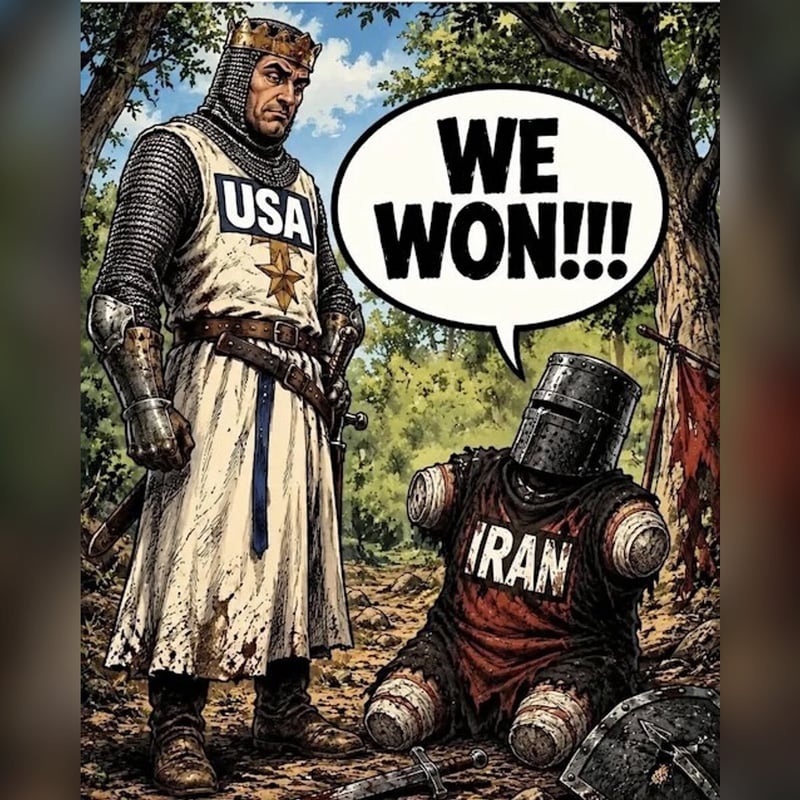
The 20 days of war in Iran have been quite different. American and Israeli forces have used astonishingly good intelligence and sophisticated precision weapons to more than decimate (the word means “kill every 10th one”) the Iranian regime’s leadership, from the Ayatollah Khamenei on the first day of attacks and Ali Larijani earlier this week.
American media and most Democratic politicians have nonetheless characterized the conflict as a debacle for Donald Trump and, when they bother to mention him, Benjamin Netanyahu. The president is said to have had no plans to deal with Iran’s strategy of blocking the Strait of Hormuz oil export route. His failure to get help from NATO allies is attributed, with more justice, to his slaphappy attempts to grab Greenland and bully Canada.
U.S. news coverage stresses uncertainty and possible ill effects — factors in every military operation — and emphasizes the small number of personnel deaths. A broader perspective comes from Mark Dubowitz and Richard Goldberg in The Atlantic.
“Two weeks after the United States and Israel launched their combined military against Iran’s clerical regime, the outlines of victory are beginning to emerge,” they write. Depriving the regime of its “ability to wage war against America and its allies” has had results that are “promising, though much remains unfinished” after 20 days.
The U.S. and Israel, with command of the air and precision weapons, have devastated the regime’s air defense, ballistic missiles and navy, and “the human system behind the arsenal is fading.”
The U.S. and Israel seem to be getting staunch support from Saudi Arabia and the Gulf States, including Hamas-backer Qatar — fruit it seems of the Abraham Accords, negotiated in the first Trump term, in abeyance during Israel’s operations in Gaza, now lively again.
“The picture is not one of U.S. failure,” writes Qatar-based analyst Muhanad Seloom in Al Jazeera. “It is one of systematic, phrased degradation of a threat that previous administrations allowed to grow for four decades. ... Iranian ballistic missile launches have fallen by more than 90 percent from 350 on February 28 to roughly 25 by March 14, (and) ... drone launches tell the same story: from more than 800 on Day 1 to about 75 on Day 15.”
This is a far more kinetic as well as far more one-sided conflict than Russia’s war on Ukraine. And just as Putin, after four years and 25 days, has refused to abandon his plainly unattainable effort to conquer Ukraine, so what is left of the Iranian regime after 20 days of bombardment has refused to concede and seems to have squashed any internal challenge to its power.
Critics of the Feb. 28 initiative have argued that air power has never brought down a hostile regime — a valid point, but air power has never been wielded with such intensity, such precision and such granular knowledge of enemy leaders’ whereabouts. Israel clearly seeks an ouster of the regime long pledged to destroy it.
Trump’s aim may be more limited, to prevent a regime from unwanted behavior beyond its borders, as he seems to have done with Venezuela. This falls short of what he seemed to be promising Iranian rebels back in January.
But just as the course of war is not predictable, as we have learned once again over four years and 25 days in Ukraine and 20 days now in Iran, so the process of revolutionary regime change is even more so. Almost no one predicted the American Revolution of 1776, the French Revolution of 1789, the Russian Revolution of 1918 — or the Islamic Revolution of 1979. The U.S. initiative in Iran is proceeding more successfully than its critics would have you believe. But there’s no guarantee of an entirely happy ending.
COPYRIGHT 2026 CREATORS.COM