
Storyteller and actor Kelsey Grammer visited our National Medal of Honor Heritage Center this week with historians and filmmakers to unveil plans for his upcoming feature film, “So Help Me God.” Produced by Mark Huffam (“Napoleon,” “Saving Private Ryan”), it will be a film you will want to see!
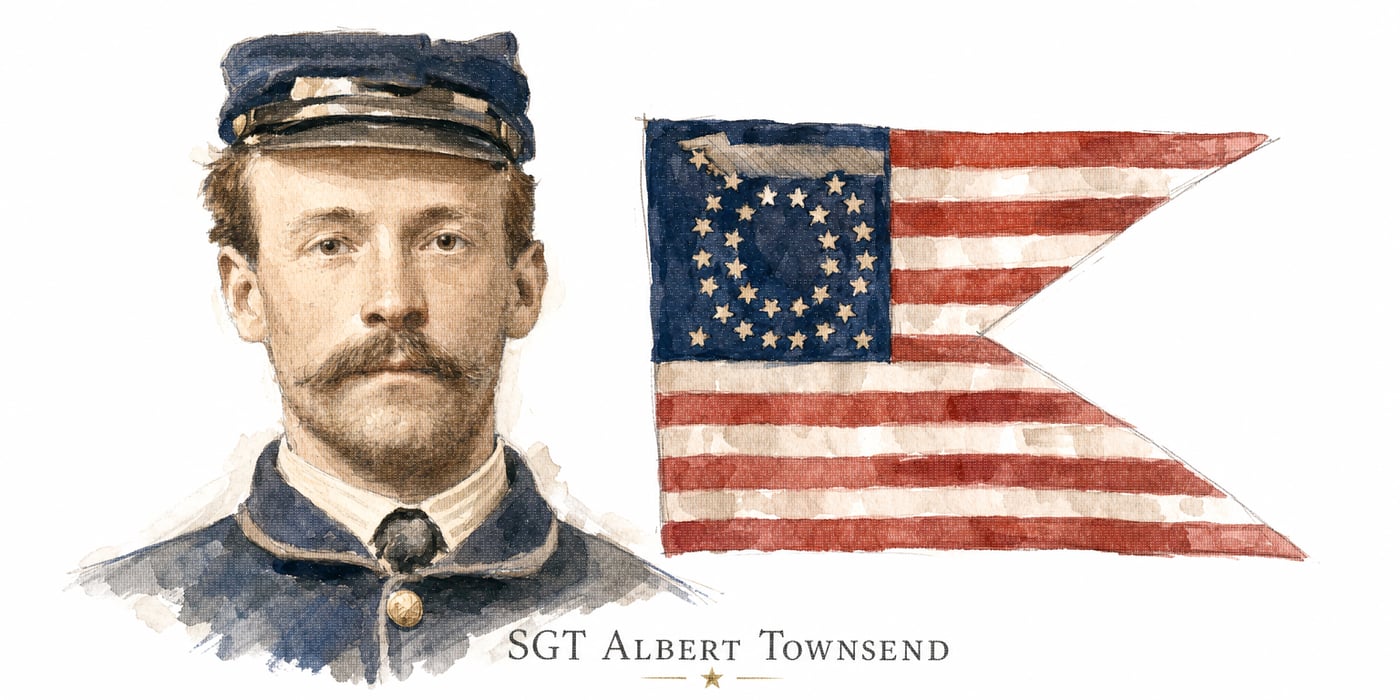
This epic movie will detail the true story of SGT Albert Townsend, a young man who, after hearing an impassioned speech by Frederick Douglass, joined what would become the Union Army’s 34th Battery, New York Light Artillery, in Flushing.
The project is based on the research of Townsend’s great-great-grandsons, Douglas and Robert Scheidet. Doug is a principal with Inspired Artist Productions, the company that will organize the film’s production, and notes that Townsend’s “journey through love, brotherhood, sacrifice, and courage unfolds against the backdrop of a divided nation, culminating in a campaign to award him the Medal of Honor.” While honoring the military actions of the “Bad Boys of Flushing,” the film will deliver a powerful reminder of unity in a time when our nation was stridently divided.
SGT Townsend was nominated with nine others from the 34th Battery for a Medal of Honor recognizing his actions in 1864 — but his nomination was lost. Beyond the film project, a substantial effort is underway to restore his nomination.
The chief historian doing the laborious research required for the Medal of Honor nomination is my friend Brad Quinlin. Two years ago, he was instrumental in securing long-overdue Medal of Honor awards for PVT Philip Shadrach and PVT George Wilson, the last two recipients among Andrews’s Raiders — who received the first Medals of Honor in our nation’s history.
Those first Medals were for actions near Chattanooga, making our city the Birthplace of the Medal of Honor, and the reason the National Medal of Honor Heritage Center is located here.
As Brad noted when the Shadrach and Wilson nominations were approved, “This rectifies a historical oversight that has deprived Privates Shadrach and Wilson from receiving our nation’s highest military honor for valor on the battlefield.” He is a man on a mission to rectify another historical oversight regarding the heroic actions of Albert Townsend, and has already forwarded a near-complete nomination package to the Army Awards and Decorations Department at Fort Knox.
As I have noted before regarding long delays between service rendered and recognized, the effort to recognize heroic actions often falls to those with whom the recipient served, and frequently many decades after their “conspicuous gallantry and intrepidity at the risk of his life above and beyond the call of duty...” But in the case of a nomination for actions more than 160 years ago, the verification process is exponentially more difficult.
Albert Townsend was born August 2, 1843, to a farming family in Great Neck, New York. On November 18, 1861, at age 18, he enlisted at Flushing, New York. Originally under the command of CPT Thomas Robinson, his 34th Battery was stationed in Washington, DC. He was present for every battle the 34th fought from 1862 forward, including Second Manassas in August 1862, Burnside Bridge at Sharpsburg in September, and the Battle of Fredericksburg in December of that year.
The 34th was sent to Mississippi for the Siege of Vicksburg in 1863, and then fought at the Battle of Fort Sanders near Knoxville, Tennessee, in November. In May and June of 1864, the Battery fought in the Battles of Wilderness, Spotsylvania, Cold Harbor (where my ancestor George Lewis Gillespie received a Medal of Honor), and on to the Battles of Richmond and Petersburg.
But it was Townsend’s actions on September 30, 1864, for which he was nominated for the Medal of Honor.
On that day, Townsend’s Battery was placed out on the left flank of the 9th Army Corps at the Battle of Peebles Farm near Petersburg, Virginia. They guarded the Corps’ left flank, with three infantry regiments to their left and right.
In the early afternoon, an estimated 3,500 Confederate infantry came out of the woods in a mass assault. The untested infantry units supporting the 34th New York saw the advancing Confederates and made a routed retreat, leaving the 34th Battery with four cannons on its own. Battery commander Jacob Romer had been wounded a few days earlier, so young LT Thomas Heasley took charge. Heasley froze in the face of the Confederate assault, and almost ordered a retreat. But Albert Townsend, the number one man (sponge man) on the number one gun, rallied the 34th, and his Battery fired volleys of double canister shot into the approaching Confederate lines. That halted the approaching Confederates until more Union Infantry, including the 109th New York and the 7th Rhode Island, arrived.
For Townsend’s bravery, and that of others in the 34th who have already been recognized with Medals of Honor, the entire left flank of General Ulysses Grant’s army was saved.
On January 11, 1865, Jacob Roemer, the 34th Battery Commander, wrote up eight Medal of Honor requests for men in his battery. In the transcription from handwritten notes to typed documents for the Army, Albert Townsend’s name was left off the list. The 34th’s documents ended up at the New York Military Museum, where great-great-grandsons Douglas and Robert Scheidet recovered them and began their quest to restore his nomination.
Of Townsend’s service record, COL Paul Bethke (USA Ret), who is working with the Medal of Honor nomination team, offered this assessment:
He was a man of character shaped by faith, duty, and conscience. And when we consider his actions at Pegram’s Farm — the courage he showed, the sacrifice he made — those four words in his oath, So Help Me God, take on even greater meaning. They remind us that his service was not merely an obligation. It was an expression of belief. Albert Townsend lived the traits embodied by every Medal of Honor recipient: Patriotism. Citizenship. Courage. Integrity. Sacrifice. Commitment. He lived them without expectation of recognition, without hope of reward, and without hesitation in the face of danger. Today, as we work to secure the Medal of Honor for Sergeant Townsend, we are not simply honoring a single act of heroism. We are honoring a man who lived his oath — a man whose service reflected the very values this institution exists to preserve.
At the conclusion of the War Between the States, Albert went back to Flushing and became a postal worker. He married his sweetheart, Leanna Trenchard, in 1866, and they had two children — the descendants of whom are now securing his military legacy. Albert died November 10, 1894, and Leanna died days later, it was said, of overwhelming grief from the passing of her beloved husband. Both are buried in their family plot in Flushing Cemetery.
SGT Albert Townsend: An ordinary man faced with extraordinary circumstances, he summoned the greatest measure of courage and placed his life in imminent peril. His example of valor — a humble American Patriot defending Liberty for all above and beyond the call of duty — is eternal. Live your life worthy of his sacrifice.
“Greater love has no one than this, to lay down one’s life for his friends.” (John 15:13)
Join us in daily prayer for our Patriots in uniform — Soldiers, Sailors, Airmen, Marines, and Coast Guardsmen — standing in harm’s way in defense of American Liberty, and for our nation’s Veterans, First Responders, and their families.
(Read more Profiles of Valor here.)
Semper Vigilans Fortis Paratus et Fidelis
Pro Deo et Libertate — 1776
Please consider a designated gift to support the National Medal of Honor Sustaining Fund’s character education initiatives through Patriot Foundation Trust’s online donor page, or by check payable to “NMoH Sustaining Fund” and mail it to:
Generosity Trust National MOH Sustaining Fund
345 Frazier Avenue, Unit 205
Chattanooga TN 37405
Thank you for supporting The Patriot Post, our nation’s premier journal of American Liberty.